Dallas Data Center Fire Pump Systems Design Guide
I have spent enough time around mission critical buildings to know one simple truth. When the lights stay on, nobody applauds. But when protection fails, everyone notices. That is why I take fire protection in data centers seriously, especially when we talk about Dallas data center fire pump systems. These systems sit quietly behind the scenes, ready to move enormous volumes of water the moment fire threatens servers, infrastructure, and the digital backbone of entire companies.
Dallas has become one of the largest data center hubs in the United States. With that growth comes responsibility. A modern facility can house billions in hardware and support industries from banking to healthcare. Consequently, the fire protection design must be precise, resilient, and built for continuous operation. In the sections ahead, I will walk through the requirements, design considerations, and practical realities of fire pump infrastructure for mission critical environments in North Texas. And yes, I promise to keep it more interesting than watching a loading bar crawl across a screen.
Why Dallas Data Center Fire Pump Systems Demand a Higher Standard
Not all buildings face the same risk profile. A retail plaza might close for the night. A warehouse may pause operations. A data center, however, rarely sleeps. In fact, the servers inside are working harder at 3 AM than most of us after a third cup of coffee.
Because of this nonstop operation, Dallas data center fire pump systems must meet stricter expectations than standard commercial fire protection systems.
Water supply reliability and redundancy
First, water supply reliability is critical. Dallas facilities often connect to municipal water sources, but redundancy becomes essential. Therefore, engineers frequently incorporate dedicated fire pumps capable of maintaining pressure even during heavy sprinkler demand.
Response time and pressure performance
Second, response time matters. When a fire begins near electrical infrastructure, seconds count. A properly sized fire pump ensures that water reaches suppression systems instantly rather than waiting for city pressure to catch up.
Scalability for future growth
Finally, scalability plays a major role. Data halls expand, racks grow denser, and cooling systems evolve. As a result, the pump system must support both current loads and future facility growth.
Think of it like casting the right actor for a long running TV series. You need someone who can carry the show for years. Fire pumps in large Dallas data centers play the same role. They show up every day, never complain, and deliver when the script suddenly turns dramatic.
What Do Mission Critical Facilities Actually Require?
When someone asks me this question, I usually start with codes and then move into real world engineering. Codes define the baseline. Mission critical operations demand more.
Facilities in Dallas typically follow several key standards.
- NFPA 20 for fire pump installation
- NFPA 13 for sprinkler system design
- Local Dallas fire code requirements
- Insurance driven requirements from carriers like FM Global
However, compliance alone does not guarantee resilience. I have seen buildings technically meet code yet still fall short of mission critical expectations.
Redundancy in Dallas data center fire pump systems
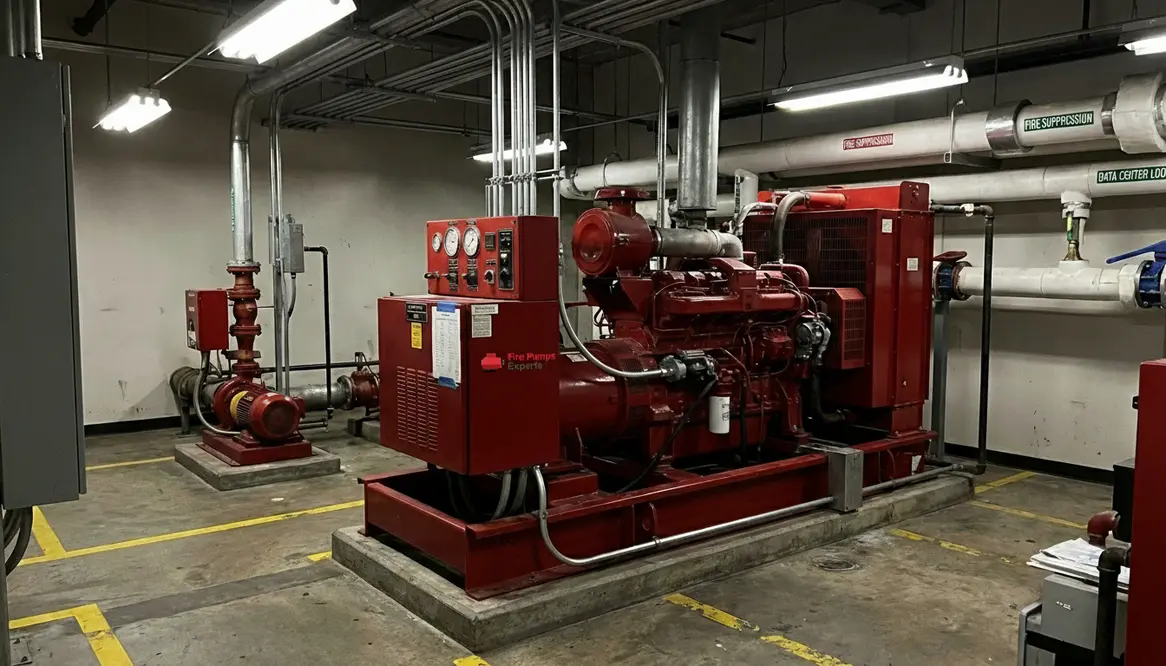
For example, redundancy is often layered into pump configurations. Facilities may install multiple pumps or backup drivers. In addition, diesel driven pumps frequently appear alongside electric pumps because they operate independently from the building power supply.
Protecting the fire pump room
Meanwhile, engineers also focus on separation and protection of the pump room. A fire pump cannot protect the building if the pump itself becomes vulnerable to heat, flooding, or electrical failure.
In short, mission critical facilities design for the moment when everything else goes wrong. It is a little like preparing for a zombie apocalypse. You hope it never happens, but the prepared folks tend to sleep better at night.
Designing Fire Pump Capacity for High Density Server Environments
Dallas data centers continue to push density limits. Modern racks generate enormous heat loads, and the electrical distribution systems supporting them carry substantial energy.
Because of this, sprinkler systems protecting these spaces require strong and consistent water pressure.
Hydraulic calculations as a starting point
Fire pump sizing begins with hydraulic calculations. Engineers evaluate the most demanding sprinkler zone, determine flow requirements, and then design the pump to exceed those values. However, that is only the starting point.
Data center environments often include:
- Preaction sprinkler systems
- Dry pipe systems in certain mechanical spaces
- Water storage tanks for supplemental supply
- Large diameter underground fire mains
System dynamics and pump performance
Each component influences how the pump performs. For instance, preaction systems rely on rapid pressure delivery once activation occurs. Therefore, pump acceleration and reliability become just as important as total flow.
Additionally, designers account for the possibility of multiple zones operating simultaneously. A fire event may trigger more than one suppression area. Consequently, the pump must maintain stable pressure under heavy demand.
It is a bit like hosting Thanksgiving dinner. You plan for twelve guests, but somehow twenty four people show up. The kitchen still needs to deliver. A well designed pump system handles those unexpected guests without breaking a sweat.
Operational Reliability Inside Dallas Data Center Fire Pump Systems
Installing the pump is only part of the story. Long term reliability requires thoughtful planning, testing, and maintenance.
Monitoring, testing, and control
For large commercial properties and industrial scale data facilities, pump rooms often include advanced monitoring and control systems. These systems track pressure levels, pump starts, and operational health.
Furthermore, facility teams conduct regular testing to confirm readiness. Weekly churn tests verify that the pump starts correctly. Annual flow tests confirm the system can still deliver its rated performance.
Redundant configurations that keep protection online
Redundancy also plays a major role in operational strategy. A common setup may include:
- A primary electric fire pump
- A secondary diesel driven pump
- A jockey pump that maintains system pressure
This layered approach prevents minor pressure fluctuations from triggering the main pumps unnecessarily. Meanwhile, it ensures that a backup driver exists if power loss occurs.
Quite honestly, redundancy is the unsung hero of mission critical design. It is the backup singer that carries the chorus when the lead vocalist loses their voice. Without it, the performance gets awkward fast.
Planning and Engineering Considerations for Large Dallas Facilities
Site infrastructure and fire mains
Dallas campuses often span large footprints. Therefore, underground fire mains must distribute water efficiently across multiple buildings and data halls. Engineers design looped piping networks so that water can approach a fire from several directions.
Water supply strategy and storage
Municipal supply works well in many areas, yet some mission critical campuses supplement it with onsite storage tanks. This approach guarantees available water even during city system disruptions.
Dedicated pump buildings and protection
Some hyperscale operators place fire pumps in hardened structures separated from the main facility. This reduces the chance that a single incident disables both the protected space and the protection equipment.
Planning capacity for future expansion
Dallas continues to attract new data infrastructure. As a result, many campuses plan pump capacity that supports additional halls long before construction begins. In many cases, that planning includes partnering with specialists who live and breathe complex fire pump work, like the team at Kord Fire Protection.
Together, these planning decisions create systems that support massive commercial properties without interruption. The end goal remains simple. When fire protection activates, water arrives instantly and reliably.
FAQ About Dallas Data Center Fire Pump Systems
As more facilities invest in sophisticated Dallas data center fire pump systems, a few questions come up repeatedly. The answers below capture the practical, real world side of keeping protection online around the clock.
Final Thoughts on Dallas Data Center Fire Pump Systems
Protecting a mission critical facility takes more than meeting minimum code. It requires thoughtful design, resilient infrastructure, and fire pump systems built for constant readiness. Dallas continues to grow as a data hub, which means the stakes only rise. If you operate or develop a large commercial data center, investing in properly engineered Dallas data center fire pump systems is not just smart. It is essential.
Connect with experienced fire pump specialists who understand complex facilities and keep your infrastructure prepared for the moment protection truly matters. When the alarms sound and suppression activates, you want the water, the pressure, and the reliability already in place, not scrambling to catch up.