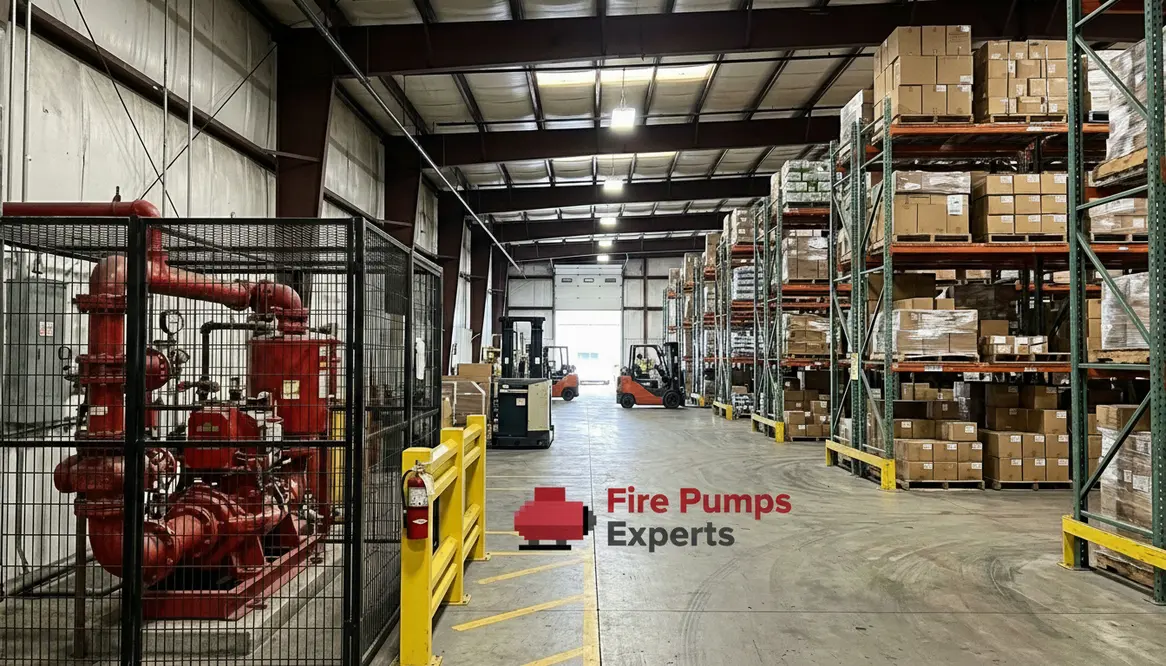
Fire Pump Requirements for Rack Storage Warehouses
How storage height, fuel load, and system design reshape fire pump needs in modern rack warehouses.
I have spent years walking through vast warehouse floors, where towering rack storage stretches toward the ceiling like a city skyline. In these spaces, mission-critical facility fire protection is not just a checkbox on a compliance form. It is the quiet guardian standing between a small spark and a catastrophic loss. And yes, while fire pumps may not get the Hollywood spotlight, they are the unsung heroes, more Batman than Superman, working in the background until the moment truly calls.
So let’s break this down together. I will keep it clear, practical, and maybe even a little entertaining along the way.
How Do Fire Pump Requirements Change with Rack Storage?
Rack storage changes everything. Once you stack goods vertically, you are no longer dealing with a simple fire load. You are managing a layered fuel system that can accelerate fire spread faster than gossip in a break room.
Because of this, fire pump requirements increase significantly. Higher storage means higher water demand. That translates into greater flow rates and stronger pressure requirements. In many warehouse environments, especially those exceeding standard height thresholds, a basic water supply simply cannot keep up.
Therefore, I always look at three factors first. Storage height, commodity classification, and sprinkler design. Together, they dictate the fire pump capacity needed to support the suppression system effectively.
Without adequate pump performance, even the best sprinkler layout becomes a well intentioned but underpowered defense.
Understanding Water Demand in High Piled Storage
Why demand spikes in rack environments
When I evaluate a warehouse, I think in terms of water demand curves, not just static numbers. High piled storage creates intense heat release rates, which in turn require more aggressive suppression.
What that means for your fire pump
As a result, fire pumps in these environments often need to deliver thousands of gallons per minute at sustained pressure. This is not overkill. This is survival.
Additionally, different commodities behave differently. Plastics, for instance, burn hotter and faster than paper products. So while two warehouses may look similar at a glance, their fire pump requirements can be worlds apart.
And yes, this is where people sometimes try to cut corners. That usually ends the same way every time. Poorly.
Key Components That Define Effective Fire Pump Systems
Not all fire pump systems are created equal. In fact, choosing the wrong configuration is like bringing a garden hose to a wildfire.
Core Elements I Focus On
- Pump type selection based on system demand
- Reliable power source with backup
- Controller precision and response time
- Integration with sprinkler and detection systems
Operational Priorities
- Consistent pressure under peak demand
- Fast startup during emergency events
- Durability in industrial environments
- Ease of inspection and testing
Moreover, redundancy matters. In mission critical environments, a single point of failure is simply unacceptable. I always recommend systems that maintain performance even when one component falters.
Design Standards That Guide Compliance and Performance
Codes are the floor, not the ceiling
Now let’s talk standards, because this is where theory meets enforcement. Fire pump systems in warehouses with rack storage must align with established codes such as NFPA guidelines. These are not suggestions. They are the blueprint for safety.
Performance when everything goes wrong
However, compliance alone is not enough. I have seen facilities meet minimum requirements and still fall short in real world scenarios. That is why I approach design with a performance mindset.
In other words, I ask a simple question. Will this system hold up when everything goes wrong at once?
Because fires rarely follow the script.
Why Mission Critical Facility Fire Protection Demands More Than Minimums
When we talk about mission-critical facility fire protection, we are talking about environments where downtime is not just inconvenient. It is devastating.
Warehouses tied to major distribution networks or industrial supply chains cannot afford extended outages. A single fire event can ripple across operations, affecting production, logistics, and revenue.
Therefore, I advocate for fire pump systems that exceed baseline requirements. Higher reliability, smarter controls, and proactive maintenance strategies all play a role.
Think of it like upgrading from economy class to first class. Both will get you there, but one gives you a much smoother ride when turbulence hits.
Common Pitfalls I See in Warehouse Fire Pump Planning
Designing for today, forgetting about tomorrow
Over time, patterns emerge. And unfortunately, so do mistakes.
One common issue is underestimating future storage changes. A warehouse might start with moderate rack heights, only to expand later. If the fire pump system is not designed with scalability in mind, it quickly becomes inadequate.
Treating pumps like set‑and‑forget equipment
Another misstep is neglecting testing and maintenance. Even the best system will fail if it is not exercised regularly. Fire pumps are not decorative equipment. They need attention.
Misaligned components and communication gaps
Lastly, I often see disconnects between system components. When pumps, sprinklers, and controls are not aligned, performance suffers. Coordination is key.
FAQ: Fire Pump Requirements for Warehouses
These are some of the questions that come up most often when planning mission-critical facility fire protection in rack storage warehouses.
Final Thoughts and Next Steps
When I look at a warehouse filled with rack storage, I do not just see inventory. I see risk, responsibility, and the need for precision. The right fire pump system is not an accessory. It is the backbone of a resilient fire protection strategy that actually supports mission-critical facility fire protection goals rather than just decorating a drawing set.
If you are planning or upgrading a facility, now is the time to get it right. Reach out, evaluate your system, and ensure your protection measures can stand up to real world demands. Because when it comes to fire safety, close enough is never good enough.
For more technical resources, design insights, and tools focused on fire pumps and high challenge storage, you can explore the material at https://firepumps.org and use it as a reference point while coordinating with your engineering and risk management teams.