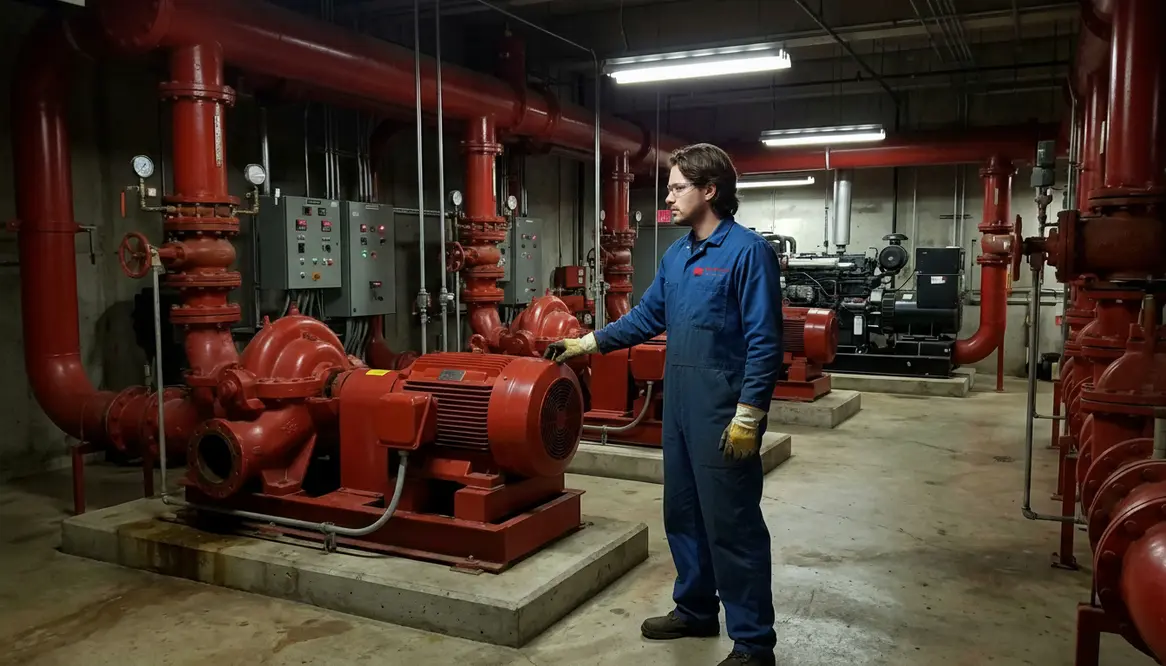
Fire Pump Design for Large Scale Facilities Guide
I have spent years around large facilities, and I can tell you this with a calm certainty: fire pump design is not just a mechanical detail tucked away in a back room. It is the quiet guardian of everything inside those walls. When I think about small commercial building fire pumps, I see them as the gateway conversation. They introduce the concept, yes, but the real story unfolds at scale, where complexity grows and the stakes rise. And trust me, in a large facility, there is no room for guesswork. Fire does not negotiate. It simply arrives.
What does fire pump design really mean for large scale facilities
At its core, fire pump design ensures that water moves with purpose. However, in a large facility, that purpose becomes far more demanding. I am talking about long pipe runs, multiple elevation changes, and systems that must respond instantly without hesitation.
Because of this, I approach design as a balance between pressure, flow, and reliability. A pump must deliver enough force to reach the highest point, yet remain stable across every zone. Meanwhile, redundancy becomes essential. One pump is good. Two is peace of mind. Three is the kind of confidence that lets you sleep at night.
And yes, if this sounds like assembling the Avengers of water pressure, that is not far off. Each component has a role, and when one fails, the others must step in without missing a beat.
How system scale changes everything
As facilities grow, so do the challenges. A small setup might rely on straightforward configurations, similar to small commercial building fire pumps. However, once you step into industrial campuses or high rise complexes, simplicity leaves the room rather quickly.
Managing pressure zones
Therefore, I focus on zoning. Dividing a facility into pressure zones prevents overloading any single part of the system. In addition, it protects equipment from excessive wear. High pressure in the wrong place can cause more damage than the fire itself.
Building layered water supply
Moreover, water supply becomes a story of its own. Municipal systems are not always enough. So, I often see dedicated storage tanks, backup reservoirs, and even on site water sources. It is a layered defense, and each layer adds resilience.
Design priorities that keep systems dependable
When I design or evaluate a fire pump system, I keep a few priorities front and center. These are not optional. They are the difference between readiness and regret.
Reliability first
Every component must perform under stress. I choose pumps and controllers that have proven records, not flashy features.
Redundancy matters
If one element fails, another must take over instantly. There is no pause button during an emergency.
Ease of maintenance
A system that cannot be maintained will eventually fail. So, I ensure access, clear layouts, and straightforward service paths.
Compliance with codes
Standards exist for a reason. They reflect lessons learned the hard way. I follow them closely, and I recommend others do the same.
Interestingly, when all these priorities align, the system becomes almost invisible. It simply works. Like a good WiFi connection, you only notice it when it is gone, and by then, it is far too late.
Key components working together in real time
Pumps
These are the heart of the system. They generate the pressure and flow needed to move water where it is required.
Controllers
They act as the brain. They monitor conditions and start the pumps automatically when needed.
Valves
These regulate direction and pressure. Without them, the system would be chaos in motion.
Water supply
This includes tanks, mains, or reservoirs. A pump without water is just an expensive paperweight.
Piping network
This is the delivery system. It must handle pressure changes while maintaining integrity.
Backup power
Because power failures often accompany emergencies, generators or diesel driven pumps are critical.
When these components work together, the system responds instantly. No hesitation. No confusion. Just action.
Why poor design becomes a costly mistake
I have seen what happens when design is treated as an afterthought. It is not pretty. Systems underperform, maintenance costs climb, and worst of all, safety is compromised.
For example, undersized pumps struggle to meet demand. Overly complex layouts confuse operators during emergencies. And inadequate testing leaves hidden weaknesses waiting for the worst possible moment to reveal themselves.
On the other hand, a well designed system pays for itself over time. It reduces downtime, lowers repair costs, and most importantly, protects lives and assets. That is not just engineering. That is responsibility.
How I future proof fire pump systems
Facilities evolve. Expansion happens. New technologies emerge. Therefore, I design with the future in mind.
I allow room for capacity growth. I select systems that can integrate with modern monitoring tools. In addition, I ensure that upgrades can occur without shutting everything down.
Think of it like planning a sequel before the first movie even premieres. If done right, the transition feels seamless. If not, well, we have all seen those disappointing follow ups.
If you are used to working with small commercial building fire pumps, scaling up requires a shift in mindset. The physics are the same, but the consequences of misjudgment grow dramatically with every additional floor, zone, and occupant relying on that system.
From small pumps to large campuses
Using smaller systems as a training ground
There is a reason I often start conversations with small commercial building fire pumps. They are a practical way to learn the fundamentals: water supply reliability, pressure requirements, controller behavior, and inspection routines. When those basics are understood and respected, they scale far more smoothly into large facilities.
Where large facilities demand more
Large campuses and towers demand tighter coordination between fire protection engineers, facility managers, and even local fire services. What was once a single riser and a compact pump room can become a small ecosystem of interconnected systems. At that point, treating design casually is an invitation to confusion when alarms are sounding and visibility drops.
That is also why I encourage teams who are comfortable with small commercial building fire pumps to step into larger projects with structured documentation, clear drawings, and a shared understanding of how each decision affects response time, survivability, and long term performance.
FAQ
Conclusion
When I look at fire pump design, I do not just see equipment. I see assurance, preparation, and quiet strength built into a facility’s core. If you manage or own a large commercial or industrial property, now is the time to evaluate your system. Make it stronger, smarter, and ready. Because when the moment comes, and it will, the right design makes all the difference. Let us help you build that confidence today.