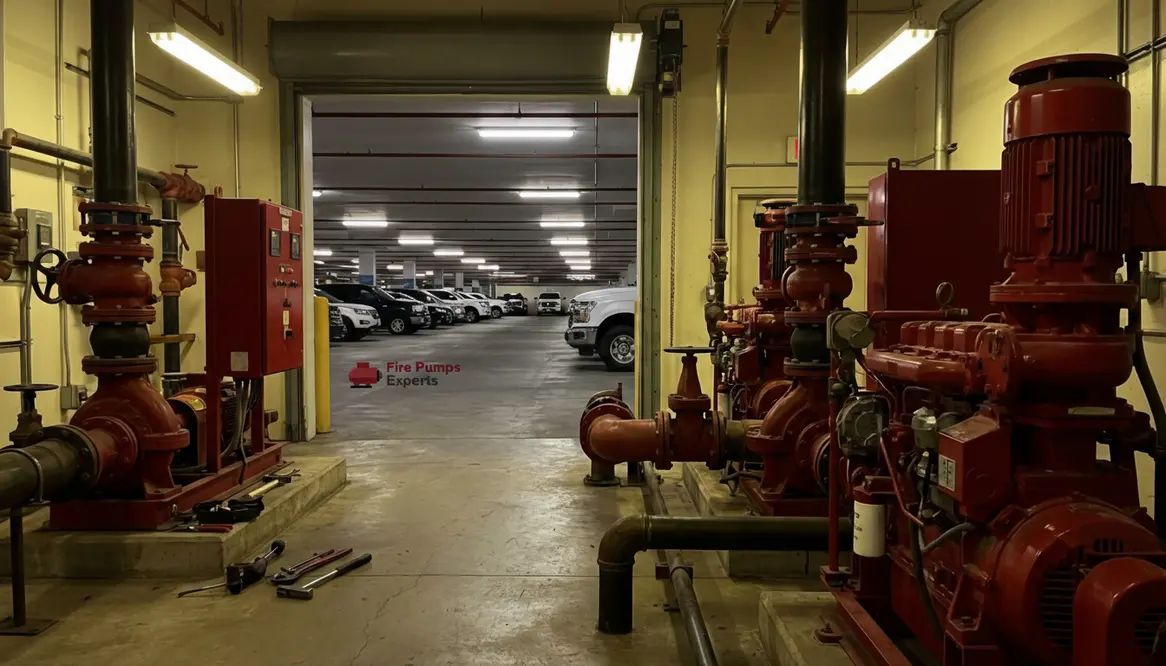
Commercial Garage Fire Pump Systems Guide
I have walked through enough vehicle storage buildings to know one truth: when fire protection is done right, nobody notices. When it is not, everyone notices. That is why I always bring the conversation back to commercial garage fire pump systems early. These systems quietly carry the burden of keeping high value assets, fleets, and entire operations safe. And yes, they do it without applause, a bit like the bass player in a great band. You may not see them, but remove them and the whole thing falls apart.
So let me walk you through what really matters when selecting and designing fire pump solutions for large vehicle storage facilities. I will keep it practical, a little entertaining, and grounded in real world performance.
What makes vehicle storage buildings uniquely risky?
I always start here because context shapes every decision. Vehicle storage buildings are not just big boxes with wheels inside. They are dense environments filled with fuel, plastics, electrical systems, and sometimes charging infrastructure. In other words, they are a buffet for fire.
Because of this, fire grows fast and spreads faster. However, water demand rises quickly too. That is where properly designed fire pump systems step in. They maintain pressure when municipal supply alone cannot keep up.
Additionally, modern facilities often stack vehicles higher and tighter. While that improves space efficiency, it complicates suppression. So I design systems that anticipate rapid escalation rather than react to it. Think of it as preparing for the action scene before the explosion happens, not after.
Core design priorities for commercial garage fire pump systems
When I design for these environments, I focus on reliability first, performance second, and everything else third. Because a system that looks great on paper but fails under pressure is about as useful as a screen door on a submarine.
Here is what I prioritize:
Consistent pressure delivery
I ensure the pump maintains steady pressure across large floor areas, especially in multi level storage.
Redundancy
I often recommend backup pumps or dual power sources. Because fires do not wait for your primary system to reboot.
Demand matching
I size systems to meet peak flow requirements, not average conditions. Average is comfortable. Fire is not.
Integration with suppression systems
I align pumps with sprinkler and standpipe systems so they operate as one unified defense.
How do I size a fire pump for a large garage facility?
This is the question I hear most often, and for good reason. Oversize it and you waste money. Undersize it and you risk everything.
I begin with hazard classification and expected fire load. Then I calculate required flow and pressure based on the most demanding scenario, not the easiest one. After that, I factor in elevation changes, friction loss, and system expansion potential.
Moreover, I always leave room for growth. Facilities evolve. Fleets expand. Technology shifts. Your fire protection system should not feel outdated the moment you finish installing it.
And yes, I double check everything. Because guessing in fire protection is like improvising in a parachute factory. It is not the place for creativity.
Balancing performance and efficiency in modern systems
Now, here is where things get interesting. High performance does not have to mean high waste. In fact, modern fire pump solutions can be both powerful and efficient when designed correctly.
Performance Focus
- High flow capacity
- Rapid system response
- Strong pressure stability
- Reliable operation under peak demand
Efficiency Focus
- Smart controllers
- Reduced energy consumption
- Lower maintenance needs
- Optimized pump cycling
When I bring these together, I create systems that work hard only when needed. It is a bit like having a sports car that knows when to cruise and when to accelerate. And yes, I enjoy that comparison more than I probably should.
Common mistakes I see in vehicle storage fire protection
I have seen enough projects to spot patterns. Some mistakes show up again and again, like reruns of a show that should have ended seasons ago.
Ignoring future expansion
Facilities grow. Systems should too. If you design only for today, you are already behind.
Underestimating water demand
This is the big one. Fire events rarely follow best case scenarios.
Poor system integration
Disconnected components lead to delayed response and reduced effectiveness.
Skipping regular testing
A fire pump system that is not tested is a mystery box. And I do not like surprises when safety is on the line.
By addressing these early, I prevent costly fixes later. And trust me, fixes are always more expensive than doing it right the first time.
Commercial garage fire pump systems and long term reliability
Reliability is not a feature. It is a commitment. I build systems that perform not just on day one, but year after year.
That means selecting durable components, planning for maintenance access, and ensuring compliance with evolving codes. It also means working with partners who understand large scale commercial and industrial environments.
Because at the end of the day, these systems protect more than vehicles. They protect operations, revenue, and people. And that responsibility deserves more than a checkbox approach.
If you want to understand how commercial garage fire pump systems interact with your broader water supply, NFPA-based resources and technical overviews on sites like https://firepumps.org can help frame the bigger picture before you sit down with your design team.
FAQ: Fire pump considerations for vehicle storage buildings
Below are some of the most common questions I hear when planning or upgrading commercial garage fire pump systems for vehicle storage facilities.
Conclusion
If you are planning or upgrading a vehicle storage facility, now is the time to take fire protection seriously. I design commercial garage fire pump systems that perform when it matters most, not just on paper. Let us build a system that protects your investment, supports your operations, and stands ready without hesitation. Reach out today and we will make sure your facility is prepared, not just compliant.