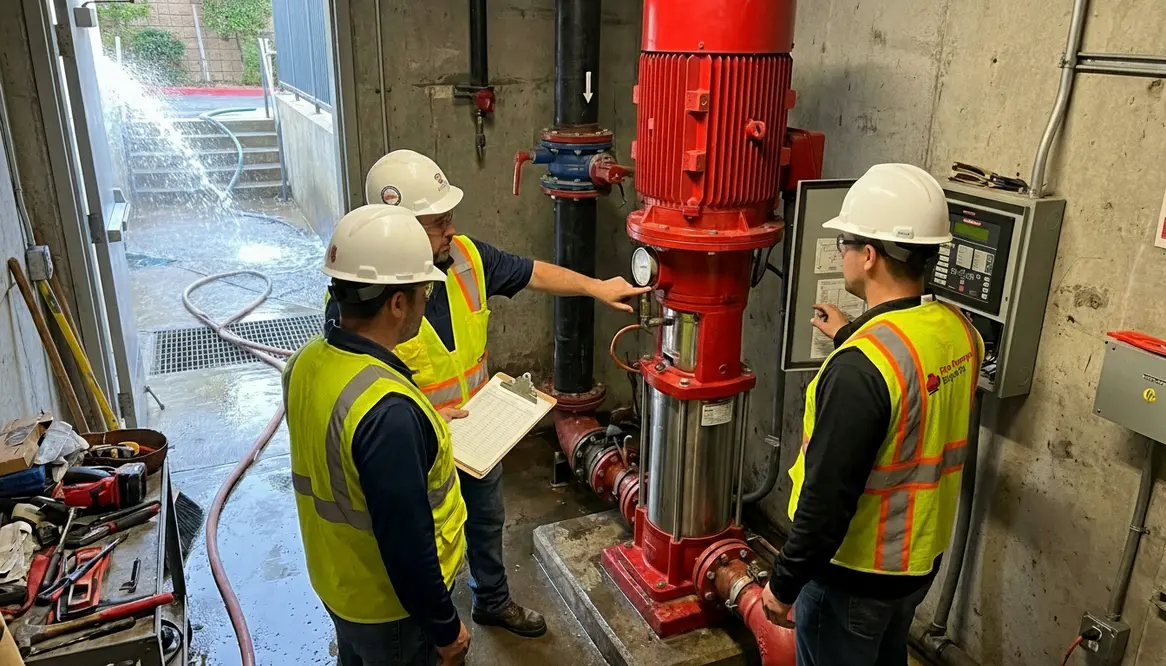
Fire Pump Acceptance Test Field Checklist Los Angeles
Turning high-stakes fire pump testing days in Los Angeles into calm, controlled performance checks instead of stress-filled emergencies.
I have spent enough time around pump rooms in Los Angeles to know one thing with absolute certainty. The acceptance test is the moment of truth. Months of design, installation, coordination, and inspection all lead to a single day when the system either performs like a hero or embarrasses everyone in the room.
That is why I always walk in with a clear fire pump acceptance test field checklist los angeles mindset. Not a literal clipboard every time, although I do enjoy a good clipboard. Rather, it is a mental playbook that keeps commercial and industrial facilities ready for scrutiny from engineers, contractors, and the fire department. When done right, the test runs smoothly, the numbers look beautiful, and everyone goes home early. When done wrong, well… let us just say nobody enjoys explaining a failed test while standing next to a silent pump.
So today I will walk you through the field approach I use to help large commercial and industrial properties pass the first time. Because in Los Angeles, time is money, inspectors are busy, and repeating a test is about as fun as rebooting a server during peak traffic.
Think of this as a practical, real-world guide you can adapt into your own fire pump acceptance test field checklist los angeles strategy, whether you are responsible for a high rise, a hospital, a data center, or a sprawling industrial site.
Why Acceptance Testing Matters for Large Commercial Buildings
First, let us set the stage. A fire pump acceptance test proves that a pump system can deliver the pressure and flow required to protect a building during an emergency. That sounds simple enough. However, for large facilities such as hospitals, data centers, distribution hubs, and high rise commercial buildings, the stakes are enormous.
When I arrive at a property preparing for this test, I always remind the team of one simple truth. The pump is not there for decoration. It is the heartbeat of the fire protection system.
Because of that, acceptance testing verifies several critical factors.
- The pump produces the required rated flow and pressure
- The controller responds correctly to pressure changes
- Power supply and backup systems perform under load
- Relief valves, gauges, and instrumentation work properly
- The installation follows NFPA standards and local Los Angeles requirements
Additionally, the test confirms something that rarely shows up on drawings. Real world performance. Pipes vibrate, valves stick, wiring mistakes happen. The acceptance test brings the entire system to life.
And frankly, inspectors in Los Angeles have seen everything. So preparation separates the calm professionals from the folks nervously flipping through manuals like they are cramming for a final exam.
From Code Requirement To Operational Reality
Code compliance is the minimum. Operational confidence is the goal. A well-prepared fire pump acceptance test field checklist los angeles mindset bridges that gap by proving your system works under live conditions, not just in design documents.
That includes respecting NFPA 20 performance expectations for churn, 100% flow, and 150% flow while still aligning with the realities of Los Angeles water supply, site constraints, and building operations.
My Fire Pump Acceptance Test Field Checklist Los Angeles Facilities Should Follow
Before a single valve opens, I walk through a structured field process. Think of it as the pregame warm up. Skip this step and the test can unravel quickly.
Here is the practical checklist I follow at commercial and industrial sites.
- Confirm documentation
First, I verify approved plans, pump curves, and manufacturer data. Inspectors often ask for these immediately. Having them ready sets a confident tone. - Inspect installation conditions
Next, I examine the pump room layout. Clearance around equipment, proper anchoring, and accessible valves all matter. Tight mechanical rooms might look impressive on paper, yet inspectors prefer space to move. - Check gauges and instrumentation
Accurate readings are everything. Therefore I confirm calibrated pressure gauges are installed on both suction and discharge sides. - Verify water supply readiness
The water source must support the test. I confirm tank levels, city supply coordination, or suction reservoir capacity. - Controller programming review
Then I verify automatic start settings and alarm signals. A pump that refuses to start automatically during the test can cause immediate failure. - Relief valve and circulation path
Finally, I ensure water has somewhere to go. Flow test headers, hoses, and discharge points must be arranged safely.
Once this groundwork is complete, the team moves forward with confidence. And confidence, I have learned, makes inspectors far more relaxed.
What Inspectors in Los Angeles Actually Look For During the Test
Many facility managers assume the acceptance test is only about hitting the right pressure numbers. That is part of it. However, inspectors watch much more than the gauges.
First, they observe the startup sequence. Does the controller respond quickly when pressure drops? Does the pump engage smoothly without hesitation?
Next, they watch the flow testing itself. Typically the system runs at churn, then at one hundred percent rated capacity, and finally at one hundred fifty percent flow. Each point reveals how the pump performs across its operating curve.
Meanwhile, inspectors watch vibration, unusual noise, and heat. A pump that sounds like a washing machine full of bricks will not inspire confidence.
In addition, they examine supporting components. Diesel fuel levels, battery chargers, transfer switches, and alarm connections all matter. After all, a pump that works only under perfect conditions is not much help during a real emergency.
Interestingly, I often see inspectors pay attention to teamwork. A coordinated crew communicates clearly, reads gauges accurately, and records results carefully. On the other hand, a chaotic team shouting numbers across the room feels like a scene from a disaster movie. And nobody wants their acceptance test to resemble an action film.
Common Field Mistakes That Cause Test Failures
Mechanical Oversights
- Closed valves hiding in the system
- Improper pump rotation
- Loose couplings creating vibration
- Air trapped in suction piping
- Relief valves set incorrectly
Coordination Issues
- Missing calibrated gauges
- Insufficient flow hoses
- Electrical connections unfinished
- Fuel supply not verified
- Incomplete documentation
Because of these recurring issues, I always revisit my internal fire pump acceptance test field checklist los angeles approach before any inspection day. A quick walkthrough often reveals problems that could otherwise delay approval.
Also, let us be honest. Discovering a closed valve before the inspector arrives feels like finding money in an old jacket pocket. Small victory, big relief.
How I Prepare a Facility to Pass on the First Try
Preparation does not begin the morning of the test. In reality, successful acceptance tests start weeks earlier.
First, I coordinate with contractors and facility engineers to schedule a full pretest. This rehearsal mirrors the official acceptance procedure. We run the pump, measure flows, and document results. If anything looks questionable, we fix it immediately.
Next, I verify that all auxiliary systems communicate correctly with the building monitoring platform. Large commercial facilities rely heavily on integrated alarms. Therefore signals from the pump controller must transmit properly.
After that, I brief the entire testing crew. Everyone receives a clear role. One person reads suction pressure. Another tracks discharge pressure. Someone else manages the flow valves. Smooth coordination keeps the process efficient.
Finally, I prepare documentation packages. These typically include pump curves, factory test results, electrical diagrams, and inspection forms. Inspectors appreciate organization. More importantly, it speeds up the entire review.
When all these pieces align, the acceptance test feels less like a nerve wracking exam and more like a well rehearsed performance. And honestly, watching a massive pump deliver perfect pressure numbers can be strangely satisfying. It is the mechanical equivalent of hearing a symphony hit the final note.
If you want a deeper code-based perspective behind that performance, resources like Kord Fire Protection’s NFPA 20 overview at https://kordfire.com/how-nfpa-20-regulates-fire-pump-systems/ pair nicely with a field-ready fire pump acceptance test field checklist los angeles mindset.
FAQ
What is a fire pump acceptance test?
It is a formal test that verifies a fire pump system delivers the required pressure and water flow for fire protection.
Who witnesses the acceptance test in Los Angeles?
Typically the fire department, project engineers, contractors, and facility representatives attend the test.
How long does a fire pump acceptance test take?
Most tests for commercial facilities take two to four hours depending on system complexity.
What happens if the pump fails the test?
The system must be corrected and the acceptance test repeated before final approval.
Why is a field checklist important for acceptance testing?
A structured checklist helps teams verify equipment readiness, avoid mistakes, and pass inspections the first time.
Conclusion
Passing an acceptance test should never rely on luck. With the right preparation, the right crew, and a disciplined approach like a proven fire pump acceptance test field checklist los angeles strategy, commercial and industrial facilities can move through inspections smoothly and confidently. If your property is approaching a pump acceptance test, our team at FirePumps.org can help you prepare, coordinate testing, and ensure your system performs exactly when it matters most.