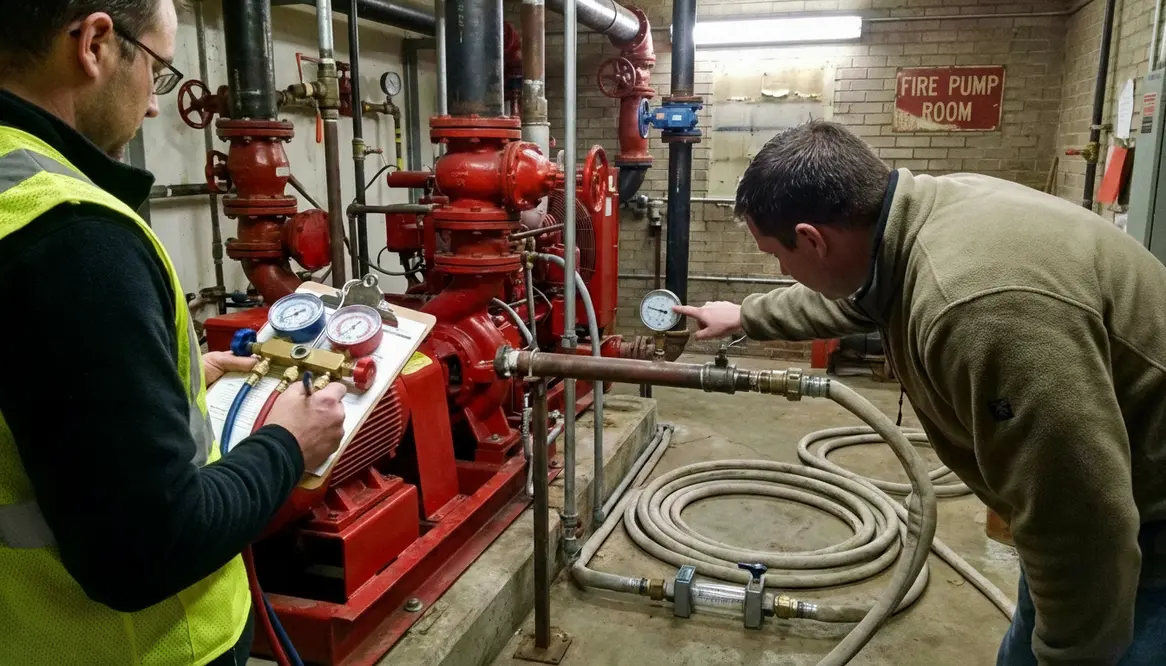
Fire Pump Annual Flow Test Boston How to Read Results
I have spent enough time in mechanical rooms to know one truth. Fire pumps do not care about opinions. They care about numbers. Flow, pressure, churn, performance. The numbers tell the story.
That is why every building owner eventually faces the same moment during a fire pump annual flow test Boston how to read results conversation. A technician hands over a report filled with gauges, curves, and data points that look like they belong in a NASA control room. And suddenly the owner, facility manager, or property executive asks the same question.
“So… is this good?”
Fortunately, the answer does not require an engineering degree or a superhero origin story. With the right perspective, the results of a fire pump flow test become surprisingly readable. In fact, once you know what to look for, you can glance at the report and understand whether your building’s life safety system is strong, slipping, or quietly asking for help.
So let me walk you through how I read these results like an owner who wants confidence, not confusion.
Fire Pump Annual Flow Test Boston How to Read Results Like an Owner
First, I start with the purpose of the test itself. The annual flow test exists for one reason. To prove that the pump protecting a commercial or industrial building still performs the way it did when it was installed.
However, time is not always kind to mechanical equipment. Valves stick. Impellers wear down. Controllers age. Meanwhile, Boston winters treat infrastructure the way a New England linebacker treats a quarterback.
Because of that reality, the annual flow test measures three main operating points.
Churn which means the pump runs with no water flowing.
Rated flow which is the pump operating at its designed capacity.
150 percent flow which pushes the pump beyond its normal duty.
Now here is the key. I do not obsess over raw numbers first. Instead, I compare the results to the original pump curve. The pump curve is the blueprint of expected performance. Think of it as the pump’s fitness benchmark. If the pump still matches that curve, then the system remains strong.
And if the curve drifts downward? Well, that is when the mechanical plot thickens.
The Three Numbers I Check First on Every Test Report
Whenever I review results for a large commercial property or industrial facility, I focus on three readings immediately. These numbers reveal more than most people realize.
Net pressure
This tells me how much pressure the pump actually produces after accounting for suction pressure. If the net pressure at rated flow drops too far below the original curve, the pump may be losing efficiency.
Flow rate accuracy
The flow meter or hose header measurement confirms whether the pump can move the expected gallons per minute. A small deviation is normal. A large deviation means the pump may struggle during a real emergency.
Controller response
During the test, the controller should start the pump quickly when pressure drops. If the start feels slow or inconsistent, that electrical system deserves attention.
In other words, these three signals reveal whether the pump still behaves like the day it left the factory. If they line up with the curve, I relax a little. If they do not, I start asking sharper questions.
Common Red Flags Hidden in Flow Test Data
Now let us talk about the subtle clues. Because a fire pump annual flow test Boston how to read results report often whispers problems before they become emergencies.
First, I watch for declining pressure across multiple years. A single weak test may simply reflect measurement conditions. However, a steady downward trend usually means wear inside the pump.
Second, I look for unstable gauge readings. Pressure that jumps or fluctuates during flow testing often points to suction problems, partially closed valves, or air entering the system.
Third, I pay attention to vibration or noise during the test. A pump should sound steady and confident. When it rattles like an old subway train pulling into South Station, something inside may be misaligned.
Finally, I check whether the 150 percent flow point drops too low. That condition sometimes signals internal impeller damage or pipe restrictions.
None of these signs mean the sky is falling. But they do mean the system deserves investigation before the next alarm bell rings.
How I Translate Flow Test Results Into Real World Risk
Numbers alone do not protect buildings. Interpretation does.
When I analyze a fire pump annual flow test Boston how to read results report, I translate those measurements into operational risk for the facility.
Performance signals I like to see
- Pressure readings that align with the original pump curve
- Stable gauges throughout the test
- Smooth motor operation
- Consistent controller start times
- Flow levels meeting rated capacity
Signals that trigger deeper inspection
- Pressure dropping below expected thresholds
- Erratic suction pressure
- Delayed controller activation
- Large differences from previous test reports
- Unusual vibration or sound
When owners see this comparison, the picture becomes clearer. The test is not just paperwork for compliance. It is a yearly health check for the heart of the fire protection system.
And let me tell you something. In a high rise commercial tower, a distribution warehouse, or a manufacturing facility, that pump is the quiet hero of the entire safety strategy.
What Boston Property Owners Often Miss in Flow Test Reports
Interestingly, the biggest misunderstanding I see is not about pressure readings. It is about context.
Many owners assume the pass or fail label tells the whole story. In reality, a system can technically pass while still drifting away from peak performance.
For example, I once reviewed a flow test for a large industrial facility where the pump technically met minimum requirements. However, the pressure curve had declined nearly ten percent compared to installation data.
Was the system compliant? Yes.
Was it trending in the wrong direction? Also yes.
This is where experience matters. Reading a fire pump annual flow test Boston how to read results report like an owner means thinking ahead. You are not just asking if the pump works today. You are asking how it will behave three years from now during the worst day your building could face.
Besides, mechanical systems rarely fail dramatically without warning. They whisper first. The flow test simply gives us a microphone.
So… What Should an Owner Do After the Test?
This is the moment where I shift from reading numbers to making decisions.
After every fire pump annual flow test Boston how to read results review, I recommend owners focus on three actions.
Archive every report
Trend analysis matters. A single test is a snapshot. Five years of tests tell a story.
Address small performance gaps early
Minor maintenance today prevents expensive repairs later.
Use specialists who understand large systems
Commercial towers, hospitals, distribution centers, and industrial plants rely on high demand fire pumps. Those systems deserve technicians who work with complex facilities every day.
Think of it like owning a high performance engine. Sure, the car runs fine now. But if the oil pressure drops a little each year, you would not wait until smoke pours out of the hood.
At least I hope not. Hollywood action movies make that look much cooler than it actually is.
If you manage complex properties and want a deeper look at inspection and testing expectations, Kord Fire Protection’s overview of fire pump testing requirements adds helpful technical context alongside your annual reports.
FAQ
Keeping Your Building Ready When It Matters
The truth is simple. A fire pump annual flow test Boston how to read results review is not about paperwork. It is about confidence. When the alarms sound and sprinklers open, the pump must deliver water with strength and certainty. If you manage a commercial tower, industrial facility, or major property in Boston, understanding those results gives you control over the system that protects everything inside your walls. Work with specialists who know these pumps inside and out, and keep your building prepared for the moment reliability matters most.