Fire Pump Flow Test Fremont Buildings Guide
A practical, real world walkthrough of what happens during a fire pump flow test, why it matters for large Fremont properties, and how to approach it without losing your sanity.
I have walked through a lot of mechanical rooms in my time. Some hum like a well tuned orchestra. Others sound like a coffee maker trying to run a marathon. Somewhere in the middle sits the heart of a building’s fire protection system. The fire pump. And if you own or manage a large commercial or industrial property, you already know the phrase fire pump flow test Fremont buildings is not just industry jargon. It is the moment when your system proves it can actually deliver water when everything else goes wrong.
In Fremont, where commercial campuses, manufacturing facilities, logistics centers, and high occupancy properties keep the city moving, that test matters. A lot. So today I want to walk you through what really happens during these tests, why they matter, and how property owners can approach them with a little less stress and maybe even a smile. Because honestly, once you understand the process, it feels less like a surprise inspection and more like a health check for your building’s lifeline.
Quick Snapshot For Fremont Property Teams
- Confirms your fire pump will perform when sprinklers need it most.
- Highlights hidden issues long before an emergency or inspection does.
- Keeps large campuses, warehouses, and towers code compliant and insurable.
- Turns “unknown risk” into clearly documented performance data.
If you want a deeper dive into how pumps are designed, installed, and tested, you can find a solid NFPA 20 overview from Kord Fire at https://kordfire.com/how-nfpa-20-regulates-fire-pump-systems/.
Why Fire Pump Testing Matters for Large Fremont Properties
First things first. Fire pumps are not decorative equipment. They exist because sprinkler systems sometimes need extra pressure and flow to control a fire. Without the pump performing correctly, those sprinklers become about as helpful as a garden hose during a warehouse fire. And nobody wants that plot twist.
Commercial and industrial buildings in Fremont often span hundreds of thousands of square feet. Manufacturing plants, biotech campuses, logistics hubs, and large office towers demand strong water delivery during emergencies. Therefore, local codes and national standards require regular pump testing to confirm that the system delivers the correct flow and pressure.
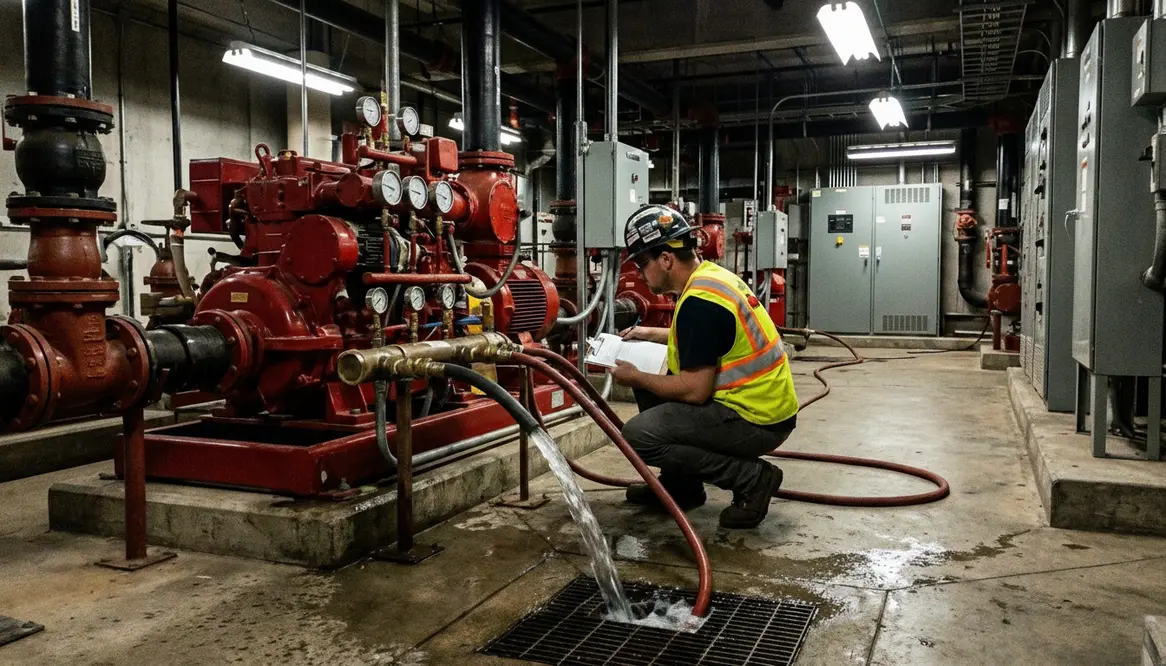
During a flow test, technicians measure how the pump performs under different loads. They verify that the pump reaches its rated capacity and that pressure levels remain stable. Meanwhile, gauges, flow meters, and sensors collect data that tells the real story of the system’s performance.
More importantly, these tests catch problems before an emergency does. A worn impeller, a clogged suction line, or a control issue might stay hidden for months. However, a properly executed flow test shines a spotlight on those issues immediately.
In other words, the test answers a simple but serious question. If a fire breaks out tonight, will the pump deliver what the building needs?
What Happens During a Fire Pump Flow Test in Fremont Buildings
Let me paint the picture.
You walk into the pump room early in the morning. The test crew is setting up hoses, flow meters, and gauges. The system looks calm now. But in a few minutes, it will roar to life like the opening scene of an action movie.
Here is the typical process property owners can expect:
Step-by-step look at the fire pump flow test Fremont buildings rely on
Preparation and system inspection
Technicians check valves, controllers, power supply, and gauges. They also confirm that discharge lines are ready to handle test water.
Churn test
The pump runs without flowing water to record baseline pressure. Think of it as the idle speed of the system.
Flow stages
The pump runs at increasing flow levels. Usually 100 percent and sometimes 150 percent of rated capacity. Technicians monitor pressure, vibration, and engine performance.
Data comparison
Afterward, results are compared to the manufacturer’s performance curve. This determines whether the pump meets required output.
Now here is the thing most property owners appreciate once they see it. The process is controlled and methodical. There are no surprises, no chaos, and definitely no dramatic explosions like you might see in an action film. Sorry, Hollywood.
Instead, the test works like a diagnostic exam. It confirms that the system designed to protect your facility can perform exactly as intended.
What Property Owners Often Ask About Fire Pump Testing
In today’s world, property managers and facility directors often start with a simple AI style question. Something like this.
How do I know if my building’s fire pump is performing correctly?
The answer is straightforward. A properly conducted fire pump flow test Fremont buildings rely on compares real time pump performance against its original design curve. If the pump delivers the expected pressure and flow at each test point, the system passes.
Beyond pass or fail
However, the real value appears in the details. During testing, experienced technicians watch for early warning signs that raw data might not show immediately.
- Pressure fluctuations that suggest suction issues
- Unusual vibration in diesel driven pumps
- Slow controller response
- Pressure drops between test stages
Each of these signals could indicate a developing mechanical issue. Addressing them early keeps your system reliable and prevents expensive downtime later.
And let’s be honest. Fixing a small issue during a scheduled test feels a lot better than discovering it during a fire department inspection.
Common Issues Discovered During Pump Flow Testing
Even the best maintained facilities encounter occasional surprises during testing. Pumps work hard, and mechanical equipment always tells the truth when pressure hits full capacity.
Over the years, I have seen a few recurring issues appear in commercial and industrial systems.
Obstructed suction supply
Debris, partially closed valves, or supply restrictions can limit water intake. As a result, the pump struggles to maintain pressure during peak flow.
Worn pump components
Impellers and bearings wear over time. Consequently, efficiency drops and output falls below design performance.
Controller or electrical issues
Control panels manage start sequences and system signals. If components age or connections loosen, the pump may start slowly or behave unpredictably.
Pressure gauge inaccuracies
It sounds simple, but inaccurate gauges can create misleading results. Therefore calibration remains a critical step.
None of these problems mean the system has failed completely. Instead, they highlight areas where maintenance or adjustments keep the system performing at its best.
Think of it like a yearly physical. Nobody enjoys stepping on the scale, yet it beats ignoring the problem until your doctor raises an eyebrow.
How Testing Protects Facilities & Controls Long Term Costs
How testing protects large facilities
Commercial properties depend on predictable fire protection performance. Flow testing confirms that pumps deliver the pressure required to support sprinkler systems across large floor areas. As a result, facility managers gain confidence that their infrastructure can handle emergency conditions without hesitation. In addition, accurate testing supports compliance with inspection authorities and insurance requirements.
Why it saves long term costs
Although testing requires planning, it often prevents far more expensive problems. Early detection of wear, suction issues, or controller faults reduces the chance of emergency repairs. Furthermore, maintaining a reliable pump protects high value assets such as manufacturing equipment, tenant operations, and sensitive inventory. In many cases, a single avoided shutdown offsets years of testing costs.
Planning Ahead for Reliable Pump Performance
Preparation makes testing smoother for everyone involved. Property owners who plan ahead usually see the most efficient results.
- Keep accurate documentation. Original pump curves, previous test reports, and maintenance records help technicians compare performance over time.
- Schedule testing strategically. Industrial facilities often choose early morning windows when water discharge and system noise create fewer disruptions.
- Ensure clear physical access. Make sure pump rooms, valves, and discharge locations are easy to reach. This simple step can save hours during a test day.
- Track trends over time. Treat each fire pump flow test Fremont buildings complete as one more data point in your long term reliability picture.
Finally, view testing as part of an ongoing strategy rather than a once a year obligation. Facilities that track performance trends build a clearer understanding of how their systems age and evolve.
And yes, the pump room may never become your favorite place in the building. But compared to a boardroom meeting that could have been an email, it is not the worst room either.
FAQ About Fire Pump Flow Testing
Before we wrap up, here are answers to questions that come up again and again when scheduling a fire pump flow test Fremont buildings must complete for compliance and peace of mind.
Keeping Fremont Buildings Ready When It Matters
At the end of the day, a well executed fire pump flow test Fremont buildings depend on is not just a compliance task. It is proof that the system protecting your people, operations, and assets actually works when called upon. If you manage a large commercial or industrial property in Fremont, proactive testing keeps your facility ready, reliable, and fully protected.
Treat every scheduled test as a chance to learn something new about your building’s resilience. Ask questions. Review the data. Track changes from year to year. The more familiar you are with your pump’s behavior, the easier it becomes to justify budgets, satisfy inspectors, and sleep at night knowing your system is ready.
Connect with experienced specialists who understand complex buildings, local expectations, and the realities of keeping a busy Fremont property online during testing. With the right team and a consistent approach, the phrase fire pump flow test Fremont buildings rely on becomes less of a source of anxiety and more of a quiet confirmation that your lifeline is exactly where it should be: ready.