Fire Pump Flow Test Jacksonville Measuring Flow Safely
How real-world flow testing keeps high-demand Jacksonville facilities ready when it matters most.
I have always liked the quiet confidence of a well designed fire protection system. You may never notice it during a normal workday, yet the moment something goes wrong, it becomes the most important equipment in the building. That is why a fire pump flow test jacksonville measuring flow safely is not just a routine inspection. It is a proof of strength. A confirmation that when water must move fast and in large volume, the pump will answer the call.
In large commercial towers, hospitals, distribution centers, and manufacturing facilities across Jacksonville, a fire pump carries the responsibility of feeding a building’s entire sprinkler network. Therefore, testing its real world flow is essential. I have stood beside many pumps during these tests, listening to the steady hum of machinery and the rush of water through test headers. It is oddly calming. Like watching a well rehearsed orchestra perform.
Of course, performing the test correctly matters. Accuracy, safety, and careful measurement determine whether a facility remains protected or unknowingly vulnerable. So let’s walk through how professionals approach flow testing in Jacksonville and why this process matters more than most building managers realize.
A quick snapshot of what a flow test proves
- That your fire pump still delivers its rated gallons per minute
- How pressure behaves across the performance curve
- Whether controllers, relief valves, and sensing lines react correctly
- If performance has slipped since the last documented test
Why Jacksonville facilities care
From coastal terminals to medical campuses, a fire pump flow test jacksonville measuring flow safely keeps sprinklers supplied when water demand skyrockets. In these environments, “close enough” is not good enough.
Why Flow Testing Matters for Large Commercial Buildings
A fire pump is designed to deliver a specific amount of water at a certain pressure. That performance is not theoretical. It must be proven. Therefore, flow testing measures exactly how the pump performs under real conditions.
In major commercial properties, the stakes are high. Think about high rise offices, shipping terminals, hospitals, industrial plants, or data centers. These facilities rely on consistent water delivery to protect lives, assets, and operations. If the pump underperforms, sprinkler systems may not control a fire quickly enough.
Moreover, codes and insurance carriers require documented testing. Annual flow verification confirms that the pump still meets its rated capacity. Over time, wear, corrosion, and valve restrictions can reduce performance. Pumps age just like the rest of us. The difference is that pumps cannot complain about sore joints.
As a result, a proper flow test answers several critical questions.
- Does the pump reach its rated gallons per minute
- Is pressure consistent across the performance curve
- Are controllers and relief valves functioning correctly
- Has performance declined since the last test
When we measure flow accurately, we remove guesswork. And when it comes to fire protection, guesswork belongs in casino games, not building safety.
Fire Pump Flow Test Jacksonville Measuring Flow Safely in High Demand Facilities
Jacksonville has a unique mix of coastal industry, large logistics centers, and expanding commercial campuses. Because of that growth, demand for reliable pump testing continues to rise. Many facilities operate around the clock, so testing must be efficient and controlled.
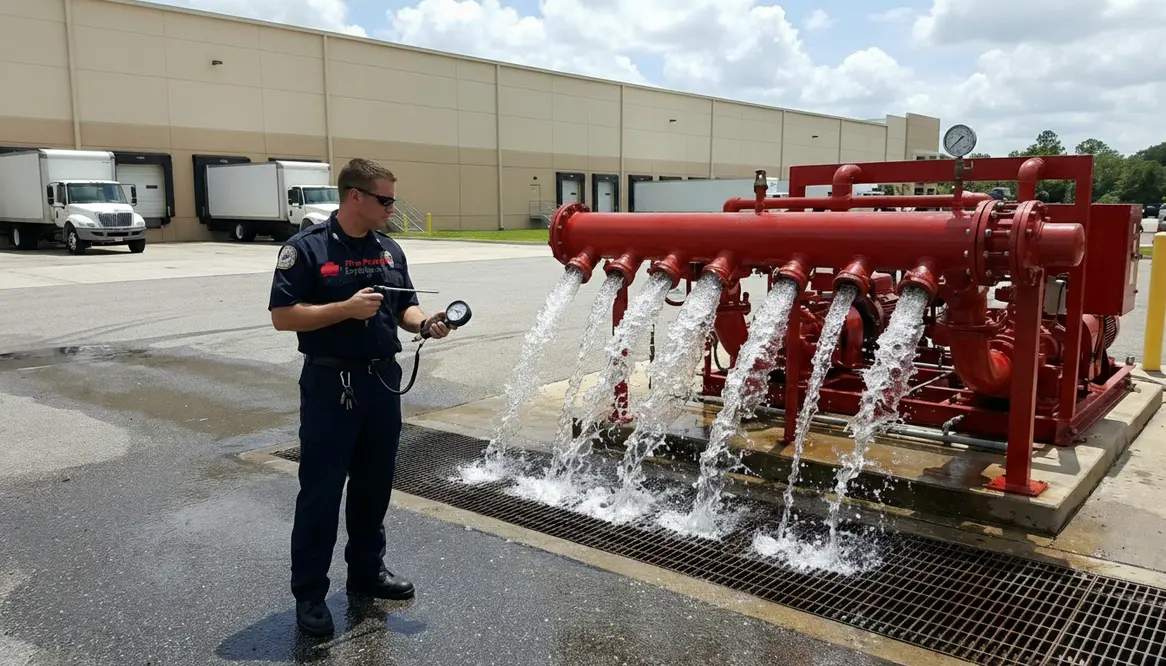
Safety always leads the process. During a fire pump flow test jacksonville measuring flow safely, technicians discharge large volumes of water through calibrated test headers or flow meters. These systems allow accurate measurement without flooding surrounding property or damaging infrastructure.
However, the procedure requires coordination. Before the test begins, professionals review several factors.
- Drainage capacity near the test header
- Nearby pedestrian and vehicle traffic
- Water supply stability
- Communication with facility staff
Then the pump runs through several performance points. We measure churn pressure, partial load performance, and full rated flow. Meanwhile, gauges track pressure changes while technicians document each reading.
If you have ever seen a proper test in action, it is impressive. Water roars from the discharge outlets like something out of an action movie. The only difference is that nobody is dramatically running away from explosions in slow motion.
Instead, professionals calmly record data, ensuring every reading aligns with the pump’s design curve.
How I Measure Flow Accurately During Pump Testing
Accuracy begins with the right equipment. A pump may move thousands of gallons per minute, so even small measurement errors can create misleading results. Therefore, testing uses calibrated instruments designed specifically for high volume water systems.
Most commercial properties rely on test headers with smooth bore outlets. Technicians measure pitot pressure at each outlet and convert those readings into flow rates. Meanwhile, digital gauges confirm suction and discharge pressure.
Because each outlet contributes to the total flow, technicians combine readings to determine the pump’s overall output. It sounds technical, yet the logic remains simple. Measure the speed of water leaving each opening and calculate the total volume.
However, measurement alone is not enough. Experienced technicians also observe system behavior.
For example, pressure fluctuations may reveal partially closed valves or suction issues. Excess vibration might suggest alignment problems. Even the sound of the pump can provide clues. Pumps speak in their own mechanical language. You just have to listen.
Additionally, comparing results against the manufacturer curve tells the real story. If readings fall below expectations, further investigation follows. No assumptions. Just facts backed by water, pressure, and math.
Key Equipment Used During Testing
- Calibrated pitot gauges
- Digital pressure gauges
- Flow meters when available
- Test header with multiple outlets
- Data logging sheets
What Technicians Monitor
- Suction pressure stability
- Discharge pressure at multiple flow points
- Pump vibration and sound
- Controller activation
- Water supply reliability
What Could Go Wrong If Flow Testing Is Ignored
Let me be direct. Skipping proper testing is like owning a parachute and never checking if it opens. It might work. It might not. Personally, I prefer certainty.
Several issues can quietly develop inside fire pump systems.
- Impeller wear reducing water output
- Partially closed valves restricting flow
- Air leaks on suction lines
- Controller failures during startup
- Blocked strainers limiting supply
Without a flow test, these problems may remain hidden. The pump may start normally during weekly churn tests yet fail to deliver full capacity during a real emergency.
Large commercial facilities face another risk. Insurance compliance. Many insurers require annual flow verification. Missing documentation can affect coverage or liability after a fire incident.
Therefore, regular performance testing protects more than equipment. It protects operations, occupants, and long term business continuity.
How Often Should Commercial Facilities Test Fire Pumps
I hear this question often, especially from facility managers responsible for large campuses. The short answer is simple. Industry standards typically require annual flow testing.
However, some high risk facilities conduct more frequent evaluations. Data centers, hospitals, and large manufacturing plants sometimes schedule additional performance checks to ensure reliability.
In Jacksonville’s humid environment, corrosion and scale can develop faster than expected. Consequently, routine inspections between tests help catch small issues before they become expensive ones.
Think of it like maintaining a high performance vehicle. If you only check the engine after it stops working on the highway, the road trip probably did not end well.
FAQ About Fire Pump Flow Testing
What is a fire pump flow test
A fire pump flow test measures how much water a pump delivers at different pressure levels to confirm it meets its rated performance.
How often should commercial fire pumps be flow tested
Most commercial and industrial buildings must complete a full flow test once per year according to fire protection standards.
Does flow testing shut down building fire protection
No. The test runs through controlled discharge points while the system remains connected to the water supply.
Why is accurate flow measurement important
Accurate measurements confirm the pump can supply enough water to support sprinkler systems during a fire emergency.
Who should perform a fire pump flow test
Qualified fire protection professionals with calibrated equipment and experience in commercial pump systems should perform the test.
Reliable Fire Pump Performance Starts with Proper Testing
If you manage a large commercial or industrial facility, you already know how many systems must work perfectly behind the scenes. Fire pumps sit near the top of that list. A professional flow test confirms the system can perform when every second matters. If your Jacksonville property needs dependable testing, now is the time to schedule it. Let experienced professionals measure performance safely and ensure your building remains fully protected.
If you are planning a fire pump flow test jacksonville measuring flow safely and want support from specialists who live and breathe these systems every day, explore how a full-service provider like Kord Fire Protection’s fire pump and testing services approach diesel and electric fire pump maintenance, inspection, and performance checks.
When your next inspection date comes up, treat it as an opportunity rather than a chore. Use that fire pump flow test jacksonville measuring flow safely to confirm that your system is not just code compliant on paper, but truly ready for the worst day your building might ever experience.