Fire Pump Flow Test vs Churn Test Philadelphia Annual
Fire Pump Annual Test Philadelphia Flow Test vs Churn Test: Why Both Matter for Large Buildings
I have spent enough time in mechanical rooms to know this simple truth. Fire pumps are like quiet bodyguards. Most days they stand in the corner, silent and patient. However, when a real emergency hits, they must perform like an action hero in the final scene of a blockbuster.
That is exactly why the fire pump annual test philadelphia flow test vs churn test conversation matters so much for commercial and industrial buildings. In Philadelphia, code requires owners and facility managers to verify that their fire pumps actually deliver the pressure and flow a system promises. Yet many people hear the terms flow test and churn test and assume they are basically the same thing. They are not.
So today I will walk through both tests, how they differ, and why every large facility from hospitals to high rise offices depends on them. Think of it less like paperwork and more like a rehearsal before opening night. Because when the curtain rises during a fire event, the pump has exactly one job. And unlike a Marvel movie, there are no retakes.
First, let me set the stage. A fire pump exists for one reason. It boosts water pressure so a sprinkler system can do its job inside large or tall buildings.
City water pressure alone often cannot push enough water to the upper floors of a high rise or across a massive industrial facility. Therefore, engineers install a fire pump that pulls water from the supply and pushes it through the system with serious force.
When I say serious force, I mean hundreds or even thousands of gallons per minute. In a hospital, warehouse, data center, or manufacturing plant, that pressure difference could mean stopping a fire in seconds instead of watching it spread through multiple floors.
However, a fire pump that sits idle for years without verification is a bit like owning a sports car you never start. It looks impressive on paper, yet nobody really knows if the engine still runs. That is why annual testing exists.
Philadelphia regulations and national standards require pumps to be tested to confirm performance. More importantly, these tests reveal issues long before an emergency exposes them.
Fire Pump Annual Test Philadelphia Flow Test vs Churn Test Explained Clearly
Now we arrive at the heart of the matter. The fire pump annual test philadelphia flow test vs churn test comparison centers around how much water moves during the evaluation.
A churn test checks pump pressure when no water flows. Meanwhile, a flow test measures performance while water actively moves through the system.
Think of churn testing as checking your car engine while it idles in the driveway. The engine runs, the gauges move, and you can confirm the machine is alive.
However, a flow test is the equivalent of driving that car onto the highway and stepping on the gas. Only then do you learn whether the machine performs under real demand.
Both tests serve a purpose. One verifies pressure stability. The other confirms actual water delivery capacity. Together, they create a full picture of pump health.
Without both, facility managers would only see half the story. And half the story during fire protection testing is about as useful as bringing half a ladder to a rescue scene.
How a Churn Test Works Inside a Pump Room
Let us begin with the quieter of the two tests.
During a churn test, technicians start the pump while keeping discharge valves mostly closed. As a result, water does not significantly flow through the system.
Instead, the pump spins while pressure builds within the casing. Technicians measure suction pressure, discharge pressure, and overall pump behavior.
This test answers several important questions.
- Does the pump start properly
- Does it maintain stable pressure
- Are the gauges reading correctly
- Do vibration or noise levels suggest mechanical problems
Because water does not leave the system in large quantities, churn testing is simple and quick. It also avoids dumping thousands of gallons onto streets or drains.
However, it tells only part of the story. A pump might maintain pressure at idle yet struggle once water begins moving. That is where the flow test enters the scene like the dramatic third act.
Flow Test vs Churn Test in the Annual Inspection
When comparing these two tests during the annual inspection, the difference becomes obvious the moment valves open and water starts moving.
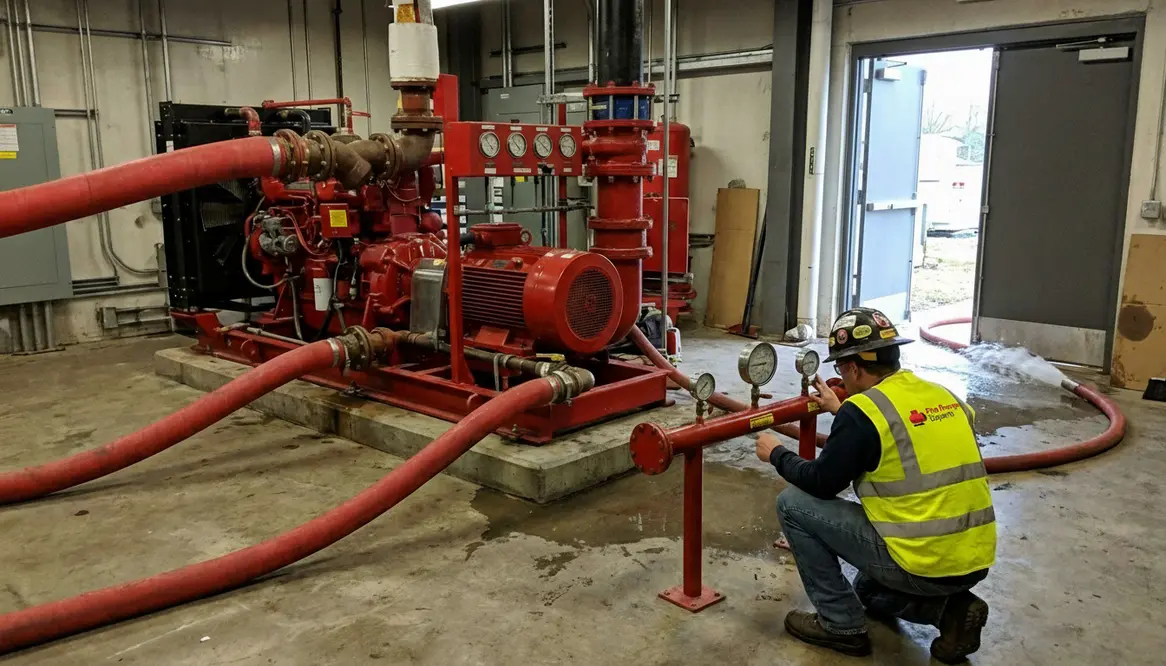
During a flow test, technicians direct water through test headers or flow meters. Then they measure performance at multiple points along the pump curve.
This test confirms whether the pump meets its rated capacity. In other words, it proves the system can actually supply the water volume engineers designed.
Flow Test
- Water actively flows from the system
- Technicians measure gallons per minute
- Performance is checked at several pressure points
- Reveals worn impellers, restrictions, or supply issues
- Simulates real fire demand conditions
Churn Test
- Pump runs with little or no water movement
- Pressure stability is measured
- Startup behavior is verified
- Identifies mechanical irregularities
- Requires minimal water discharge
Therefore, while both belong in the same testing program, they serve completely different diagnostic roles.
In large commercial properties across Philadelphia, flow tests often require careful planning. Water must discharge safely, gauges must be calibrated, and technicians must capture accurate readings.
Still, the information gained during this test is invaluable. It proves the pump can meet the exact demand needed to protect an entire building.
Why Commercial and Industrial Buildings Cannot Skip These Tests
I have walked through plenty of facilities where the pump room looked spotless. Fresh paint. Clean floors. Equipment shining under fluorescent lights.
However, appearances mean nothing if the pump cannot deliver water when called upon.
That is why property managers responsible for large structures treat annual testing seriously. Hospitals, manufacturing plants, logistics centers, and office towers carry enormous life safety responsibilities.
Moreover, insurance carriers and fire marshals expect documented proof that systems perform correctly.
If you want a deeper overview of how testing ties into national standards, resources like the NFPA 20 guidance on fire pump systems and periodic testing from Kord Fire Protection at their fire pump testing requirements guide can be helpful background reading.
Flow testing often uncovers problems that remain invisible during normal operation. For example, technicians might discover:
- Declining pump output
- Clogged suction piping
- Improper valve positioning
- Water supply limitations
- Controller issues
Meanwhile, churn tests reveal mechanical warning signs before they escalate into major failures.
Together, these inspections keep critical fire protection infrastructure dependable. And in a city packed with dense commercial buildings, dependability matters more than convenience.
Besides, discovering a problem during a controlled test is far better than discovering it while alarms echo through a building. That kind of surprise tends to ruin everyone’s day.
What Facility Managers in Philadelphia Should Expect During Testing
When planning a pump inspection program, facility teams should expect coordination, documentation, and experienced technicians.
First, the inspection team reviews pump ratings, system design, and historical records. Next, they perform the churn test to verify startup performance.
After that, technicians conduct the full flow test. Water moves through test headers while gauges track suction pressure, discharge pressure, and flow volume.
Then results are plotted against the pump’s rated performance curve. If the pump meets required output levels, the system passes.
If performance drops below acceptable thresholds, corrective action follows. Fortunately, many issues can be resolved through maintenance before they become system failures.
In other words, annual testing acts like a yearly physical for the heart of the fire protection system. No doctor waits until the patient collapses before checking blood pressure. The same logic applies here, especially when discussing the details of fire pump annual test philadelphia flow test vs churn test expectations with your testing provider.
FAQ: Fire Pump Testing for Large Buildings
Facility teams in Philadelphia often have similar questions about how the fire pump annual test philadelphia flow test vs churn test process fits into their overall fire protection strategy. The answers below keep it practical and focused on what happens in real buildings, not just in code books.
Conclusion
When it comes to life safety in major facilities, assumptions are dangerous and proof is priceless. The difference between a flow test and a churn test may sound technical, yet together they confirm whether your fire protection system will truly perform when it matters most.
If you manage a commercial or industrial building in Philadelphia, schedule professional testing and make sure your pump is ready long before the alarm bells ring. Treat the fire pump annual test philadelphia flow test vs churn test routine as a standing rehearsal for the one emergency performance you cannot afford to get wrong.