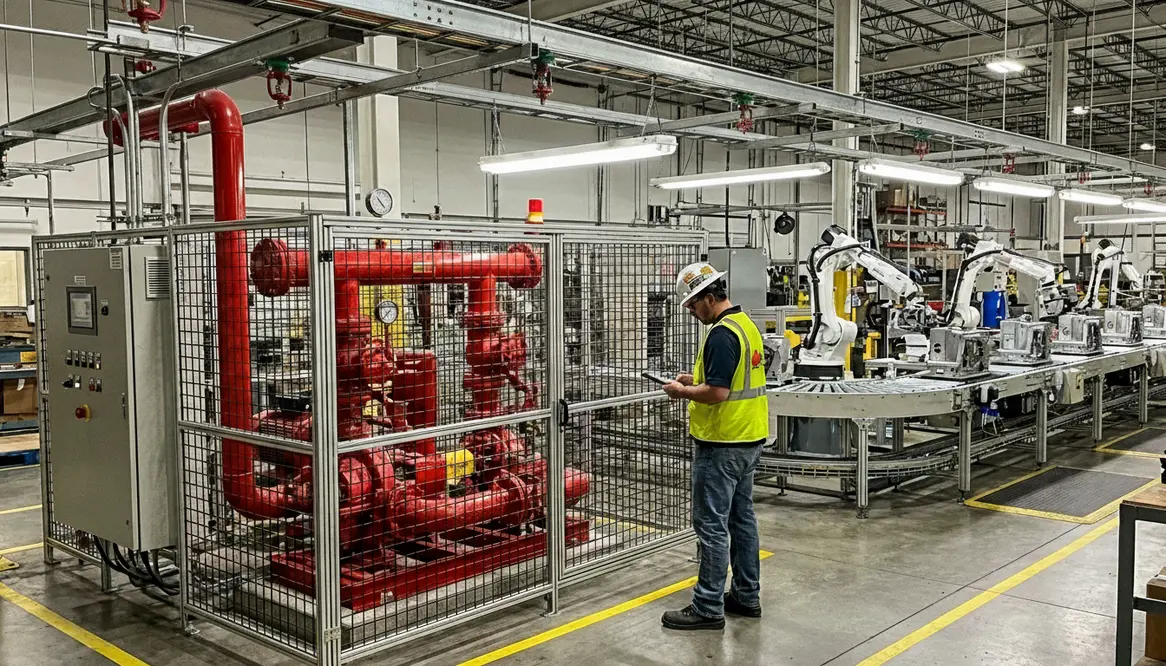
Fire Pump Planning for Component Assembly Facilities
Fire pump requirements for component assembly facilities
I have walked through enough component assembly floors to know this truth right away. repetition builds efficiency, but it also multiplies risk. That is where Fire pump planning for repetitive production spaces steps in early, quietly, and with purpose. In facilities where machines hum in rhythm and materials move in predictable cycles, fire protection cannot afford to be an afterthought. Instead, it must be engineered with the same discipline as the production line itself.
And yes, while fire pumps are not exactly the Avengers of building systems, when things go sideways, they are the ones you want showing up first.
What makes fire pump systems different in assembly facilities?
Component assembly facilities are not static environments. Equipment shifts, layouts evolve, and production volumes fluctuate. Because of this, I design fire pump systems with flexibility in mind. A standard approach simply does not hold up.
First, I account for consistent hazard zones. Since production lines repeat, fire load patterns tend to mirror each other. Therefore, water demand calculations must reflect simultaneous risk across multiple areas, not just isolated points.
Next, I consider uptime. These facilities rarely stop. So, redundancy becomes essential. A single fire pump system without backup is like relying on one coffee machine during a night shift. Eventually, something is going to break at the worst possible moment.
Finally, I align the system with applicable standards such as NFPA 20 and NFPA 13. However, I never treat compliance as the finish line. It is the baseline.
How I size fire pumps for repetitive production layouts
When I size a fire pump for an assembly facility, I start with demand, but I do not stop there. I evaluate how production repetition impacts simultaneous sprinkler activation.
For example, if multiple identical lines exist, I assume fire could impact more than one zone before suppression fully engages. As a result, I often design for higher flow rates than a typical commercial structure.
Additionally, I look at:
- Hydraulic demand overlap between adjacent production areas
- Material combustibility and storage integration
- Ceiling height and obstruction density
- Future expansion zones
Moreover, I factor in pressure stability. Assembly equipment often introduces obstructions that affect sprinkler discharge patterns. So, maintaining consistent pressure is critical for effective coverage.
Fire pump planning, layout coordination, and repetitive production spaces
Layout coordination is where many projects either shine or quietly fall apart. I have seen beautiful fire pump systems lose effectiveness simply because they were not aligned with the production floor.
In repetitive environments, I map fire protection zones directly to production modules. This way, each section operates as part of a coordinated system rather than a patchwork of coverage.
Also, I work closely with operations teams. They know where bottlenecks happen, where materials accumulate, and where heat builds up. That insight helps refine pump capacity and distribution strategies.
And let me be honest, ignoring operations input is like skipping the tutorial and jumping straight into a boss fight. It rarely ends well.
Design priorities
- Consistent pressure delivery
- Redundant pump configurations
- Scalable infrastructure
- Code compliance across all zones
Operational considerations
- Continuous production cycles
- Equipment heat output
- Material handling paths
- Maintenance accessibility
Power supply and reliability in industrial fire pump systems
A fire pump is only as reliable as its power source. In component assembly facilities, I never rely on a single power feed. Instead, I design for layered reliability.
Electric fire pumps must have dedicated feeders, protected routing, and backup power when required. Meanwhile, diesel pumps provide independence from the electrical grid, which can be a lifesaver during outages.
However, choosing between electric and diesel is not just technical. It is strategic. Electric pumps offer efficiency and lower maintenance, while diesel pumps bring resilience.
So, I often recommend a combination approach in large scale facilities. Because when production downtime costs thousands per minute, redundancy is not a luxury. It is survival.
Maintenance strategies that actually hold up over time
Even the best designed system can fail if maintenance falls short. In repetitive production spaces, I build maintenance access into the design from day one.
That means clear pathways, accessible valves, and monitoring systems that provide real time feedback. Additionally, I encourage facilities to adopt predictive maintenance tools.
Routine testing also plays a role. Weekly churn tests and annual flow tests are not optional. They are essential.
And yes, I know. No one wakes up excited to test a fire pump. But compared to the alternative, it is a pretty good deal.
Fire pump planning for repetitive production spaces and future proofing
Facilities grow. Production lines expand. Equipment evolves. So, I design fire pump systems that can grow with them.
This includes oversizing certain components, leaving room for additional pumps, and planning for increased water demand. Moreover, I integrate monitoring systems that can scale with facility upgrades.
Future proofing is not about guessing what comes next. It is about building enough flexibility to adapt when it does.
Because if there is one constant in industrial environments, it is change.
In all of this, Fire pump planning for repetitive production spaces becomes less of a checkbox and more of a strategic tool. When the system is shaped around how the facility actually works, it supports uptime, safety, and long term scalability instead of just occupying a mechanical room.
How Fire pump planning for repetitive production spaces supports operations
There is a direct line between well planned fire pumps and smooth operations on the floor. When discharge pressures are stable, sprinkler performance becomes predictable, which keeps minor incidents from turning into full blown shutdowns.
By tying Fire pump planning for repetitive production spaces to production data, like throughput rates and changeover frequency, the system can be tuned to match real world behavior. That reduces the chance that a reconfigured line or new storage area quietly outgrows the original protection strategy.
When the fire protection team, the operations team, and the maintenance crew all work from the same model of the facility, fire pumps stop being mysterious hardware in a distant room and become part of the performance story of the plant.
FAQ
Conclusion
If you are managing or developing a component assembly facility, now is the time to take fire protection seriously. I approach every project with precision, foresight, and a clear focus on performance. Let us build a fire pump system that works as hard as your production line. Connect with firepumps.org and ensure your facility is protected, compliant, and ready for whatever comes next.