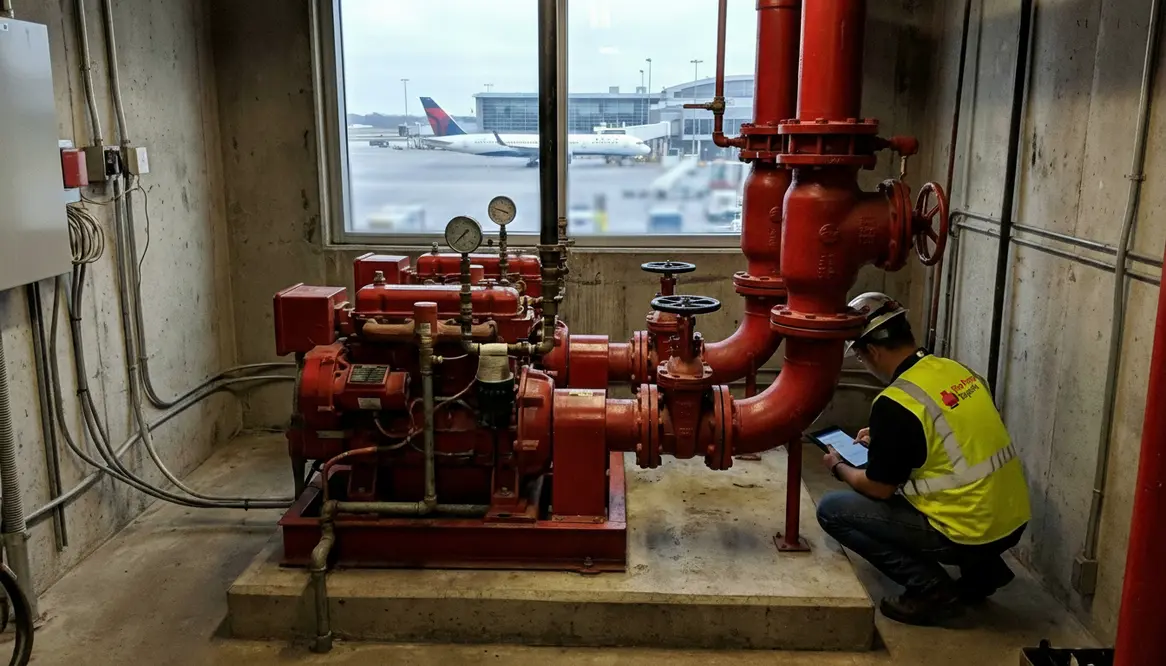
Fire Pump Requirements for Airport Hotels Guide
I have spent enough time around large commercial properties to know one thing for certain: when people travel, they rarely think about fire protection. They think about flight times, late check ins, and whether the coffee in the lobby is drinkable. Yet behind the scenes, Fire Pump Requirements for Airport Hotels quietly carry the weight of safety for hundreds, sometimes thousands, of guests every single day. And if those systems fail, well, suddenly nobody is worried about their frequent flyer miles anymore.
So let me walk you through what really matters, in a way that keeps you awake and maybe even entertained along the way.
Fire Pump Requirements for Airport Hotels: What Actually Matters Most
First, location changes everything. Airport hotels are not your average roadside inn. They operate at high occupancy, around the clock. Because of this, fire pump systems must deliver consistent pressure across large vertical and horizontal layouts.
More importantly, these systems must comply with strict commercial building standards. I always emphasize reliability over everything else. A fire pump that performs 99 percent of the time is still a liability. In this environment, it must perform every time.
Additionally, redundancy plays a critical role. Backup power sources, such as diesel driven pumps or emergency generators, ensure that even during a power outage, the system keeps working. And yes, outages do happen. Usually at the worst possible time, like a surprise plot twist in a thriller movie.
Finally, system testing cannot be treated as a formality. Regular flow testing and inspection keep the system honest. Think of it as a rehearsal before the big show, except the stakes are much higher.
How Do Fire Pumps Handle High Occupancy Buildings?
In simple terms, they do not get a break. Airport hotels run at near constant capacity, which means water demand during an emergency can spike quickly.
Therefore, I always recommend sizing fire pumps based on peak demand scenarios, not average use. Engineers must calculate flow rates that account for multiple sprinkler zones activating at once. Because in a real emergency, fire does not politely stay in one corner.
Moreover, pressure consistency across multiple floors becomes critical. Without it, upper levels may not receive adequate water flow. And trust me, gravity is not on your side here.
Another factor is system zoning. By dividing the building into zones, the pump can maintain pressure more effectively. It is a bit like managing traffic in a busy airport terminal. Without structure, everything turns into chaos.
Design Considerations That Go Beyond the Basics
Now, this is where things get interesting. Designing fire pump systems for travel centered lodging is not just about meeting code. It is about anticipating real world challenges.
For example, airport hotels often expand over time. Therefore, I always consider future capacity during the initial design phase. It is far easier to build with growth in mind than to retrofit later.
Additionally, noise control matters more than you might think. Guests may tolerate jet engines overhead, but a poorly isolated fire pump can still generate complaints. And nobody wants a review that says, “Great location, but the basement sounds like a spaceship taking off.”
Another overlooked detail is system accessibility. Maintenance teams need clear, safe access to pumps, controllers, and valves. If reaching the equipment feels like navigating a maze, inspections will suffer. And when inspections suffer, so does reliability.
Key Design Priorities
- Accurate demand calculations
- Future expansion capacity
- Noise and vibration control
- Accessible equipment layout
Operational Must Haves
- Reliable backup power
- Routine testing schedules
- Clear monitoring systems
- Trained maintenance personnel
Why Compliance Alone Is Not Enough
Here is a truth that does not always make it into brochures: meeting minimum code requirements is just the starting point.
While codes define baseline expectations, high traffic properties demand more robust solutions. I often see systems that technically pass inspection but lack resilience under real stress conditions.
Therefore, I encourage property owners to go beyond compliance. Invest in higher quality components. Implement advanced monitoring systems. Train staff thoroughly. Because when an emergency occurs, there is no time to figure things out.
And besides, cutting corners on fire protection is like bringing a spoon to a sword fight. Technically, you showed up, but the outcome is not looking great.
Fire Pump Requirements for Airport Hotels in Modern Developments
Modern airport hotels are evolving rapidly. With smart building systems and integrated safety networks, fire pumps are no longer standalone components.
Instead, they connect with centralized monitoring platforms that provide real time data. This allows facility managers to detect issues early and respond quickly.
Furthermore, sustainability is becoming a factor. Efficient pump designs and optimized water usage help reduce environmental impact without compromising performance.
However, technology should support reliability, not replace it. I always remind clients that a smart system is only as good as its maintenance plan. Even the most advanced setup still needs regular human oversight.
Where Fire Pump Requirements for Airport Hotels Hit Reality
This is where theory meets the chaos of real travel schedules, late arrivals, and full occupancy. Fire Pump Requirements for Airport Hotels must support 24/7 operation, constant turnover, and a building that rarely sleeps. Pumps, controllers, and backup systems are expected to run quietly in the background while every other system in the building is being pushed to its limits.
In practice, that means designing for worst case scenarios: multiple alarms, simultaneous sprinkler activation, power fluctuations, and limited time for on site teams to react. Fire Pump Requirements for Airport Hotels are not just technical checkboxes; they are the backbone of life safety during the most stressful possible conditions.
FAQ: Fire Pump Considerations for Travel Centered Lodging
These are some of the most common questions that come up when planning or upgrading systems in properties that sit just a shuttle ride away from the terminal.
Final Thoughts That Actually Matter
If you manage or develop airport hotels, do not treat fire pump systems as background infrastructure. They are front line protection, quietly standing guard while everything else takes the spotlight. Investing in strong design, consistent maintenance, and forward thinking upgrades ensures safety and operational continuity. If you are ready to strengthen your property’s fire protection, now is the time to act. Because in this business, preparation is not optional. It is everything.