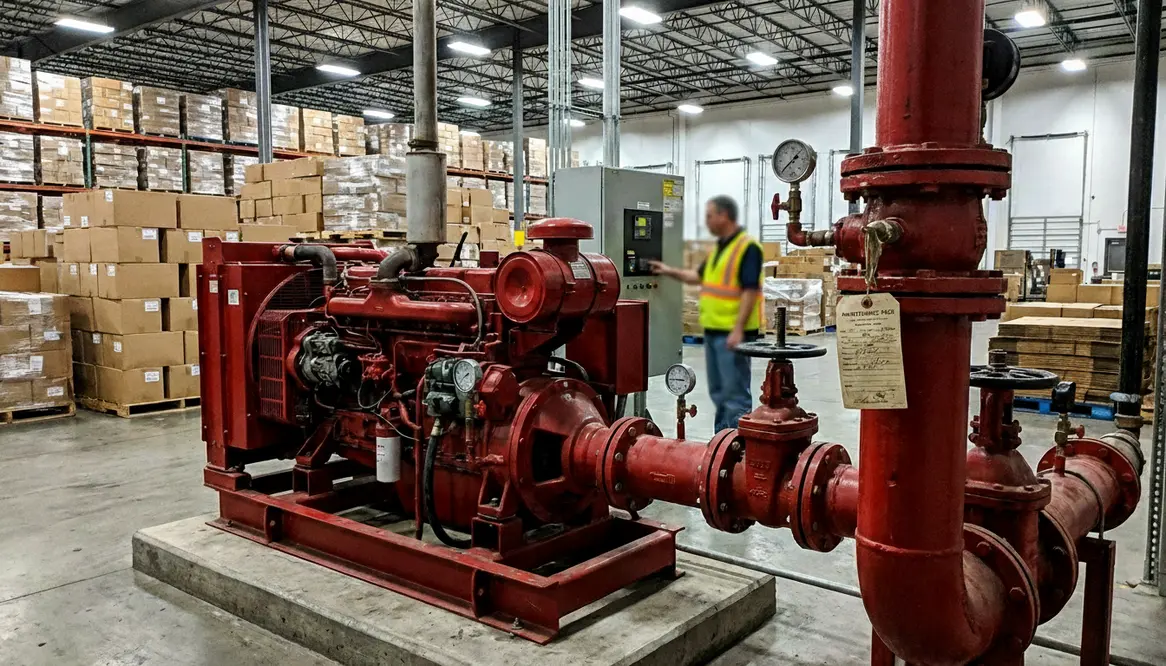
Fire Pump Requirements for Distribution Hubs
What it takes to keep high-velocity distribution hubs protected, pressurized, and ready for the worst day imaginable.
I’ve spent years walking through distribution hubs that hum like beehives and move goods like clockwork. And yet, beneath all that motion, there’s one system that quietly stands ready for the worst day imaginable: fire protection. More specifically, the backbone of it all, the fire pump. When I talk about class A office fire protection, I’m not just thinking about paperwork or tidy office corridors. I’m thinking about the same level of precision and reliability applied to vast industrial spaces where one spark could rewrite the day in seconds.
So let’s slow things down, take a closer look, and unpack what fire pump requirements really mean for distribution hubs. And yes, I promise to keep it more interesting than watching a loading dock at 3 a.m.
What fire pump requirements apply to distribution hubs?
At the core, fire pump requirements in distribution hubs revolve around ensuring consistent water pressure and flow, even when municipal supply taps out. These facilities are large, often sprawling, and filled with combustible materials stacked higher than your average movie villain’s ego.
Because of that, I always look at three critical factors first: water supply reliability, system demand, and code compliance. NFPA standards guide most of these requirements, especially NFPA 20 for fire pumps and NFPA 13 for sprinkler systems.
Why codes are only the starting line
It’s not just about checking boxes. Distribution hubs demand systems that can respond instantly and sustain performance over time. Therefore, fire pumps must be sized correctly, tested regularly, and integrated seamlessly with suppression systems.
Performance when seconds matter
In other words, if your system hesitates, you’re already behind. For facilities that expect the same discipline as class A office fire protection across their campus, hesitation is not an option.
How do I size a fire pump for a large distribution facility?
Now this is where things get interesting. And by interesting, I mean math, flow curves, and decisions that engineers quietly lose sleep over.
Start with hazard classification
I always start with hazard classification. Distribution hubs often fall under Ordinary Hazard Group 2 or even Extra Hazard depending on storage height and materials. As a result, required flow rates can climb quickly.
Match demand with supply
Then I calculate total system demand. This includes sprinkler discharge, hose allowances, and any special suppression systems. After that, I compare that demand to available water supply.
If the city supply can’t keep up, and spoiler alert, it often can’t, that’s where the fire pump steps in like a superhero who doesn’t wear a cape but definitely deserves one.
Key inputs I evaluate
- Hazard classification
- Sprinkler density requirements
- Storage configuration
- Water supply test results
What I deliver
- Accurate pump sizing
- Reliable pressure output
- Compliance with NFPA standards
- System longevity
And yes, getting this wrong is like casting the wrong actor as Batman. It just doesn’t end well for anyone involved.
Power sources and redundancy planning for fire pumps
Once I’ve nailed the sizing, I turn my attention to power. Because a fire pump that doesn’t run is just an expensive paperweight.
Choosing the right driver
Electric pumps are common, especially in facilities with stable power. However, I often recommend diesel driven pumps for distribution hubs. Why? Because power outages and fires have a nasty habit of showing up together.
Redundancy that actually works
Additionally, redundancy becomes critical. Backup power sources, automatic transfer switches, and controller reliability all come into play. A well designed system ensures that even if one component fails, the pump still runs.
It’s a bit like having a backup quarterback. You hope you never need them, but when you do, you really do.
Integration with broader class A office fire protection systems
Even though distribution hubs are industrial in nature, I often see administrative offices attached to these facilities. That’s where class A office fire protection blends into the larger system.
Balancing offices and warehouses
Integration matters. Fire pumps must support both warehouse suppression systems and office sprinkler networks without compromising performance. Therefore, zoning, pressure regulation, and system balancing become essential.
Unified detection and response
Moreover, I make sure alarm systems, monitoring, and controls are unified. When something triggers, everyone needs to know immediately. No delays. No confusion.
Think of it like an orchestra. Every instrument must come in at the right time, or the whole thing falls apart. When you treat the complex mix of warehouse storage, loading docks, and office suites with the same rigor as class A office fire protection, that orchestra actually sounds the way it should.
Maintenance expectations that keep systems reliable
Now here’s the part most people underestimate. Installation is only half the story. Maintenance is where reliability lives or dies.
Testing that isn’t optional
I always emphasize routine testing. Weekly churn tests, monthly inspections, and annual flow tests are not optional. They are essential.
Catching problems before they catch you
Additionally, I look for signs of wear. Seal leaks, unusual vibrations, and controller faults can all signal trouble ahead. Addressing these early prevents failures when it matters most.
And let’s be honest, nobody wants their fire pump’s big debut to be during an actual fire. That’s not a dress rehearsal you want to skip.
Common mistakes I see in distribution hub fire pump design
Over the years, I’ve seen a few patterns. Some are minor. Others are the kind that make you pause and stare at the ceiling for a moment.
Mistake 1: Undersized pumps
First, undersized pumps. This happens when future expansion isn’t considered. Distribution hubs grow, and systems need to grow with them.
Mistake 2: Poor placement
Second, poor placement. Fire pumps should be accessible, protected, and located in dedicated rooms. Not tucked away like forgotten gym equipment.
Mistake 3: Lack of coordination
Third, lack of coordination. When fire protection systems are designed in isolation, conflicts arise. Therefore, collaboration between engineers, contractors, and facility managers is crucial.
Fixing these issues early saves time, money, and more importantly, risk. Treating industrial buildings and attached office components with a mindset similar to class A office fire protection helps keep these mistakes from creeping in during fast-track projects.
FAQ
Bringing it all together
When I look at a distribution hub, I don’t just see racks, forklifts, and inventory. I see a complex environment that demands precision, planning, and resilience. Fire pump systems sit at the center of that equation, quietly ensuring everything else has a fighting chance.
If you’re planning, upgrading, or evaluating your system, now is the time to act. Reach out, take a closer look, and make sure your protection strategy is built to perform when it matters most. Whether you are chasing best-in-class warehouse safety, or you expect the polished reliability you associate with class A office fire protection applied across your whole site, the fire pump is the last place to cut corners.
For deeper technical guidance and resources on pumps, drivers, and standards, you can explore references from organizations like https://firepumps.org as you refine your design and maintenance strategy.