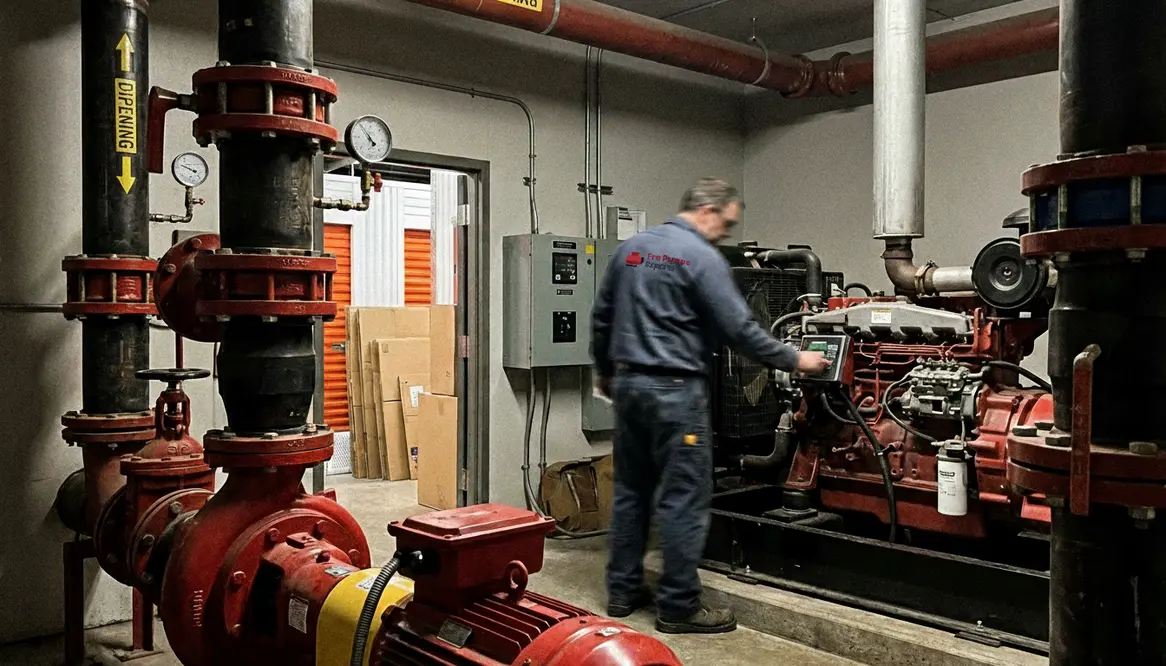
Fire Pump Requirements for Self Storage Facilities
Self storage facilities quietly depend on the same level of fire protection muscle you see in busy commercial properties. The difference is that instead of protecting weekend shoppers, they are protecting people’s memories, side hustles, and occasionally some very questionable life decisions in cardboard boxes.
When I talk about fire protection, I like to start where most people least expect it. Not with alarms or sprinklers, but with the quiet workhorse behind it all. Yes, I am talking about strip mall fire pumps. Now, you might be thinking, “What do strip malls have to do with self storage?” Fair question. The answer is simple. The same level of reliability demanded in high traffic retail centers applies just as much, if not more, to self storage facilities. After all, people store their lives in those units. And fire does not care if it is a box of old holiday decorations or a priceless collection of vintage comic books. It just burns.
So let me walk you through what actually matters when it comes to fire pump requirements for self storage facilities, without putting you to sleep in the process.
What fire pump requirements apply to self storage facilities?
I will give it to you straight. Fire pump requirements are not optional suggestions. They are driven by codes like NFPA 20 and NFPA 13. However, the real goal is simple. Maintain enough water pressure to support your sprinkler system at all times.
Most self storage properties, especially multi story or climate controlled buildings, cannot rely on municipal water pressure alone. That is where a fire pump steps in. It boosts water flow so sprinklers perform exactly as designed.
In practice, I look at three core factors:
- Building size and height because taller buildings demand more pressure
- Hazard classification since stored contents can vary widely
- Water supply reliability because city systems are not always dependable
And yes, just like with strip mall fire pumps, consistency is everything. A system that works only on a good day is not a system. It is a liability.
Designing for real world storage risks
Now here is where things get interesting. Self storage is not as predictable as an office building. One unit might hold furniture, another might hide stacks of paper, and the next could be packed with who knows what. I have seen units that look like the final scene of a hoarding reality show.
Because of that, I always design with a margin of safety. Fire pumps must support higher demand scenarios, not just average ones. Additionally, climate controlled facilities introduce enclosed environments where fire can spread faster before detection.
Therefore, I focus on:
- Higher density sprinkler demand
- Redundant pump reliability
- Consistent pressure across all units
It is not about overbuilding. It is about avoiding the moment when everything fails at once. And trust me, fire loves bad timing.
How do I choose the right fire pump system?
I like to think of this as casting the right actor for the role. You would not cast a sitcom comedian in a serious drama, unless you are going for chaos. The same logic applies here.
Fire pumps generally fall into a few categories. Electric, diesel, and sometimes vertical turbine systems. Each has its place depending on the facility.
Electric Fire Pumps
- Reliable and efficient
- Best where power supply is stable
- Lower maintenance overall
Diesel Fire Pumps
- Operate during power outages
- Ideal for critical facilities
- Require more maintenance
In many commercial storage properties, I lean toward diesel backups or dual systems. Because when the lights go out, the fire does not politely wait for them to come back on.
Installation and layout that actually works
Let me say this clearly. A fire pump is only as good as its installation. I have seen top tier equipment fail because someone treated layout like an afterthought.
The pump room must be accessible, protected, and properly ventilated. Furthermore, suction and discharge piping must follow strict design rules to prevent pressure loss.
I also pay close attention to:
- Controller placement for easy access
- Test headers to verify performance
- Isolation valves for maintenance without shutdown
And yes, the same disciplined approach used in strip mall fire pumps applies here. Different building, same expectation. No shortcuts.
Maintenance is where most systems fail
This is the part nobody gets excited about, yet it matters the most. A fire pump that is not maintained is like a gym membership you never use. It sounds good on paper, but it will not save you when it counts.
I stick to a strict testing schedule. Weekly churn tests, monthly inspections, and annual full flow testing. Not because the code says so, although it does, but because real reliability demands it.
Additionally, I recommend professional servicing for commercial and industrial properties. These are not systems you want handled casually. One overlooked issue can compromise the entire building.
And if you are wondering, yes, this is where most failures happen. Not during design. Not during installation. During neglect.
Why reliability from retail carries over to storage
If you have ever worked with systems used in busy shopping centers, you already understand what reliable looks like. Strip mall fire pumps do not get much glory, but they are expected to perform perfectly after long periods of quiet. Self storage facilities deserve that same standard, and then some.
The challenge is that storage tenants change constantly, contents are unpredictable, and nobody walks the aisles thinking about fire conditions. That is exactly why the infrastructure behind the scenes needs to be built and maintained with the same seriousness you would see in a well designed commercial center.
Whether we are talking about strip mall fire pumps or systems serving a four story climate controlled storage building, the mission stays the same: steady water, steady pressure, and no surprises when the alarms sound.
FAQ: Fire Pump Requirements for Self Storage
Closing thoughts and next steps
If you own or manage a self storage facility, the fire pump is not just another piece of equipment. It is the backbone of your entire fire protection strategy. I take these systems seriously because the stakes are high and the margin for error is thin. If you want a system that performs when it matters most, partner with professionals who understand commercial scale fire protection inside and out. The right design today prevents a disaster tomorrow.
If you are weighing options or comparing designs, look for teams that treat your project with the same rigor they would bring to busy retail centers built around strip mall fire pumps, hospitals, or industrial plants. That level of thinking, applied to your rows of quiet roll-up doors, is what keeps small fires from turning into headline stories. For more technical resources, you can start with industry guides at https://firepumps.org and then match those best practices to the real world layout of your specific facility.