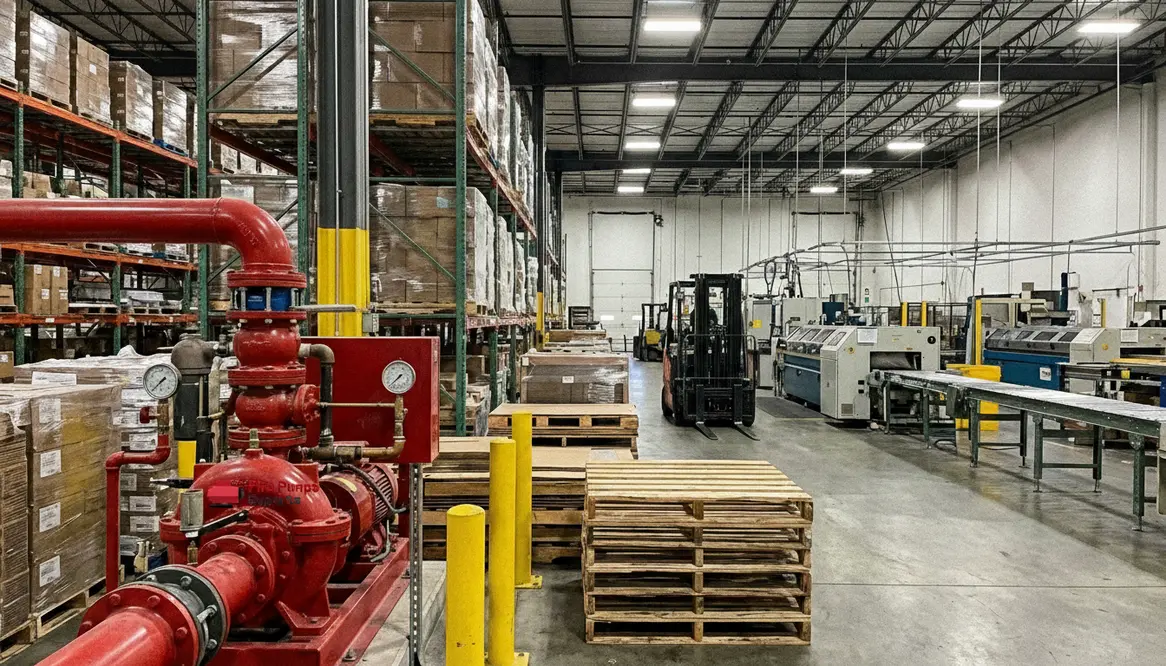
Fire Pump Systems for Hybrid Storage Warehouses
Where storage meets manufacturing, fire protection has to work harder, react faster, and cover more complexity than in a simple box of shelves.
I have spent years around production floors where machines hum, forklifts dance in tight aisles, and inventory stacks high enough to make you question gravity itself. In these environments, Fire protection for hybrid storage and manufacturing is not just a requirement, it is a quiet guardian. Fire pump systems sit at the heart of that protection, ready to act faster than any human could. And while they do not wear capes, they are about as close to superheroes as a warehouse gets.
Why fire pump systems matter in production warehouses
Let me say it plainly. Warehouses that blend storage and manufacturing carry layered risks. You have raw materials, active machinery, electrical systems, and human movement all sharing space. Therefore, when a fire starts, it does not politely stay in one corner.
A fire pump system ensures water moves with enough pressure and volume to control or suppress a fire immediately. Without it, even the best sprinkler system becomes a garden hose trying to stop a volcano. And yes, I have seen systems that were installed without proper pump support. It is not pretty.
Moreover, these systems support integrated fire safety for mixed use industrial spaces, ensuring that both stored goods and active production lines receive equal protection.
How do fire pump systems actually work in large facilities
I get this question a lot, and honestly, it is a good one. A fire pump system is not just a big pump sitting in a room waiting for applause.
When pressure drops in the sprinkler system, the pump activates automatically. It pulls water from a reliable source, usually a tank or municipal supply, and pushes it through the system at a controlled, powerful rate.
In large production warehouses, this matters because distance is the enemy. Water needs to travel across wide spaces, up high racks, and sometimes into areas packed tighter than a rush hour subway.
Additionally, modern systems include controllers, backup power, and monitoring tools. So even if the power goes out, which fires have a funny habit of causing, the system keeps running.
Designing fire protection for hybrid storage and manufacturing spaces
Balancing fuel load, layout, and operations
Design is where things get interesting. And by interesting, I mean where mistakes can get expensive very quickly.
In hybrid environments, I always consider three factors. Fuel load, layout complexity, and operational flow. Each one affects how the fire pump system must perform.
For example, high piled storage increases water demand. Meanwhile, active manufacturing zones may require faster response times due to ignition risks from machinery.
Because of this, Fire protection for hybrid storage and manufacturing must be tailored, not copied from a standard template. One size fits all works for socks, not for fire systems.
Smart design also means thinking about how people, forklifts, and materials move through the space, and how those movements might change water demand during an actual fire.
Common mistakes I see and how to avoid them
I have walked into facilities where the fire pump system looked impressive but failed in practice. It is like owning a sports car that cannot start. Looks great, does nothing.
Common mistakes
- Undersized pumps for warehouse scale
- Poor maintenance schedules
- Ignoring system testing requirements
- Improper integration with sprinklers
Better approaches
- Match pump capacity to hazard level
- Schedule routine inspections
- Run full flow tests regularly
- Coordinate system components early
In addition, facilities often underestimate future expansion. I always recommend planning ahead. Because tearing out a system later is about as fun as rewatching a bad sequel no one asked for.
Maintaining reliability in industrial fire pump systems
Routine attention beats emergency improvisation
Even the best system needs attention. Fire pumps are not set it and forget it equipment. They require routine testing, inspection, and occasional upgrades.
I advise weekly or monthly checks depending on system type. These tests confirm that the pump starts correctly, maintains pressure, and communicates with the rest of the system.
Furthermore, maintenance supports fire safety solutions for combined warehouse and production facilities by ensuring reliability when it matters most. Because during a fire, there is no time for troubleshooting.
And let us be honest. The only surprise you want during a fire emergency is how well your system performs.
What should I consider before installing a fire pump system
Laying the groundwork for resilient protection
If you are planning a new installation, I always suggest starting with a hazard analysis. Understand your materials, processes, and storage configurations.
Next, evaluate your water supply. Not all sources provide consistent pressure. That is where fire pumps prove their value.
Finally, work with experienced professionals who understand large scale industrial environments. Because installing a system for a small office and designing one for a production warehouse are two very different challenges.
The goal is straightforward: Fire protection for hybrid storage and manufacturing that remains robust as your business grows, shifts, and adds new production technologies.
Hybrid storage, manufacturing, and the role of fire pumps
Why “hybrid” changes the rules
In a purely storage warehouse, you might only worry about rack heights, commodity classifications, and aisle spacing. In a purely manufacturing plant, you are focused on machinery, process hazards, and utilities. When both live under one roof, everything overlaps.
This overlap is where Fire protection for hybrid storage and manufacturing earns its keep. Fire pumps must be sized and configured not only for today’s sprinkler demand but also for process changes, new equipment, and evolving storage strategies that may quietly increase the water you need during an emergency.
Add in battery charging areas, flammable liquids, or specialized production cells, and the need for reliable, high-performance fire pumps becomes non-negotiable.
Done right, Fire protection for hybrid storage and manufacturing quietly supports business continuity, keeps insurers calmer, and lets your operations team sleep better at night.
FAQ
Conclusion
When I look at a production warehouse, I do not just see operations. I see risk, responsibility, and the need for systems that perform without hesitation. Fire pump systems deliver that reliability, forming the backbone of effective protection.
If you are managing a commercial or industrial facility, now is the time to assess your setup, strengthen your defenses, and ensure your fire protection strategy is ready for anything. Because in this business, preparation is everything, especially when you rely on Fire protection for hybrid storage and manufacturing to keep people, assets, and productivity safe.