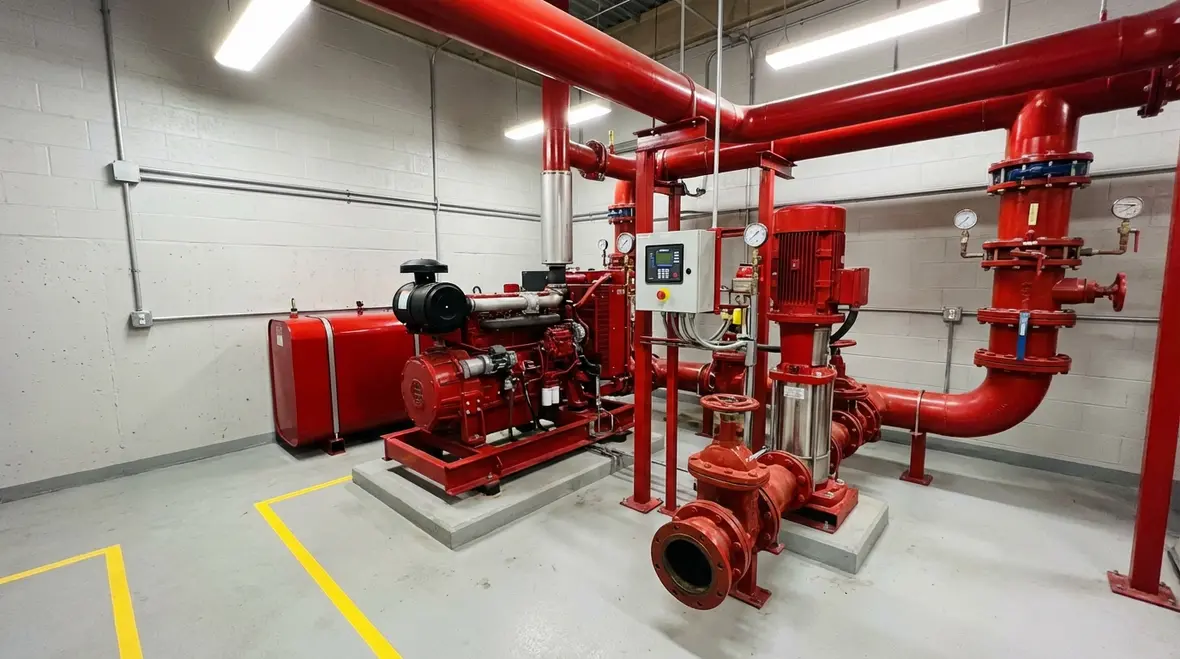
NFPA 20 Compliance for Commercial Fire Pump Systems
NFPA 20 Compliance for Commercial Fire Pump Installations
Let me take you on a journey. A journey through steel pipelines, diesel engines, and the comforting hum of a properly primed fire pump. Now, don’t roll your eyes just yet. I promise you, by the end of this article, you’ll not only grasp the importance of NFPA 20 compliance for commercial fire pump installations—you might even smile along the way.
Here at FirePumps.org, we don’t just install commercial fire pump systems—we live and breathe them. And that means treating every installation like it’s got to survive an action scene from a Mission Impossible film. Because in a real fire, you’ve got zero room for error and a massive need for power, pressure, and precision.
So, buckle up. We’re diving deep into the meat (and potatoes) of NFPA 20. But don’t worry, we’ll keep it smooth, like a bedtime story read in the calmest possible voice… about pump curves and relief valves.
Understanding NFPA 20: It’s Not Just Fire Code, It’s Fire Gospel

NFPA 20 is the go-to standard for the installation of stationary pumps for fire protection. It’s issued by the National Fire Protection Association and—get this—it’s not a suggestion. It’s a rulebook. A manual. A 150-page guardian angel that ensures your fire suppression system doesn’t just look good on paper but works when your commercial property truly needs it.
That’s why for us, every installation is about meeting, and often exceeding, those requirements. Think of it as following the sacred recipe for crème brûlée. Miss one step, and you’re left with burnt sugar and tears. Except in this case, it’s not your dessert on the line. It’s the safety of an entire building and the businesses inside it.
Key aspects of NFPA 20 include:
- Proper sizing and selection of fire pumps
- Acceptable pump types (centrifugal, vertical turbine, etc.)
- Alignment with power supplies and controllers
- Water supply reliability
- Testing, maintenance, and access procedures
It’s an intricate dance of engineering, not a tap-dance from some cable TV DIY show. One misstep, and your whole system could be out of compliance—or worse, out of commission.
How Do NFPA 20 Standards Affect My Commercial Building?
If you own, manage, or operate a commercial or industrial-scale building—say, a data center, hospital, high-rise, or ginormous warehouse—NFPA 20 isn’t just a regulation, it’s your playbook for staying fire-safe, insurance-okay, and lawsuit-free.
The bottom line? Non-compliance can void insurance policies, halt occupancy permits, and open you up to enough legal trouble to make Saul Goodman nervous. It can also cost lives and livelihoods. And if your building has more square footage than a football field, that’s a big “no thanks.”
Real-world implications of non-compliance:
- Insurance companies denying claims post-incident
- AHJs (Authorities Having Jurisdiction) slapping on fines
- Delayed CO issuance slowing down your Grand Opening
- Increased liabilities for building ownership and investors
Compliance ensures you’re ready for worst-case scenarios. It’s not just about following rules—it’s about being responsibly prepared.
The Most Common Mistakes We Fix (So You Don’t Have To)
Let me guess. You hired a contractor recommended by your friend’s cousin from TikTok, and now your fire pump room looks like the inside of Doc Brown’s DeLorean? Don’t worry. We’ve been there. Well, not literally, but metaphorically—in messy, code-violating pump rooms across America’s commercial heartland.
Here are the most “classic” fire pump fails we see:
- Incorrect Pump Location: Tucked behind storage shelves like an afterthought. NFPA 20 demands secure, accessible, ventilated spaces—not broom closets.
- Improper Water Supply Gravity or Pressure: Everyone loves gravity, but if your suction supply can’t maintain volume and pressure during fire conditions, you’re not compliant.
- Pump Too Small for Demand: Size matters here. If the curve doesn’t meet your peak design demands, your protection is just paperwork.
- No Automatic Transfer Switch (ATS): Backup power should exist—not just in optimistic facility plans from 2013.
Every flaw can cost time, money, and peace of mind. And unfortunately, they’re often only noticed during inspections or, worse, a real incident.
Why Accurate Sizing and Installation Are the Real Superheroes
You could install the Bat-Signal on your roof, but if your fire pump is underpowered, even Bruce Wayne can’t save you. Fire pumps need to match the required system hydraulic demand with deadly precision. Undersizing leads to underperforming. Oversizing leads to inefficiencies, wasted fuel, and… well, the fire protection equivalent of buying a Hummer to drive across the street.
How we ensure proper fire pump sizing:
- Site-specific hydraulic calculations
- Evaluation of demand curves under expected worst-case conditions
- Choosing the right pump type: horizontal split-case, vertical turbine, or end suction (we don’t discriminate, we assess)
- Properly rated controllers and power sources
Bottom line: Fire pumps aren’t “install and forget.” They’re engineered solutions that must be tailored like a bespoke suit. A very red, very industrial, life-saving bespoke suit.
Dual Column Snapshot: Electric vs Diesel Fire Pumps
Diesel Fire Pumps
- Independent power source
- NFPA requires fuel storage for at least 8 hours
- Ideal where electrical reliability is a concern
- More maintenance due to moving parts
Electric Fire Pumps
- Quieter and more efficient operation
- Require reliable backup power (generator/ATS)
- Lower maintenance compared to diesel
- Limited in areas prone to outages or power surges
Choosing your type isn’t about preference. It’s about suitability, redundancy, and how well your building’s infrastructure supports it. Kind of like choosing between Iron Man’s Mark I and his nanotech suit, but with less flying and more pumping.
Inspection, Testing, and Record-Keeping: The Often-Ignored MVPs
Your fire pump system doesn’t just need to work. It needs to prove it works—anytime, every time. That’s where inspection and testing under NFPA 25 guidelines (which go hand-in-hand with NFPA 20) come in.
Every commercial property should have a scheduled plan for weekly, monthly, and annual tests. That means:
- No more “set it and forget it” thinking
- Sign-off sheets that’d make NASA jealous
- Detailed performance logs over time
Remember: if it’s not documented, it didn’t happen. Even if your pump roared to life like Optimus Prime during last week’s test, your AHJ won’t care unless it’s in writing.
NFPA 20 in 2026: What’s Coming Down the Pipeline?
As of the latest edition (2022 with minor 2025 updates), more attention is being paid to digital integration, remote monitoring systems, and cybersecure controllers. Yes, even fire pumps need to protect their firewalls now. In upcoming years, expect stricter guidelines around tech-based reporting, system redundancy, and energy efficiency.
If your fire pump room still has a dusty clipboard labeled “DO NOT OPEN,” it may be time to trade up.
Frequently Asked Questions
Conclusion
NFPA 20 compliance for commercial fire pump installations isn’t just a checkbox—it’s the backbone of any reliable fire protection strategy. From choosing the right pump to installing, testing, and documenting everything, every step matters. Whether you’re building a skyscraper or managing a data warehouse, do it right. Do it safe. Let FirePumps.org be your partner for expert code-compliant installations that protect lives and assets without compromise. Ready to take the next step? Reach out to us today and let’s fireproof your future.