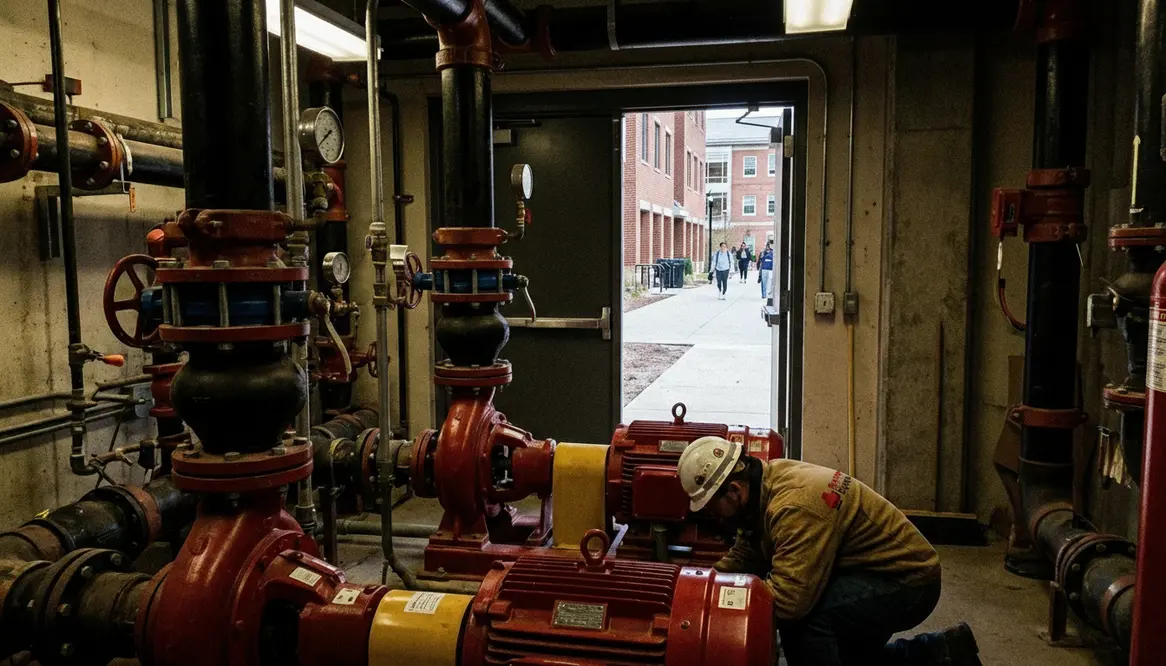
Fire Pump Systems for College Campus Buildings
I have walked through enough higher education campuses to know one thing for certain: behind the ivy covered walls and late night study sessions, there is a quiet, relentless system standing guard. Fire Pump Systems for College Campus Buildings are not glamorous. They do not get scholarships or applause. Yet, when things go sideways, they are the difference between a close call and a catastrophe. And trust me, when you are managing a campus with thousands of students, “close enough” is not a strategy.
Why campuses demand more from fire protection systems
College campuses are not simple buildings. They are small cities pretending to be peaceful learning spaces. You have laboratories, dormitories, libraries, stadiums, and dining halls all operating at once. Because of that, the demand on fire protection infrastructure is constant and complex.
So, I look at fire pump systems for educational facilities as the backbone of safety. They must deliver consistent water pressure across large footprints. More importantly, they must respond instantly, even during peak demand or power interruptions. In other words, this is not the place for guesswork or budget shortcuts.
Additionally, campuses expand. New buildings rise, old ones get repurposed, and suddenly the original system is playing catch up like an underdog in a sports movie. Except here, there is no inspirational montage to save the day.
What makes Fire Pump Systems for College Campus Buildings unique
The design requirements here are not your typical commercial setup. I have seen systems fail simply because they were not built for scale. A campus requires layered protection, redundancy, and precise engineering.
High occupancy density
Thousands of people move through buildings daily. That means faster response times and stronger water flow are essential.
Diverse building types
Science labs need different protection than dorms. A one size system does not cut it.
Extended infrastructure
Long pipe networks increase pressure loss. Pumps must compensate without hesitation.
Critical uptime
Failure is not an option. Redundancy and backup power are standard, not optional.
Because of these factors, I always recommend systems that are tailored, tested, and scalable. Otherwise, you are building a safety net with holes in it.
How do I size a fire pump system for a large campus?
Good question. And thankfully, not one that requires a crystal ball.
Start with hazard classification
I start with hazard classification. Laboratories, for example, increase risk levels compared to administrative buildings. Then, I calculate the required flow rate and pressure based on the most demanding scenario, not the average day. Because fires, much like surprise exams, rarely show up when convenient.
Check water supply and plan ahead
Next, I evaluate water supply reliability. If municipal pressure is inconsistent, the pump system must carry more of the load. After that, I account for future expansion. It is always cheaper to plan ahead than to retrofit later.
Code compliance is non-negotiable
Finally, I ensure compliance with NFPA standards and local codes. Not because it looks good on paper, but because it saves lives in practice.
Common pitfalls I see in campus fire pump planning
Even experienced teams can miss the mark. And when they do, the consequences tend to be expensive.
Undersized or poorly integrated systems
First, undersized pumps. They may pass initial inspections but struggle under real demand. Second, poor integration with alarm and sprinkler systems. If these components do not communicate well, response times suffer.
Maintenance neglect
Then there is maintenance neglect. A fire pump system is not a “set it and forget it” situation. It needs regular testing, inspection, and documentation. Otherwise, you are relying on hope. And hope is not listed in any fire code I have ever read.
Forgetting backup power
Lastly, ignoring backup power. If the grid goes down during an emergency, your system should not follow it into darkness.
Fire Pump Systems for College Campus Buildings and long term reliability
Reliability is not built overnight. It is designed, installed, and maintained with intention.
I always emphasize routine testing. Weekly churn tests and annual flow tests are not just checkboxes. They reveal issues before they become headlines. In addition, smart monitoring systems now allow facilities teams to track performance in real time. That means fewer surprises and faster responses.
Moreover, investing in quality components pays off. Cheaper parts might save money upfront, but they tend to fail when it matters most. It is like bringing a plastic spoon to a sword fight. Technically, you showed up, but you are not winning.
Ultimately, a reliable system protects more than property. It protects reputation, continuity, and peace of mind. Fire Pump Systems for College Campus Buildings should be treated as mission critical infrastructure, not an afterthought tucked away in a mechanical room.
FAQ: Fire pump systems on campus
Conclusion
If you are responsible for a college campus, then you already know the stakes are high and the margin for error is thin. I encourage you to take a closer look at your fire pump infrastructure and ask the hard questions now, not later. The right system does more than meet code. It protects lives and keeps operations running.
Reach out to experts who specialize in large scale commercial properties and make sure your campus is ready for anything. Treat Fire Pump Systems for College Campus Buildings as critical infrastructure that deserves the same attention as data networks, power systems, and laboratories. When the alarm sounds, you want more than luck on your side. You want a system that was built, tested, and maintained to perform when it matters most.