Fire Pump Backup Power Solutions for Commercial Buildings
When the lights go out, the fire pump does not get a grace period. It either runs instantly, or the building takes its chances. In commercial and industrial settings, that is not a gamble anyone should be comfortable with.
Fire Pump Backup Power Options for Commercial and Industrial Buildings
I have spent enough time around mechanical rooms and fire protection systems to know one simple truth. When the power goes out, the fire pump still needs to run. Not maybe. Not eventually. Immediately.
That is exactly why fire pump backup power solutions exist. In large commercial facilities, industrial plants, hospitals, data centers, and high rise properties, a fire pump cannot depend on the local grid alone. Storms roll in. Transformers fail. Someone digs where they should not. Suddenly the lights go dark and the sprinkler system needs serious pressure.
Therefore, backup power becomes the silent hero of the building. It waits quietly for years, then springs to life when things get dramatic. Think of it as the action movie sidekick. The hero might get the spotlight, but the sidekick is the one carrying the extra ammo.
In this guide, I will walk through the major backup power options used in commercial fire protection systems. Along the way, we will look at how they work, when they make sense, and why facility managers sleep better at night when the right system is in place.
Why Commercial Buildings Cannot Rely on Grid Power Alone
First, let us start with the obvious question many building owners ask.
“If the building already has electricity, why do we need a separate power source for the fire pump?”
The short answer is reliability.
During a fire, the electrical infrastructure is often the first thing to fail. Heat damages wiring. Fire crews shut down utility feeds. Electrical rooms become unsafe. As a result, the main power supply becomes unpredictable at the exact moment water pressure matters most.
Commercial codes and standards understand this risk. NFPA guidelines require dedicated power arrangements for fire pumps because a sprinkler system without pressure is basically a very expensive ceiling decoration.
In addition, large properties have unique challenges.
High rise buildings require massive pressure to push water upward.
Industrial facilities may store flammable materials.
Data centers must protect millions in equipment.
Because of these stakes, the fire pump must remain operational even when the building power system fails. That requirement leads us directly to the most common backup strategies used across major commercial properties.
Common Fire Pump Backup Power Solutions Used in Large Facilities
When engineers design fire pump backup power solutions, they typically focus on three proven approaches. Each option has strengths depending on the building size, infrastructure, and operational risk.
The goal is simple. Provide instant, reliable power with minimal failure points.
Electric Fire Pumps with Emergency Generators
This is one of the most common configurations in modern commercial buildings.
The fire pump runs on electricity, while a dedicated emergency generator activates during outages. Once the generator senses power loss, it starts automatically and supplies energy to critical life safety systems.
However, not all generators qualify. The fire pump must receive priority power and a protected circuit path. Otherwise, the system risks losing power if other building loads compete for electricity.
Facilities like hospitals, airports, and manufacturing plants often use this approach because they already maintain large emergency generators for operations.
And yes, generators do require regular testing. Think of it like exercise. If it never runs, it may refuse to wake up when needed.
Diesel Engine Driven Fire Pumps
Now we arrive at a classic solution that many engineers trust deeply.
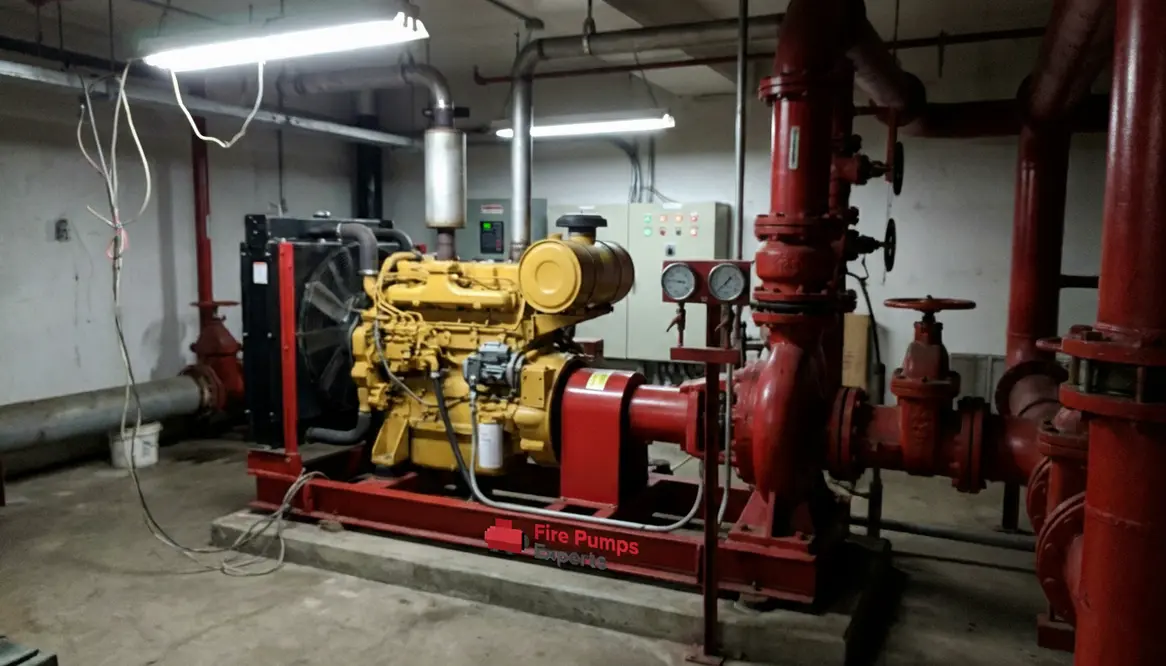
Diesel fire pumps operate independently of electrical power. Instead of relying on the building grid, the pump uses a diesel engine similar to what you might find in heavy equipment.
When pressure drops in the sprinkler system, the diesel engine starts automatically and drives the pump.
This design offers several advantages.
- It removes electrical dependency entirely. Even if the building loses all electricity, the fire pump still operates.
- Diesel engines provide powerful and consistent performance for large scale water delivery.
Of course, diesel systems require fuel storage, ventilation, and regular maintenance. Still, many industrial facilities prefer them because they add a strong layer of redundancy.
Besides, diesel engines have a reputation for toughness. They are basically the pickup trucks of the fire protection world. Loud, reliable, and stubborn in the best possible way.
How Facility Engineers Compare Backup Power Approaches
Electric Pump with Generator
- Integrates with existing building generators
- Lower fuel storage needs
- Cleaner mechanical layout
- Requires reliable generator maintenance
Diesel Driven Fire Pump
- Independent from building power
- Strong reliability during grid failure
- Requires fuel storage and ventilation
- More mechanical components to maintain
Both systems remain widely used across commercial properties. Ultimately, the right choice depends on infrastructure, local code requirements, and operational risk tolerance.
How Do Engineers Choose the Right Fire Pump Backup Power Solutions?
The decision process usually begins with a simple question.
How critical is continuous fire protection for the facility?
In a distribution warehouse, downtime may cost money. In a hospital or chemical plant, downtime could risk lives and environmental damage. Therefore, system designers examine several factors before selecting a backup configuration.
Building size and water demand
Larger buildings need stronger pumps and more reliable energy sources. High rise structures, for example, require significant pressure to reach upper floors.
Utility reliability in the region
Some regions experience frequent outages due to storms, aging infrastructure, or heavy demand. Facilities in those areas often favor independent diesel systems.
Existing emergency infrastructure
If a property already operates industrial scale generators, integrating the fire pump may be efficient. However, the system must still meet code requirements for dedicated circuits and priority power.
Maintenance capabilities
Every backup system requires testing. Diesel engines need fuel monitoring and mechanical checks. Generators require load testing and routine inspection. Therefore, the best option is often the one a facility team can maintain consistently.
Because in the world of life safety equipment, reliability always beats convenience.
Designing Reliable Fire Pump Backup Power Solutions for Critical Properties
Choosing the power source is only part of the equation. A truly reliable system requires thoughtful design across several layers of protection.
- The electrical path must remain protected from fire exposure. Engineers often route fire pump feeders through fire rated assemblies or separate shafts to reduce vulnerability.
- Control systems must start the pump instantly when pressure drops. Even a few seconds of delay can reduce sprinkler effectiveness during early fire growth.
- Testing programs must verify performance regularly. Commercial fire pumps undergo weekly or monthly churn tests depending on system design. During these tests, operators confirm the pump starts correctly and reaches proper pressure.
And yes, some facilities treat these tests like clockwork. Others treat them like dentist appointments. Important, necessary, and occasionally avoided until someone reminds them.
Finally, redundancy matters.
Large industrial campuses sometimes install multiple pumps or dual power paths to ensure water delivery under extreme conditions. It may seem excessive until you consider the potential loss from a major fire event.
In other words, the backup system itself sometimes needs a backup.
Practical Examples of Fire Pump Backup Power Solutions
In many real-world projects, fire pump backup power solutions end up being a blend of code requirements, existing infrastructure, and budget reality. A high rise downtown might pair an electric pump with a generator and a hardened feeder route. A remote industrial site might rely primarily on a diesel driven pump with a dedicated fuel supply and robust ventilation.
Some facilities even combine approaches: an electric fire pump tied into the generator and a diesel driven fire pump as a secondary unit. It is not the cheapest path, but for high hazard occupancies, that level of resilience is far less expensive than a catastrophic loss.
If you want to see how these concepts play out in real inspection and maintenance programs, resources like the routine inspection guide at Kord Fire Protection show how testing and upkeep keep backup systems reliable over the long haul.
FAQ: Fire Pump Backup Power in Commercial Buildings
Questions about fire pump backup power solutions come up constantly during design reviews and inspections. Here are a few of the most common ones, answered in plain language.
Conclusion
Reliable fire protection starts long before an emergency ever happens. The right fire pump backup power solutions ensure that when the lights go out and pressure matters most, the system performs exactly as designed. If you manage a commercial or industrial facility, investing in proper backup power is not just compliance. It is protection for people, property, and operations.
Work with experienced specialists who understand large scale fire pump systems, know how to interpret local code requirements, and can design a power strategy that matches your risk profile. Get the right combination of pump type, emergency generation, diesel capacity, and protection for feeders and controls. When your building finally calls on its backup power, you will not be wondering whether it will start. You will already know.