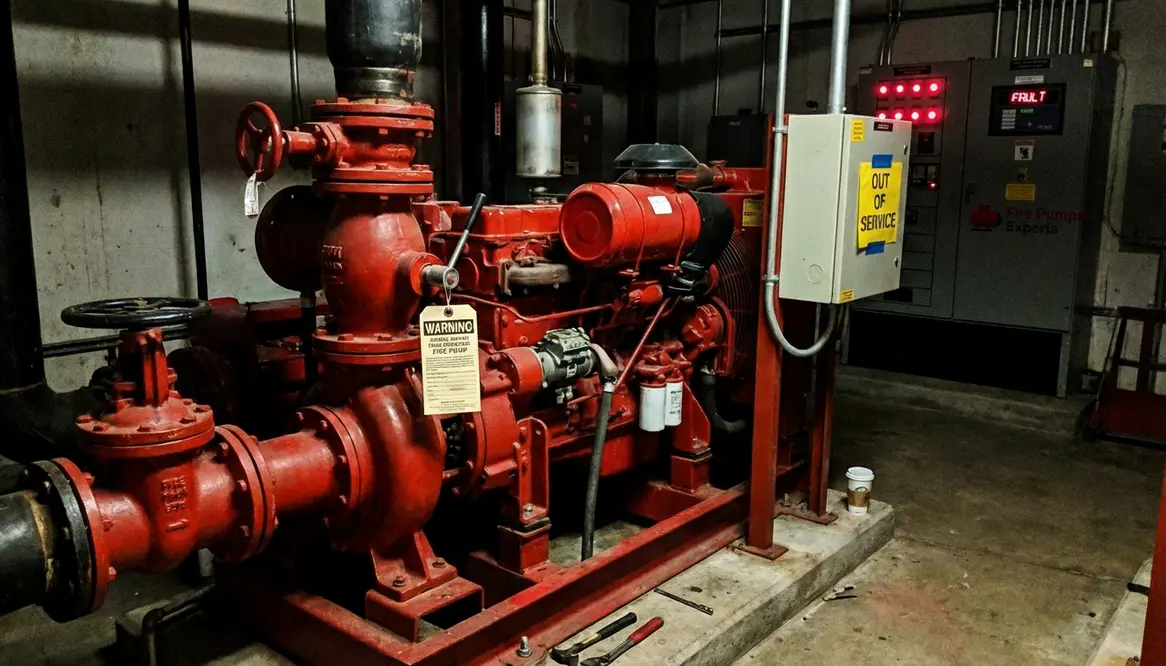
Fire Pump Failure During Fire: What Happens Next
When the heart of your fire protection system skips a beat, the entire building feels it.
Fire does not send a calendar invite. It shows up loud, hot, and uninvited. In those moments, every part of a building’s fire protection system must work in perfect rhythm. Yet sometimes the unthinkable happens. A fire pump failure during fire can turn a controlled emergency into a race against time.
I have spent years around commercial and industrial fire protection systems, and I can tell you something with absolute certainty. When the pump that feeds the sprinkler system stops doing its job, the entire strategy shifts instantly. Firefighters notice. Building systems notice. And unfortunately, the fire notices too.
When The Pressure Vanishes
So today I want to walk through what really happens when the pressure disappears at the worst possible moment. We will talk about the chain reaction inside the building, why these failures happen, and what facility managers can do to prevent a disaster from becoming a catastrophe.
Understanding what follows a fire pump failure during fire is not just theory. It is the difference between a contained incident and a headline nobody wants to read.
Why Fire Pumps Exist in Large Commercial Buildings
First, let us set the stage. In large commercial and industrial properties, municipal water pressure often cannot supply enough force to push water through hundreds of sprinklers across multiple floors. That is where fire pumps come in.
I like to think of a fire pump as the heart of a building’s fire protection system. It pushes water where gravity alone cannot. And just like the human heart, when it stops doing its job, everything else begins to struggle.
These pumps activate automatically when the system senses a drop in pressure caused by an open sprinkler head. Within seconds, water pressure rises dramatically, allowing sprinklers and standpipes to attack the fire quickly.
However, if the pump fails during that critical moment, several problems unfold at once.
Immediate impacts of pump failure include:
- Sprinklers receive little or no pressure
- Firefighters lose standpipe water support
- The fire spreads faster across materials
- Smoke production increases dramatically
- Building evacuation becomes more dangerous
In other words, the system designed to contain the fire suddenly loses its muscle.
And if this sounds like the plot twist in a disaster movie, you are not far off. The difference is that this scenario plays out in real warehouses, hospitals, factories, and data centers every year.
What Actually Happens During a Fire Pump Failure During Fire
Let us imagine a real scenario inside a large distribution center.
A pallet ignites. A sprinkler activates. Pressure drops in the system, which should trigger the pump to roar to life. Normally, the pump starts within seconds.
But this time it does not.
When The Pump Stays Silent
Now the sprinkler is spraying water at a fraction of its designed pressure. Instead of forming a strong spray pattern, it dribbles. The fire continues to grow, feeding on packaging, plastics, and stored inventory.
Meanwhile, firefighters arrive expecting a fully pressurized standpipe system. They connect their hoses and open the valve.
Nothing close to the expected pressure appears.
At that moment, firefighters must switch tactics. They often need to run supply lines from external hydrants, which takes precious minutes. And during a fire, minutes behave like caffeinated squirrels. They move fast.
Consequently, the fire grows larger, temperatures spike higher, and smoke spreads through areas that might otherwise have stayed safe.
In major facilities like manufacturing plants or logistics centers, this delay can allow the fire to reach structural elements or high rack storage. Once that happens, suppression becomes far more complex.
That is why a fire pump failure during fire is considered one of the most serious fire protection breakdowns a building can experience.
Why Do Fire Pumps Fail at the Worst Possible Moment?
It is tempting to imagine that pumps fail because of some dramatic mechanical explosion. Reality, however, is usually less cinematic and more frustrating.
Most failures come from small overlooked issues.
Over the years, I have seen a few repeat offenders that cause pump problems inside commercial facilities.
Mechanical causes
- Worn bearings or seals
- Impeller damage
- Controller malfunction
- Driver failure in diesel units
- Coupling misalignment
Operational causes
- Power supply interruptions
- Closed valves left after maintenance
- Fuel system issues in diesel pumps
- Improper weekly testing
- Lack of inspection documentation
Notice something interesting here. None of these problems appear dramatic at first glance. However, during an emergency they suddenly matter more than the plot armor in an action movie.
Furthermore, commercial facilities operate complex systems around the clock. Pumps sit idle for long stretches, waiting for the one moment they must perform perfectly. Without routine inspection and testing, hidden problems can stay buried until the worst possible day.
How Firefighters Respond When Pump Pressure Disappears
When firefighters encounter a system without proper pressure, their strategy changes quickly.
First, they verify whether the building fire pump is running. If it is not, someone will attempt to manually start the pump. In many cases this solves the issue immediately.
However, if the pump truly cannot operate, crews move to external water supply.
This means connecting hoses to hydrants and feeding the standpipe system from outside the building. While effective, it adds complexity and time to the operation.
Additionally, firefighters must now push water vertically through the structure using their apparatus. In tall office towers or high rack warehouses, that task becomes significantly harder.
During this time, the fire continues evolving. Heat builds. Materials ignite. Smoke migrates through corridors and mechanical shafts.
Think of it like trying to stop a leaking dam while someone hands you the tools five minutes late.
Consequently, even a small delay in water delivery can allow fires to grow beyond the capacity of the initial sprinkler activation. That is the brutal math behind a fire pump failure during fire.
How Facility Managers Can Prevent Fire Pump Failure During Fire
The good news is that most pump failures are preventable. In fact, the fire protection industry has clear testing and maintenance standards designed specifically to catch problems early.
However, those standards only work when facilities treat them seriously.
For commercial and industrial buildings, the key practices include:
- Weekly churn tests to confirm automatic startup
- Annual flow testing to verify performance under load
- Routine controller inspections
- Fuel and battery checks for diesel drivers
- Valve position monitoring
- Professional service documentation
High-Stakes Systems Deserve Specialists
Additionally, facility managers should partner with experienced fire pump service providers who specialize in large scale systems. Industrial campuses, hospitals, manufacturing plants, and high rise buildings all rely on complex pump configurations that require expert oversight.
Think of it like maintaining an aircraft engine. Technically it might sit still most of the time. But when you need it, you really need it.
Regular testing ensures that when pressure drops in the sprinkler system, the pump answers the call instantly and a potential fire pump failure during fire remains a story you tell in training, not an experience you live through.
FAQ About Fire Pump Failures in Commercial Buildings
Below are some of the most common questions building owners and facility teams ask about what happens when a fire pump fails and how to stay ahead of trouble.
The Quiet Machine That Protects Everything
A fire pump spends most of its life in silence, tucked away in a mechanical room like the backstage crew of a Broadway show. Nobody applauds it. Nobody takes selfies with it. Yet when the curtain rises and a fire breaks out, that quiet machine suddenly becomes the star.
If you manage a commercial or industrial property, the reliability of that system matters more than most people realize. Routine inspections, professional maintenance, and proper testing ensure your building’s fire protection system performs exactly when it must.
At firepumps.org, we help major facilities keep their pumps ready for that moment. Because when the alarm sounds, the last thing anyone should worry about is whether the pump will answer the call.
Turn Today’s Insight Into Tomorrow’s Readiness
If this made you rethink your pump room, that is a good sign. Use that concern as momentum. Review your testing records. Walk the space. Ask hard questions about what would happen in your building if a fire pump failure during fire occurred tonight.
If you need help evaluating or upgrading your system, providers like Kord Fire’s fire pump service team specialize in keeping pumps inspection-ready, code-compliant, and prepared for the one day that truly matters.