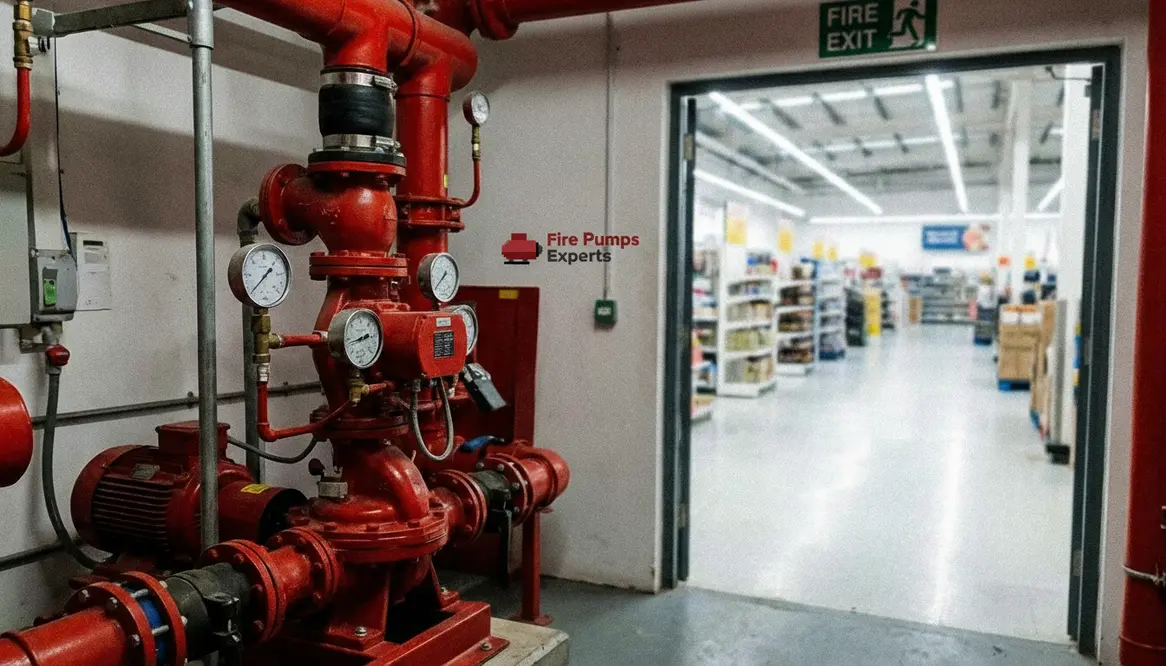
Fire Pump Systems for Large Retail Chains Safety
I have spent years around large properties where safety is not a feature, it is a promise. From big box retailers to sprawling shopping centers, the stakes are always high. And while college campus fire protection often sets the benchmark for layered safety systems, I find those same principles quietly shaping how we protect retail giants. After all, when thousands of people walk through wide automatic doors each day, the fire pump system behind the walls has to be more dependable than your morning coffee. Preferably more dependable than your WiFi too.
What makes fire pump systems essential for large retail chains?
I like to think of a fire pump system as the heartbeat of a building’s fire protection strategy. Without it, even the most advanced sprinklers are just well meaning decorations. In large retail environments, water pressure from municipal supplies often falls short. Therefore, fire pumps step in to deliver consistent, high pressure flow exactly when it matters.
Moreover, retail chains operate at scale. One store might be manageable, but dozens or hundreds across regions demand uniform performance. Consequently, a properly designed system ensures every location meets strict safety codes while protecting assets, inventory, and most importantly, people.
And yes, if you are picturing a dramatic movie scene where sprinklers go off at the wrong time, let me reassure you. Real systems are smarter than that. This is not an action film. It is engineering doing its job quietly.
Why scale changes the fire protection conversation
A small standalone shop can often work with straightforward suppression strategies. A chain with vast floor areas, multi tenant complexes, and regional distribution hubs enters a different world. At that scale, water supply variability, aging infrastructure, and regional code differences all converge on one question: will the fire pump system deliver when hundreds or thousands of people are inside?
Designing systems that mirror college campus fire protection standards
When I approach a large retail project, I often borrow lessons from college campus fire protection. Campuses function like small cities. Similarly, retail chains operate like distributed ecosystems. Both demand reliability, redundancy, and adaptability.
First, I focus on system layout. Every pump, valve, and controller must align with the building’s footprint. Next, I consider peak demand scenarios. Holiday rushes, for instance, bring more people and higher risk. Therefore, systems must perform under pressure both literally and figuratively.
Additionally, I account for future expansion. Retail spaces evolve. New sections get added. Layouts shift. A well designed fire pump system anticipates change rather than reacting to it later at a higher cost.
Key design priorities
- Reliable water supply integration
- Consistent pressure across large footprints
- Code compliance across jurisdictions
- Scalability for future growth
Operational benefits
- Reduced downtime risks
- Improved occupant safety
- Asset protection at scale
- Long term cost efficiency
Borrowing from layered protection strategies
What stands out in college campus fire protection is how many layers quietly sit behind the scenes: pumps, sprinklers, alarms, compartmentation, and emergency response planning. Retail chains that borrow these layered approaches enjoy the same benefit. If one safeguard needs support, the others are already in motion.
How do fire pump systems handle high occupancy and large footprints?
Here is where things get interesting. Large retail chains are not just big buildings. They are dynamic environments filled with movement, inventory shifts, and constant energy use. Therefore, fire pump systems must adapt instantly.
I ensure pumps are sized correctly to meet hydraulic demand across vast areas. At the same time, zoning becomes critical. By dividing systems into zones, we maintain pressure where needed without overloading the entire network.
Furthermore, backup power sources play a major role. Because when the power goes out, that is precisely when you cannot afford hesitation. Diesel driven pumps or emergency generators step in without missing a beat. Think of them as the understudy who secretly carries the whole show.
And yes, regular testing is non negotiable. A system that sits idle too long becomes a liability. So I treat maintenance like a routine, not an afterthought.
Designing for people first, square footage second
When occupancy surges for a seasonal sale or a major product launch, the design should already assume that crowd. That means understanding how customers actually move, where queues form, and how storage spaces stack combustibles. The fire pump system, standpipes, and sprinklers have to prioritize egress routes and high density areas, not just neat lines on a blueprint.
Compliance, inspections, and why consistency matters
Across different regions, fire codes vary. However, the expectation remains the same. Systems must perform flawlessly. Therefore, I emphasize consistency across every location in a retail chain.
Inspections should not feel like surprise exams you forgot to study for. Instead, they should confirm what you already know. That everything works exactly as intended. This means documenting performance, testing flow rates, and verifying alarm integrations regularly.
In addition, aligning practices with standards seen in college campus fire protection helps maintain a higher baseline. These environments demand accountability, and retail chains benefit from adopting that same mindset.
Let me put it simply. If a system only works on paper, it does not work at all.
From checklists to culture
The best inspection programs do more than pass audits. They create a culture where managers know how the fire pump system behaves, what normal looks like on a test printout, and when something feels off. Borrowing from the rigor often seen in college campus fire protection, smart retailers treat inspections as a continuous feedback loop, not a once a year obligation.
Smart technology and modern fire pump control
Technology has changed the game, and I welcome it with open arms. Modern fire pump controllers now offer real time monitoring, remote alerts, and performance tracking. Consequently, facility managers can respond faster and with more confidence.
Moreover, integration with building management systems creates a unified safety network. When one component reacts, others follow in sync. This coordination reduces response time and limits damage.
And while we are talking about smart systems, let us not forget cybersecurity. Because in today’s world, even your fire pump controller should not be easier to hack than a streaming account password. Protection must extend beyond physical systems.
Data, diagnostics, and quieter emergencies
The real advantage of these smarter systems is not flashy dashboards. It is the ability to spot problems before they become incidents. A pressure anomaly, a failed automatic start test, or a slow rise to duty speed can all trigger alerts. That kind of early diagnostics is exactly what keeps college campus fire protection resilient and makes large retail chains much harder to surprise.
Conclusion: Protect the scale you operate at
If you manage large retail properties, your fire protection strategy should match your scale. I design fire pump systems that perform under pressure, adapt to growth, and meet strict compliance standards. Now is the time to evaluate your infrastructure and strengthen it where needed. Connect with experts who understand complex commercial environments and build systems that do more than meet code. Build ones that protect your business every single day.
The most reliable programs treat every store with the same seriousness usually reserved for critical facilities. When large retail chains apply the mindset of college campus fire protection to their own portfolios, they stop depending on luck and start depending on design, data, and disciplined testing.
If you want to explore best practices and deeper technical resources, you can start with organizations dedicated to pumps, water supplies, and fire protection, such as https://firepumps.org, and then adapt those principles to the real world challenges of your own sites.