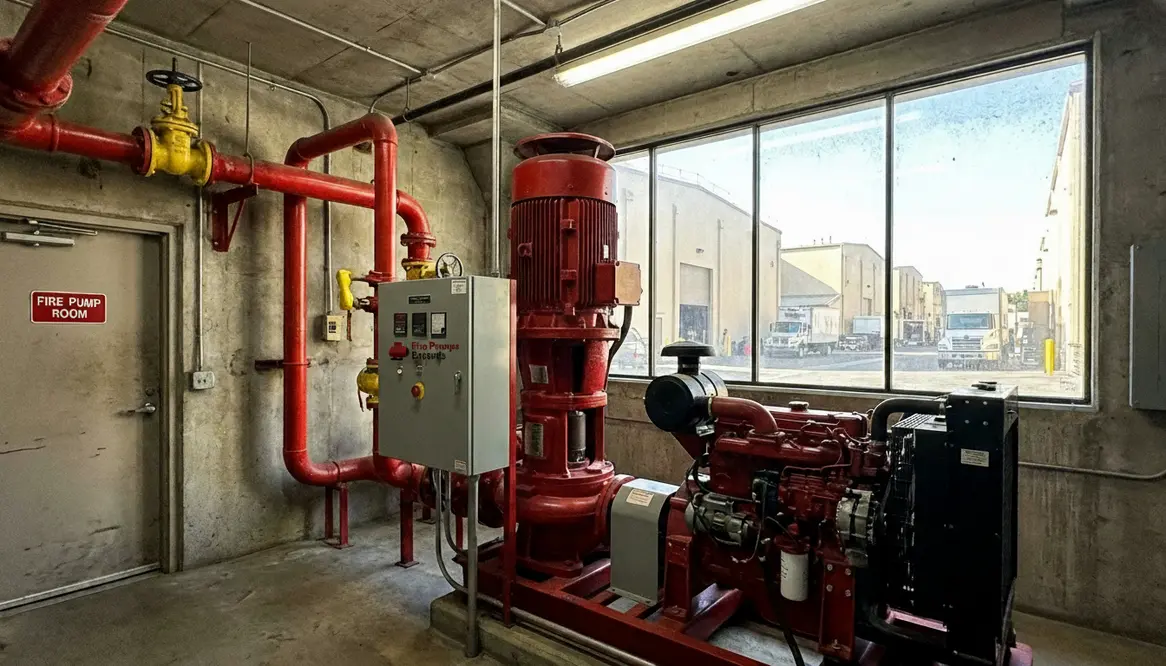
Los Angeles Film Studio Fire Pump Requirements
Behind every spaceship cockpit and 1940s diner set, there is something far less glamorous keeping the story safe: the fire protection infrastructure that keeps productions from becoming headlines.
Fire Pump Requirements for Film Studios and Production Facilities in Los Angeles
I have spent a fair amount of time walking through massive sound stages in Los Angeles. One minute you are staring at a spaceship cockpit. The next minute you are in a 1940s diner. That is the magic of the film industry. However, behind the lights, cables, and Oscar dreams sits something far less glamorous but absolutely essential. Fire protection.
In fact, los angeles film studio fire pump requirements play a major role in how modern production campuses operate. Large stages, storage warehouses, prop shops, and post production buildings demand reliable fire suppression systems that can respond instantly. Fire pumps sit at the center of that protection. While they rarely get screen time, they quietly ensure that an electrical fault, pyrotechnic mishap, or overloaded lighting grid does not turn a blockbuster into a breaking news headline.
So today I want to walk you through how fire pump systems support major production properties across Los Angeles. Think of it as a behind the scenes tour. No popcorn required.
Why Film Studios Have Unique Fire Protection Demands
Film studios are not ordinary commercial buildings. They operate more like miniature cities. A single production lot may contain massive sound stages, mill shops, wardrobe warehouses, office towers, editing suites, outdoor sets, and even artificial streets. Because of that scale, water supply pressure from municipal systems often cannot meet fire suppression demands.
Therefore, fire pumps step in to provide the muscle.
These systems boost water pressure so sprinkler networks and standpipes perform exactly as designed during an emergency. For large Los Angeles production campuses, the difference between municipal pressure and required suppression pressure can be dramatic.
Several factors make studio environments particularly demanding.
- High ceilings inside sound stages
- Large open floor areas
- Temporary set materials such as wood and foam
- Extensive electrical lighting rigs
- Pyrotechnic or special effects equipment
- Large storage areas for props and wardrobe
Additionally, many stages house expensive equipment worth millions. A single camera rig can cost more than a luxury sports car. Losing a facility to fire would halt productions, delay releases, and cost studios enormous sums. Consequently, robust fire pump infrastructure is not just code compliance. It is business continuity.
Los Angeles Film Studio Fire Pump Requirements Explained
If you asked an AI prompt something like “what codes regulate fire pumps for film studios in Los Angeles,” the answer would begin with a familiar trio of standards.
- NFPA 20 for installation of stationary fire pumps
- California Fire Code requirements
- Local Los Angeles Fire Department enforcement and review
However, the reality inside major production campuses goes deeper than basic code compliance. For anyone trying to truly understand los angeles film studio fire pump requirements, the on-paper standards are just the starting point.
1. Determining Total System Demand
First, engineers must determine total system demand. Sound stages often require large sprinkler flows because of their ceiling heights and open floor areas. When municipal water supply cannot maintain those flows, a fire pump becomes mandatory.
2. Planning for Redundancy and Power Loss
Second, redundancy often enters the picture. Major studio properties may install diesel fire pumps or backup power systems. After all, when the power goes out during an emergency, the sprinkler system still needs pressure. A pump that depends on a silent electrical panel will not help anyone.
3. Designing Practical, Serviceable Pump Rooms
Third, pump rooms themselves require careful design. They must remain accessible, protected from flooding, and built with sufficient clearance for service crews. Maintenance technicians need space to inspect valves, controllers, and test equipment without performing yoga poses around piping.
4. Testing and Ongoing Reliability
Finally, the testing regime matters. Weekly churn tests, annual flow tests, and system inspections keep the pump ready for action. Fire pumps are like stunt doubles. They spend most of their time waiting quietly, but when the moment comes they must perform flawlessly.
If you want a deeper look at how NFPA 20 shapes these expectations, resources like NFPA 20 fire pump design and compliance overviews explain how modern installations are evaluated and maintained in practice.
Designing Fire Pump Systems for Large Production Lots
When engineers design protection for studio campuses, they do not think about a single building. Instead, they think about entire districts within the property.
For example, a studio may include multiple sound stages served by a shared underground fire main. In that case, the fire pump must support simultaneous demand scenarios. If two stages trigger sprinkler systems at once, pressure must remain stable across the network.
Moreover, underground piping layouts become critical. Long distances across studio lots can reduce pressure before water even reaches the building. Fire pump capacity must account for those losses.
Additionally, modern studio expansions often introduce high density storage areas for props and set pieces. These spaces may require higher water flows than the stages themselves. Therefore, engineers frequently evaluate the entire property rather than designing pump systems for isolated buildings.
That broader approach aligns with the operational reality of production campuses. On any given day, multiple projects may run simultaneously. A superhero film might shoot on Stage 12 while a streaming series films across the street. Fire protection must support the entire ecosystem, and that is where well-planned los angeles film studio fire pump requirements turn into real-world resilience.
What Engineers Consider When Meeting Los Angeles Film Studio Fire Pump Requirements
When I review a fire pump installation for a large production property, I look at several technical factors immediately. These are the nuts and bolts that take los angeles film studio fire pump requirements from a code checklist to a working, dependable system.
- Water supply analysis
Engineers test municipal flow data to determine available pressure and volume. - Hazard classification
Sound stages, workshops, and storage buildings often require different sprinkler densities. - Pump type selection
Electric motor pumps dominate urban sites, while diesel pumps provide independence from utility failures. - Controller configuration
Controllers must meet NFPA standards and support automatic startup.
- Backup power planning
Critical production campuses often require emergency generators. - Testing connections
Flow testing must safely discharge water without flooding the property. - Seismic bracing
California codes require strong seismic support for pump systems and piping. - Maintenance accessibility
Technicians must inspect valves, gauges, and controllers without obstruction.
Together, these design factors ensure the pump will perform when the sprinkler system calls for help. It is not glamorous work. No one gives a standing ovation to a perfectly sized impeller. Still, when a system activates and controls a fire quickly, that quiet engineering becomes the hero of the story.
How Film Production Activity Influences Fire Pump Planning
Production facilities constantly change their internal environments. Sets appear and disappear. Lighting grids evolve. Entire stages may transform overnight.
Because of that, fire protection engineers design systems with flexibility in mind.
For instance, large sound stages often use high capacity sprinkler systems capable of protecting multiple types of temporary sets. Whether the stage hosts a courtroom drama or a sci fi alien invasion, the fire suppression system must handle combustible scenery materials.
Meanwhile, prop warehouses introduce another layer of complexity. These buildings often contain dense racks of costumes, furniture, wood structures, and foam props. If you have ever watched an action film explosion scene, you know exactly how combustible some of those materials can be.
Consequently, pump sizing often considers worst case storage scenarios rather than average daily operations.
And yes, special effects departments occasionally keep fire protection teams on their toes. Controlled flames may look dramatic on camera, but behind the scenes every effect must operate within strict safety planning. The fire pump stands ready as a silent backup, translating abstract los angeles film studio fire pump requirements into practical, on-set safety.
FAQ About Fire Pumps for Los Angeles Production Facilities
Conclusion
When you step onto a Los Angeles studio lot, you see creativity everywhere. Yet beneath the storytelling sits serious infrastructure protecting people, property, and productions. Proper fire pump design keeps sprinkler systems ready for the unexpected. If you operate or develop large production facilities, understanding these systems matters.
Work with experienced fire pump specialists who focus on major commercial properties and understand the unique pressures of the entertainment industry. Because when safety runs quietly in the background, the show can go on without interruption, and those carefully met los angeles film studio fire pump requirements stay exactly where they belong: off camera.