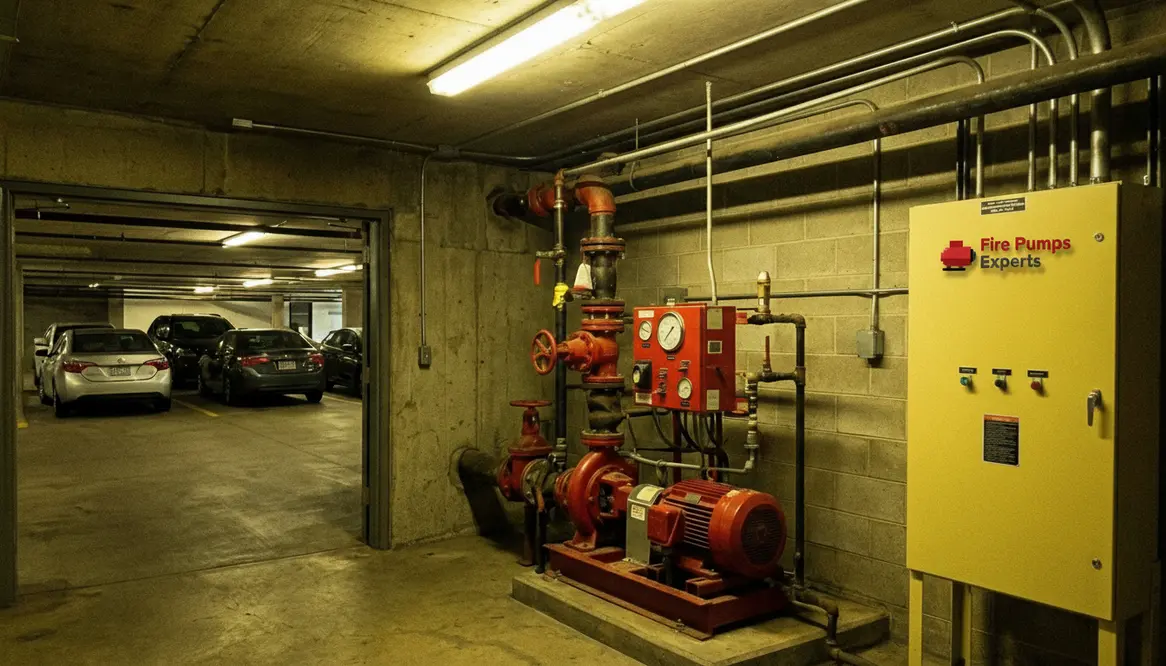
Parking Garage Fire Pump Requirements Guide
I have spent enough time around commercial buildings to know one thing with certainty. Fire does not care how well your parking deck is painted or how new the lighting looks. It cares about fuel, airflow, and opportunity. That is exactly why parking garage fire pump requirements matter so much in enclosed structures. Within the first moments of a fire event, the difference between control and chaos often comes down to whether the fire pump system was designed, installed, and maintained with precision. And yes, while this topic might not sound thrilling at first, stick with me. I promise it has more twists than a late night thriller and far fewer plot holes.
What are the fire pump requirements for enclosed parking structures?
Let me answer this plainly, the way I would explain it standing beside a mechanical room humming with purpose. Enclosed parking structures require fire pumps when the available water supply cannot meet sprinkler system demand. That includes both pressure and flow. Without sufficient supply, sprinklers become more decorative than functional, and no one wants that kind of interior design choice.
Codes such as NFPA 20 and NFPA 13 guide these requirements. However, interpretation depends on building size, hazard classification, and system demand. Enclosed garages often fall under Ordinary Hazard Group classifications due to vehicle fuel loads. Therefore, higher water demand is expected.
Additionally, local codes may tighten these standards. So while national codes set the stage, local authorities direct the performance. Think of it like jazz. There is structure, but the city adds its own rhythm.
Why enclosed parking garages demand more from fire pump systems
Unlike open structures, enclosed parking garages trap heat and smoke. This creates a more aggressive fire environment. As a result, sprinkler systems must work harder and faster. That is where properly designed fire pumps step in, quite literally saving the day without asking for applause.
Furthermore, vehicle fires today burn hotter than ever. Modern materials, plastics, and lithium batteries introduce new risks. Consequently, fire pumps must be sized with these evolving hazards in mind. A system designed twenty years ago may not meet today’s realities.
Also, ventilation plays a role. Poor airflow can increase sprinkler demand because heat builds rapidly. Therefore, fire pump sizing must consider worst case scenarios, not best case assumptions.
Core design elements I always focus on
When I evaluate fire pump requirements for parking structures, I zero in on a few critical factors. These are not optional details. They are the backbone of system reliability.
Water supply analysis
I always verify available flow and pressure. If the municipal supply falls short, the fire pump becomes essential.
Pump capacity
The pump must meet peak sprinkler demand. Undersizing is not a gamble. It is a guaranteed failure.
Redundancy
In large commercial properties, backup pumps or dual power sources ensure reliability.
Power source
Electric pumps are common, but diesel backups provide resilience during outages.
Controller systems
Smart controllers monitor performance and initiate operation instantly.
Testing access
Routine testing is required, so systems must allow safe and easy inspection.
Each of these elements works together. Ignore one, and the whole system starts to wobble like a shopping cart with one bad wheel.
How do codes and compliance shape parking garage fire pump requirements
Compliance is not just paperwork. It is a living framework that ensures systems perform under pressure. NFPA 20 governs fire pump installation, while NFPA 25 handles inspection and testing. Together, they create a lifecycle approach.
However, local jurisdictions often add their own requirements. For example, some cities require higher safety factors due to dense urban environments. Others may demand additional redundancy for high rise mixed use buildings with underground parking.
Therefore, I always recommend early coordination with authorities having jurisdiction. It saves time, money, and the occasional headache that feels like it came straight out of a courtroom drama.
Installation realities in large commercial and industrial properties
Installing fire pumps in major facilities is rarely straightforward. Space constraints, electrical infrastructure, and integration with existing systems all come into play. In many enclosed garages, pump rooms must be carefully located to remain accessible yet protected.
Additionally, vibration control and noise management are often overlooked. A poorly installed pump can turn into an unwanted percussion instrument. While that might impress a drummer, it does nothing for system longevity.
Moreover, coordination with sprinkler contractors, electrical engineers, and facility managers is essential. These systems do not exist in isolation. They operate as part of a larger ecosystem.
Maintenance expectations that keep systems ready
A fire pump that is not maintained is simply a very expensive paperweight. Regular testing ensures the system performs when needed. Weekly churn tests, annual flow testing, and periodic inspections are all part of the routine.
Furthermore, documentation matters. Inspectors want records, not guesses. Keeping detailed logs ensures compliance and provides insight into system health over time.
I often say this with a bit of humor, but it holds true. Fire pumps are like gym memberships. They only work if you actually use them.
Key points about parking garage fire pump requirements
- Parking garage fire pump requirements are driven by sprinkler demand, water supply limits, and hazard classification.
- NFPA 20, NFPA 13, and NFPA 25 provide the backbone, while local codes refine the specific expectations for each city.
- Modern vehicle hazards, including lithium batteries, are pushing designers to recheck whether existing systems still satisfy current parking garage fire pump requirements.
- Owners and facility teams who routinely test, document, and upgrade their systems are the ones who truly meet parking garage fire pump requirements in practice, not just on paper.
FAQ about parking garage fire pump requirements
Final thoughts and next steps
When I look at enclosed parking structures, I see more than concrete and cars. I see a complex environment where fire protection must perform flawlessly. Understanding and applying parking garage fire pump requirements is not just about compliance. It is about protecting assets, operations, and lives. If you manage or own a large commercial property, now is the time to review your system, partner with experts, and ensure everything is ready when it matters most. Because in this line of work, preparation always wins.