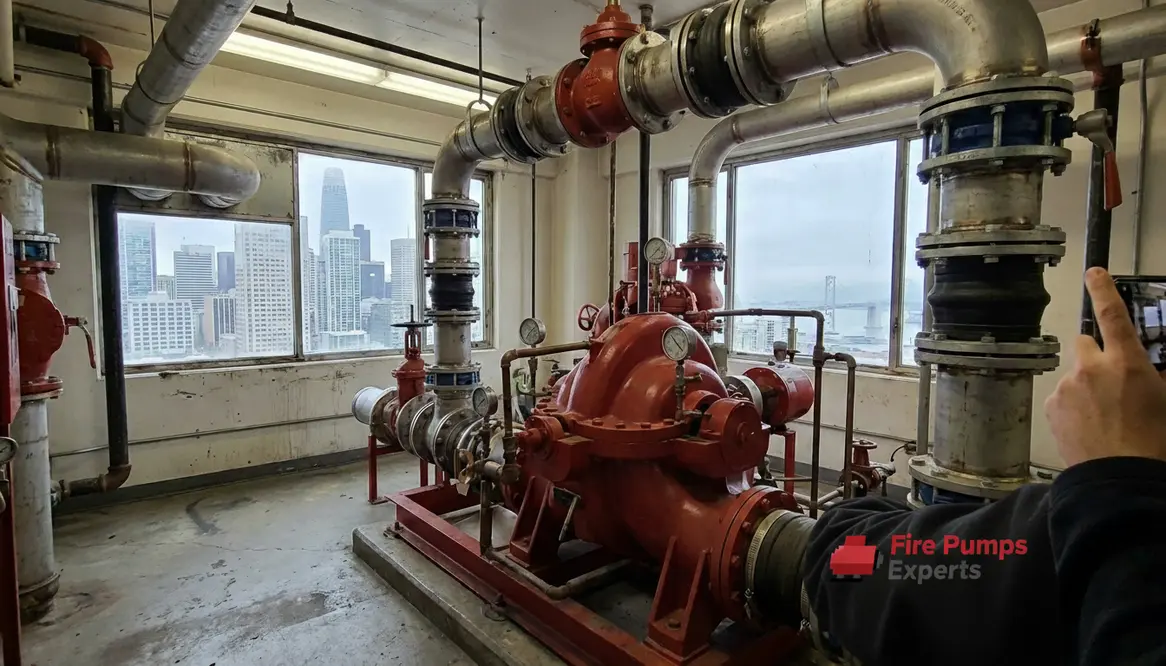
San Francisco High Rise Fire Pumps Planning Guide
A practical guide to making sure your San Francisco high-rise fire pumps are more dependable than the weather app on a foggy morning.
I have spent years walking through mechanical rooms that hum like quiet engines of safety, and if there is one system I never take lightly, it is San Francisco high-rise fire pumps. In a city where buildings stretch upward and the ground beneath them likes to move just enough to keep engineers humble, fire pump planning becomes more than a checklist. It becomes a responsibility. And yes, while it may not sound as thrilling as a Hollywood blockbuster, I assure you, when designed right, it performs like one. Quiet, powerful, and always ready when the plot thickens.
You are not just sizing a pump; you are designing how water will fight its way to the 40th floor when everything else is going wrong. That demands more than minimum code language and optimistic assumptions. It demands clear thinking, real-world experience, and a healthy respect for gravity and earthquakes.
Understanding the stakes in vertical cities
San Francisco does not build small. Towers rise, tenants stack, and water must climb just as high. Therefore, I always begin with one simple truth: gravity is not your friend here. Fire protection systems in high-rise environments depend heavily on pressure consistency. Without it, even the best sprinkler heads are just expensive ceiling decorations.
Moreover, local seismic activity adds another layer. Equipment must not only perform but endure movement. I have seen systems that looked perfect on paper but failed to consider real world stress. As a result, proper anchoring, flexible connections, and seismic bracing become non negotiable.
And while codes guide us, experience sharpens the edge. I often say codes tell you the minimum. Good planning goes well beyond that.
Why high-rise pumps carry extra responsibility
In low-rise buildings, minor design shortcuts sometimes sneak by without anyone noticing. In a high-rise, those shortcuts show up as dry sprinklers, delayed hose streams, and very nervous incident commanders. San Francisco high-rise fire pumps have to bridge the gap between street-level water and rooftop demand while also staying online during shaking, power disturbances, and sometimes less-than-ideal maintenance habits.
How do I plan fire pump capacity for tall buildings?
I get this question often, and the answer is both technical and practical. First, I calculate demand based on the most hydraulically demanding area. Then, I account for elevation loss. Water does not politely climb 40 stories without resistance.
However, I do not stop there. I factor in redundancy. Because in commercial and industrial high-rise properties, downtime is not just inconvenient. It is expensive and dangerous.
- Flow demand: Based on sprinkler and standpipe requirements
- Pressure needs: Adjusted for building height and friction loss
- Backup systems: Secondary pumps or backup power
- Future expansion: Because buildings evolve
In addition, I always coordinate with mechanical and electrical teams early. Otherwise, you end up playing Tetris with equipment rooms. And unlike the game, there is no reset button.
Planning beyond the numbers
Hydraulic calculations give you the math. What they do not give you is the reality of tenants adding more load, future renovations, or a building owner deciding the roof is the perfect place for new occupied space. That is why I treat pump sizing for San Francisco high-rise fire pumps as a long-term decision, not a one-time code exercise.
I also pay attention to support systems: ventilation, drainage, and emergency power. An undersized generator or a poorly drained test header can quietly undo all your careful pump selection when you finally need the system to perform.
Design considerations unique to San Francisco high-rise fire pumps
Now we get into the details that separate a decent system from a resilient one. San Francisco presents a mix of coastal conditions, dense infrastructure, and strict regulations. Therefore, each decision matters.
First, corrosion resistance is critical. Salt air does not care about your budget. It will quietly degrade components over time. So, I lean toward materials and coatings that stand up to that environment.
Next, I consider space constraints. Mechanical rooms in high-rises are rarely generous. As a result, vertical turbine pumps or compact split case designs often become the go to.
Then comes power reliability. Because even the strongest pump is just a statue without electricity. Diesel backups or generator supported electric pumps are common solutions I trust.
And finally, noise control. Because while a fire pump should roar when needed, it should not hum like a late night neighbor every day.
Building a system that survives real life
Real life is rarely polite. Elevators get added, roofs are reimagined, tenants complain about sound, and the corrosion you were warned about shows up on schedule. Designing San Francisco high-rise fire pumps means thinking about inspections, testing, and repairs that will occur years from now, long after the ribbon cutting.
That is also where partners matter. Working with a contractor who lives and breathes pump codes and testing, like the team behind this NFPA 20 fire pump overview, helps make sure your design on paper translates into a system that can be installed, certified, and maintained without drama.
Key components I never overlook
Every system is only as strong as its weakest link. So I pay attention to the details that others sometimes rush through. That is usually where problems like to hide.
|
Pump assembly Controller systems |
Water supply Testing connections |
Additionally, I ensure that maintenance access is never an afterthought. Because if a technician cannot reach it easily, it will not get the attention it needs. And that is when small issues grow into big headlines.
Designing with the maintenance crew in mind
If you have ever watched a technician try to change a valve trim while twisted into a shape that would impress a yoga instructor, you understand why I push for clearances, lighting, and logical layouts. It is not about making the room pretty. It is about making it easy to keep San Francisco high-rise fire pumps in peak condition year after year.
Common planning mistakes I have seen and fixed
I have walked into buildings where the system looked impressive at first glance. Shiny pipes, modern panels, everything neat. Yet underneath, problems waited patiently.
One frequent mistake is underestimating pressure loss. Designers sometimes assume best case scenarios. Real systems rarely behave that politely. Therefore, I always build in a buffer.
Another issue is poor coordination between trades. For example, I have seen fire pump rooms squeezed into leftover space after everything else was installed. That never ends well.
Then there is neglecting long term maintenance. Systems are installed with enthusiasm but maintained with forgetfulness. Consequently, performance drops over time.
And yes, occasionally I see overengineering. Bigger is not always better. It is just more expensive and harder to manage. Balance is key.
A quick checklist for staying out of trouble
- Verify that calculated pressures include realistic friction loss and elevation.
- Confirm the fire pump room layout with all trades before anything is built.
- Ensure test headers, valves, and controllers are accessible for real humans, not acrobats.
- Plan for long-term operation, not just the final inspection.
- Review proposed changes in the building that might affect San Francisco high-rise fire pumps over time.
FAQ about high-rise fire pump planning
What type of fire pump is best for high-rise buildings?
Electric or diesel driven pumps are common, often paired with backup power for reliability.
How often should fire pumps be tested?
Weekly churn tests and annual flow tests are standard for commercial systems.
Why is pressure so critical in tall buildings?
Water must overcome elevation and friction losses to reach upper floors effectively.
Do seismic requirements affect fire pump design?
Yes, components must be anchored and flexible enough to handle movement safely.
Can one pump handle the entire building?
Sometimes, but many systems include redundancy to ensure continuous operation.
Final thoughts and next steps
If you are planning or upgrading a system, I encourage you to take a closer look at your approach to San Francisco high-rise fire pumps. The right design protects people, property, and peace of mind. Work with experts who understand commercial and industrial demands, think ahead, and build systems that perform when it matters most. Because when the moment comes, there is no room for guesswork. Only performance.
Treat your pump room as the beating heart of your fire protection strategy. Demand clear calculations, honest assumptions, and layouts that respect operations and maintenance. When you do, your San Francisco high-rise fire pumps will be the quiet heroes of your building, waiting patiently in the background until the day they are called to carry the story to a better ending.