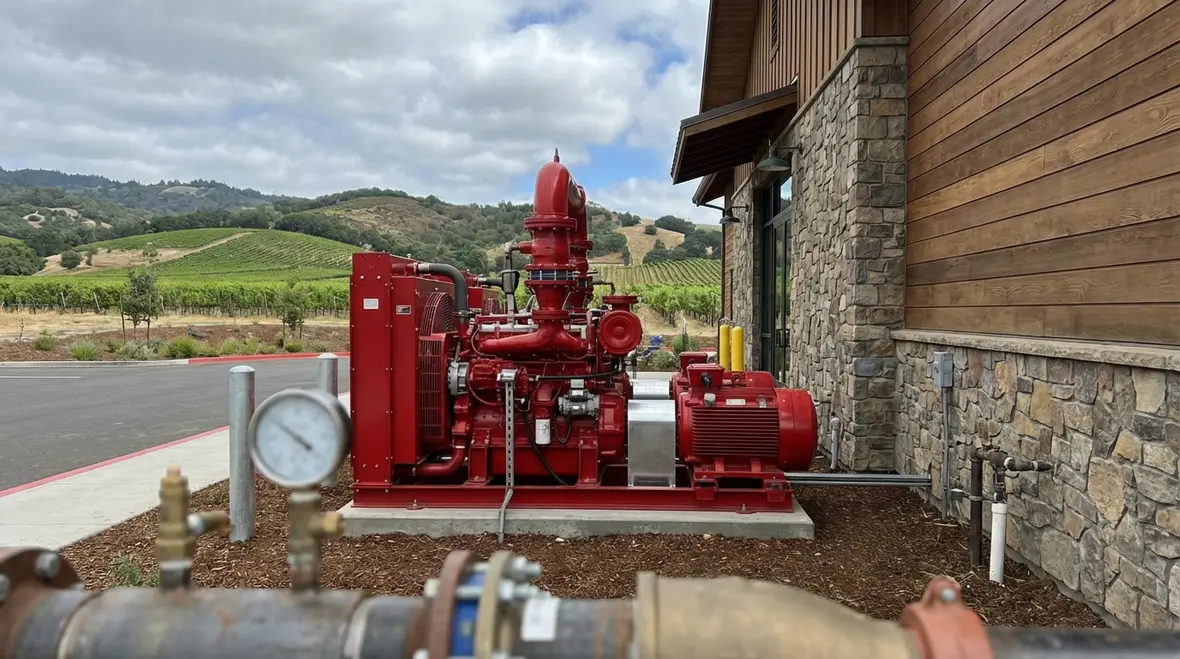
Fire Pump Performance Tips for Napa Commercial Buildings
Fire Pump Performance Considerations for Properties in Napa
Let’s take a walk through wine country—but instead of swirling Pinot Noir, we’re swirling around fire pump performance Napa buildings and how it actually affects day-to-day risk.
If you’re someone who owns or manages a commercial or industrial property in Napa, you know that fire safety systems aren’t just a checkbox on a compliance sheet. They’re the backstage crew that you hope never has to take center stage—but when they do, they’d better be on point.
With Napa’s mix of sprawling wineries, state-of-the-art production facilities, and those majestic commercial complexes nestled between rows of Cabernet vines, your fire pump isn’t just some box collecting cobwebs in the mechanical room. It’s arguably the silent guardian of your empire. So today, this is going deep—but not Titanic-deep—into what really matters when looking at fire pump performance Napa buildings depend on. And yes, this will be as fun as talking about pump curves can possibly get.
What Fire Pump Performance Means for Large-Scale Properties
Fire pumps aren’t new kids on the safety block, but they’re often misunderstood—like the middle child in a trilogy (looking at you, “Iron Man 2”).
Essentially, a fire pump is your pressure booster. It kicks in when your water supply—municipal or otherwise—isn’t quite cutting it. In places like Napa, where terrain shifts from valleys to hills quicker than your contractor’s project timeline, that pressure inconsistency can be critical.
Commercial facilities like production plants, resorts, or distribution warehouses often have expansive systems that require consistent, high-flow water delivery in an emergency. Underperforming pumps don’t just slow that down—they jeopardize everything. A lack of consistent PSI in a fire event is like bringing a Nerf gun to a Super Soaker contest. Not ideal.
So yes, performance here isn’t just about running—it’s about pressure, flow rates, and reliability coming together like Avengers assembling under duress. When you zoom out and look at fire pump performance Napa buildings actually need, it comes down to whether that system can deliver water fast and hard enough when the worst happens.
How Napa’s Landscape Affects Fire Pump Metrics
You might be thinking: “It’s just fire pumps. Why make it poetic?” But Napa makes everything a little more dramatic—including your fire systems.
Napa’s changing elevations and rural-to-urban shifts demand unique engineering for fire protection infrastructure. One minute you’re surrounded by vineyards and the next you’re driving past a 200,000-square-foot bottling facility. Fire pumps in hilly terrain need to defeat elevation loss, while urban properties must prep for older city mains that just aren’t built for today’s demand spikes.
Now factor in wildfire season—the actual worst roommate in California. Fire pumps have to be designed not just for indoor emergencies but must also work with external sources like cisterns or gravity tanks in rural zones where city water is laughably unreliable. Yeah, it’s complicated—kind of like trying to explain the plot of “Tenet” after one glass of Syrah.
Bottom line? Performance isn’t about buying the “biggest” or “latest” pump. It’s about tailoring output and pressure to the actual fire demands and property location. If you care about fire pump performance Napa buildings can trust, you care about how terrain, elevation, and water sources all play together.
Choosing Between Electric and Diesel: A Debate Worth Having
This one’s a little like choosing a car—but instead of horsepower, we measure firepower.
Do you go diesel or electric? Well, it depends on your facility’s backup power infrastructure and uptime expectations. Let’s break it down with a clean side-by-side that keeps things readable.
Electric Fire Pumps
- Lower maintenance compared to diesel
- Cost-effective over time when power is stable
- Cleaner and quieter operation
- Relies heavily on grid stability or backup generators
Diesel Fire Pumps
- No reliance on utility power
- Requires fuel storage and consistent maintenance
- Louder and bulkier footprint
- Stable option during outages and grid failures
Choosing the right fire pump for your Napa property isn’t as binary as red vs. blue pill. You might actually need both if you’re managing a large-scale operation with mission-critical zones. Hybrid setups, anyone? The key is matching the configuration to the type of fire pump performance Napa buildings require during blackouts, peak demand, and emergencies.
What Metrics Actually Matter When Evaluating Fire Pump Performance
Let’s say you’re handed a spec sheet. It’s got all these numbers: gallons per minute, PSI, churn rate. You nod. But inside? You’re just hearing elevator music. Here’s the translation layer.
Core Fire Pump Metrics to Watch
- Flow Rate (GPM): The volume of water the pump delivers per minute. Bigger properties = higher GPM needs.
- Pressure (PSI): Determines how well water reaches multiple floors or distant zones. Critical in tall or wide structures.
- Run Time: Your fire pump should sustain output through the required burn duration, typically 90 to 120 minutes.
- Suction Source: Where is your water coming from? This affects your pump’s start time and efficiency.
- Redundancy Specs: Backup components like controller panels and jockey pumps can make or break response time.
Think of these as the Marvel lineup of your fire protection system. Each plays a role. Take one out, and suddenly you’re just the person in a suit yelling “assemble.” Not nearly as effective when you’re counting on fire pump performance Napa buildings rely on to protect vineyards, barrel rooms, and tasting spaces all at once.
Regular Testing Isn’t Optional—It’s Mission Critical
If you’re the kind of person who skips oil changes or calls duct tape “a solution,” lean in here. Fire pumps can’t afford to be forgotten until inspection day.
Once a week? Test it. Monthly? Run that baby under load. Annually? Get a certified performance evaluation. It’s not overkill, it’s peace of mind. Like checking your parachute before skydiving—nobody complains about too many checks on that flight.
Especially in Napa, where seasonal threats—from wildfires to earthquakes—compound property risk, you can’t afford downtime or guesswork. Testing under simulated load conditions ensures your system doesn’t just start; it performs under stress. That’s the kind of fire pump performance Napa buildings need when the sky is orange and the wind is not on your side.
How to Upgrade an Aging System Without Rebuilding Your Facility
Here’s some good news: You don’t always need to rip out your whole system when someone drops the dreaded phrase, “code noncompliance.”
Retrofitting is the magic word (no wand required). Many commercial and industrial properties across Napa are modernizing their fire pump systems with upgraded controllers, new impellers, or auxiliary tanks—without bulldozing their mechanical rooms into oblivion.
Smart Upgrade Ideas
- Vertical turbine pumps for properties near water storage tanks or ponds
- Variable frequency drives for intelligent pressure control
- WiFi monitoring for real-time diagnostics (yes, your fire pump can text you now)
So if your fire pump looks like it shares parts with Doc Brown’s DeLorean, maybe it’s time to step into the future. A well-planned retrofit can tighten up fire pump performance Napa buildings rely on without tearing out walls or shutting down operations for weeks.
Why Local Regulations in Napa Require Custom Engineering
Fun fact: Building codes are not suggestions. And in a county like Napa? They’re half science, half politics, and one-third “surprise inspections just because.”
California’s Fire Code gets extra legs under Napa’s local ordinances. You’re dealing with seismic concerns, wildland-urban interface issues, and city-specific flow testing standards.
This is not the time for a plug-and-play solution from a generic supplier. You need custom fire protection engineered for both the laws and the land. When your code inspector shows up and says, “Show me your flow curve data,” you’ll be glad you worked with specialists who actually understand how nuanced fire pump performance Napa buildings require can be.
Want a deeper technical take on compliance? Check out this detailed overview of NFPA 20 fire pump system design and installation from Kord Fire Protection: NFPA 20 fire pump standards and compliance guide.
FAQ: Quick Fire Pump Facts
Final Thoughts: Fire Pump Upgrades Are Not a DIY Weekend Project
You’ve made it this far—bravo. Now let’s not let that knowledge collect dust like a treadmill used solely for hanging dry laundry.
If you’re managing a high-value facility in Napa and it’s been ages since your fire pump got some love, let’s fix that. Performance isn’t optional—it’s survival. The experts at firepumps.org are ready to custom-engineer and future-proof your fire pump system into something Mr. Stark himself would admire.
Don’t wait until the alarm bell rings—because by then, it may be too late. Treat fire pump performance Napa buildings depend on as a core business asset, not an afterthought, and the “what if” scenarios start to look a whole lot less terrifying.