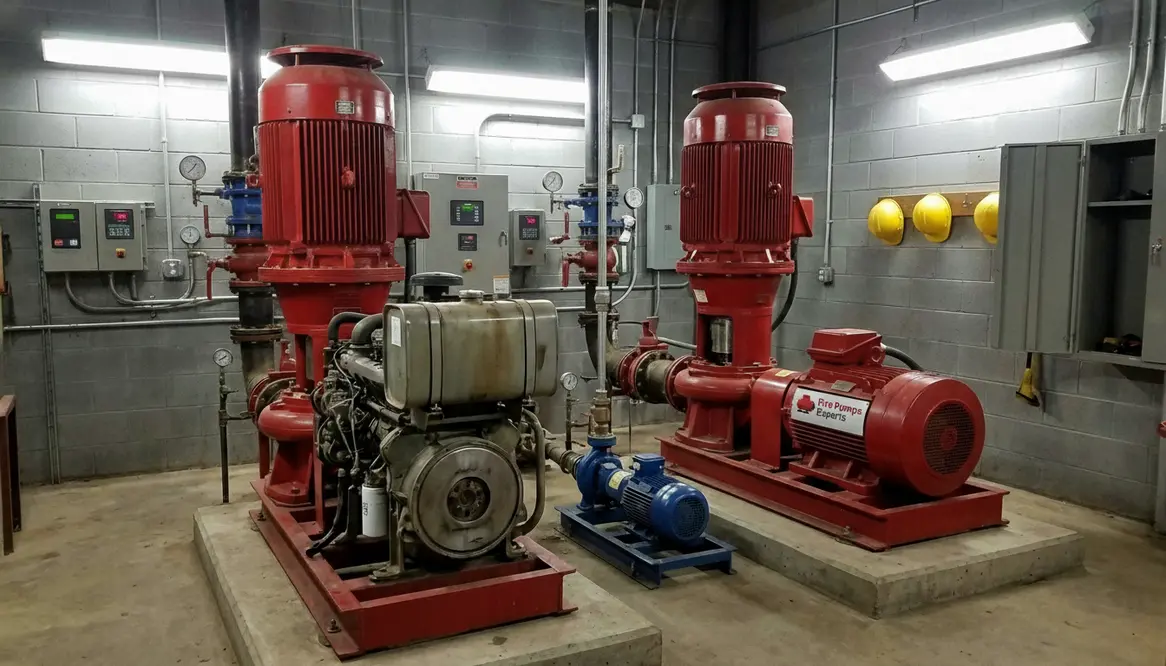
Fire Pump Redundancy Design for Commercial Buildings
I have spent enough time around pump rooms to know one thing for certain. When a fire breaks out in a major facility, there is no room for “hopefully it works.” Fire protection in large commercial and industrial buildings demands systems that stay dependable under stress. That is exactly where fire pump redundancy design strategies come into play. I rely on them to ensure that if one component fails, another quietly steps in like a well trained understudy waiting behind the curtain. Because in a data center, hospital complex, refinery, or high rise campus, a single point of failure is about as welcome as a power outage during the Super Bowl halftime show.
In this article, I walk through how I approach redundancy, reliability planning, and pump system design for large scale properties. We will talk about layered protection, backup pump configurations, and why thoughtful engineering beats last minute improvisation every time.
At-a-Glance: Why Redundancy Matters
- Prevents single points of failure
- Keeps protection online during power loss
- Supports code compliance and liability defense
- Protects high value operations and assets
If your facility relies heavily on fire pumps for sprinkler performance, treating fire pump redundancy design strategies as optional is a fast way to invite risk you really do not want.
Why Redundancy Matters in Large Commercial Fire Protection Systems
I like to think of redundancy as the insurance policy that actually shows up when you call. In large commercial and industrial buildings, the fire pump is the heart of the suppression system. However, even the most reliable mechanical equipment can fail under the wrong conditions.
Because of that reality, engineers build redundancy into the system design. Instead of depending on one pump and hoping it performs flawlessly forever, the system introduces backup components that activate when needed.
For example, a large manufacturing plant might rely on several layers of pump protection.
- Primary electric fire pump delivering standard pressure
- Secondary diesel pump ready if power fails
- Jockey pump maintaining system pressure
- Independent power sources supporting reliability
As a result, the system continues operating even when one element drops out. It is similar to having both Batman and Robin on patrol. Sure, Batman is impressive on his own, but teamwork tends to win the night.
Additionally, redundancy protects property owners from downtime and liability. Commercial properties operate under strict safety regulations, and failure during an emergency can bring severe consequences. A properly designed pump system provides both safety and compliance.
Fire Pump Redundancy Design Strategies for High Demand Facilities
When I plan fire protection for a major facility, I never assume a single pump will handle every scenario. Instead, I evaluate the building size, hazard classification, and water demand. Then I apply layered reliability measures.
Several proven approaches guide modern fire pump redundancy design strategies in commercial environments.
Dual Pump Configuration
First, I often install two fire pumps capable of meeting system demand. One acts as the primary unit while the other remains on standby. If the lead pump fails to start or cannot maintain pressure, the backup automatically takes over.
Electric and Diesel Pairing
Next, I frequently combine electric and diesel driven pumps. Electrical systems offer efficiency and reliability under normal operation. However, if power drops during an emergency, the diesel pump continues delivering water pressure.
This combination protects facilities such as:
- Airports
- Data centers
- Industrial campuses
- Healthcare complexes
Zoned Pump Systems
In extremely large properties, zoning becomes essential. Separate pump groups supply different building zones or elevations. Consequently, failure in one zone does not compromise the entire fire protection network.
It is a bit like dividing a city into districts with their own fire stations. Each area stays protected even if another station becomes unavailable.
How I Build Reliability Into Fire Pump Infrastructure
Redundancy alone does not guarantee reliability. The supporting infrastructure must work just as smoothly.
Therefore, I look closely at the entire system environment. Pumps, controllers, power sources, water supply, and maintenance planning all contribute to dependable performance. This is where fire pump redundancy design strategies intersect with long term reliability and maintainability.
Independent Power Sources
Power failure remains one of the biggest risks during fire events. Because of this, many facilities incorporate dedicated emergency generators or diesel driven fire pumps.
Separating electrical feeds and control panels further improves reliability. If one power line fails, another keeps the pump ready.
Controller Redundancy
Controllers act as the brain of the pump system. When pressure drops, they initiate the pump start sequence. In mission critical environments such as data centers, redundant controllers or backup control circuits ensure that a single electronics failure does not stop activation.
Water Supply Stability
A pump without water is about as useful as a coffee machine with no beans. So I evaluate supply reliability carefully.
- Dedicated water storage tanks
- Dual water mains
- Gravity reservoirs
- Looped underground supply piping
Each option reduces the chance that a single disruption cuts off supply to the fire pump.
Common Redundancy Approaches in Commercial and Industrial Properties
Across the industry, certain reliability patterns appear again and again. Over the years, I have seen these methods perform well in complex properties where safety cannot rely on guesswork.
Physical Equipment Backup
- Secondary fire pump
- Backup driver type
- Spare controllers
- Dual suction lines
Operational Reliability
- Automated pump sequencing
- Weekly testing programs
- Condition monitoring
- Remote alarm notification
Because of these measures, facility managers gain visibility into system health long before an emergency appears.
And yes, routine testing matters. I have seen beautifully engineered pump rooms fail simply because nobody exercised the equipment. Mechanical systems enjoy movement. Leave them sitting long enough and they behave like a gym membership in January. Full of good intentions but rarely used.
What Should Facility Managers Ask About Fire Pump Reliability?
When I work with property teams responsible for large campuses or industrial operations, a few questions always rise to the surface. These questions help sharpen fire pump redundancy design strategies before any drawings are finalized.
Is there a single point of failure?
If one pump, valve, or controller failure can disable the system, redundancy must improve.
Can the backup pump handle full demand?
A standby pump should match system capacity. Otherwise, it only offers partial protection.
Does the system include diverse power sources?
Electrical outages happen. Diesel or generator supported pumps ensure water flow continues.
Are testing and monitoring procedures documented?
Even the best design requires verification. Weekly pump churn tests, alarm checks, and flow testing confirm that every component remains ready.
These questions guide smarter fire protection decisions and support stronger redundancy planning across large properties.
Long Term Value of Strategic Pump Redundancy
Investing in reliability rarely makes headlines. No one throws a parade for a pump that quietly worked exactly as expected. Yet in commercial fire protection, that quiet success is the goal.
Strong redundancy planning protects:
- Employee safety
- Operational continuity
- Insurance compliance
- Asset protection
Additionally, facilities with dependable fire pump systems often experience fewer emergency repairs and lower downtime risk. Over time, that stability pays for itself.
I often compare redundancy planning to wearing a seatbelt. Most days you forget it is there. But when the unexpected happens, you are very glad it was part of the design.
For facilities that lean heavily on sprinkler performance, treating fire pump redundancy design strategies as a one-time checkbox is a missed opportunity. Revisit them as the building evolves, tenants change, and local codes update, and they will keep paying dividends in risk reduction.
FAQ About Fire Pump Redundancy and Reliability
Reliable Fire Protection Starts With Smart Design
When I walk into a pump room serving a major facility, I look for confidence in the design. Redundant equipment, stable water supply, and clear monitoring systems tell me the building takes safety seriously. If you manage a commercial or industrial property, now is the time to evaluate your pump infrastructure.
A practical next step is to compare your current setup with what certified professionals recommend for modern fire pump systems. For example, reviewing inspection, testing, and maintenance expectations alongside services like those described at Kord Fire Protection’s fire pump services can highlight where your own program is strong and where it needs backup.
Visit firepumps.org and explore how proven engineering and thoughtful redundancy planning can keep your facility protected when it matters most. When fire pump redundancy design strategies are woven into the DNA of your building, you can step into the pump room and feel prepared instead of just hopeful.