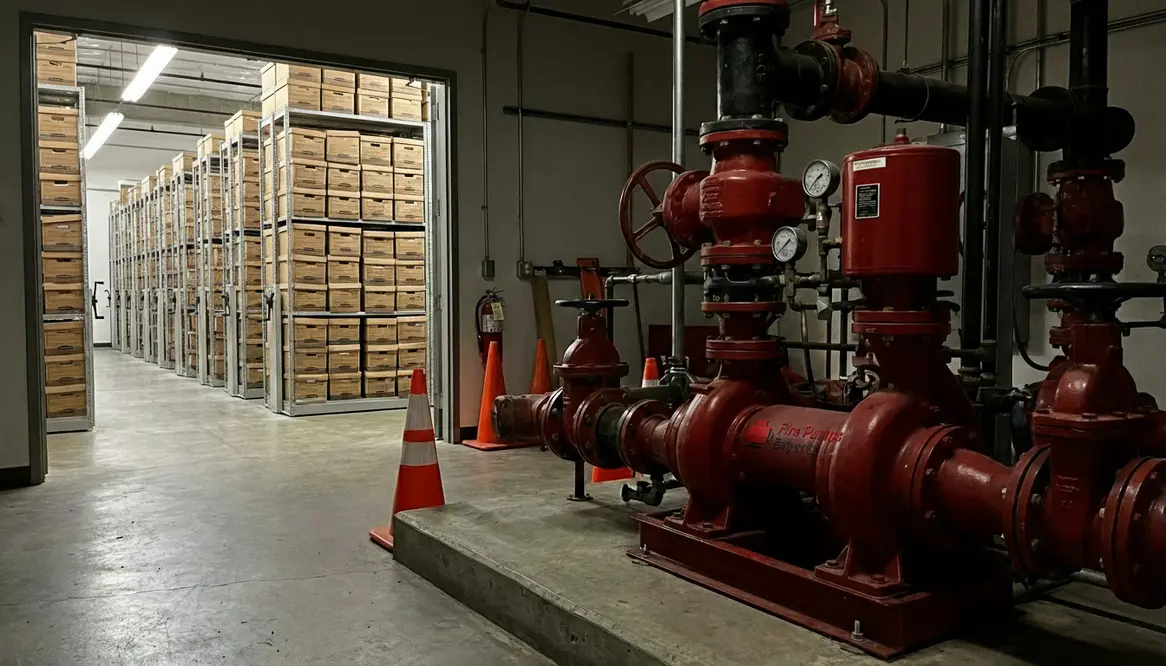
Pressure must be consistent. Archive shelving often reaches significant heights. Therefore, I ensure the pump can maintain adequate pressure across all levels. Otherwise, the upper tiers become vulnerable, and fire does not politely stay on the ground floor.
Pillar 3: System integration
Integration matters. The fire pump must work seamlessly with sprinkler systems, alarms, and backup power. In many cases, I tie pumps into emergency generators. Because when the power goes out during a fire, that is exactly when you need the system most. Murphy’s Law loves fire protection engineers.
How do I size a fire pump for records storage facilities
I get this question often, and the answer is never one size fits all. However, I follow a clear method when working through Fire Pump Requirements for Archive Buildings in real projects.
Step 1: Assess the hazard classification
Archive storage often falls under high density storage categories due to compact shelving. Consequently, this drives higher flow and pressure requirements. You are not protecting open office space; you are protecting tightly packed fuel with limited gaps.
Step 2: Evaluate building height and layout
Next, I evaluate building height and layout. Long horizontal runs and tall vertical stacks both impact hydraulic demand. Therefore, I calculate total system demand rather than guessing based on square footage. Every bend, elevation change, and remote rack matters.
Step 3: Account for growth and change
Then, I factor in future expansion. Archive facilities rarely shrink. If anything, they grow like a streaming service content library. So I size pumps with a margin that supports future shelving or additional rooms.
In the end, the goal is simple. Deliver enough water, at the right pressure, exactly when needed. No drama, no surprises.
Balancing fire suppression with document preservation
This is where things get interesting. And by interesting, I mean slightly nerve wracking.
Traditional sprinkler systems can cause significant water damage. However, under protecting the facility is not an option. So I often recommend a layered approach.
Fire Protection Priorities
Maintain rapid fire suppression capability.
Ensure full coverage across storage zones.
Support high density shelving layouts.
Damage Control Strategies
Use pre action sprinkler systems where applicable.
Control discharge zones precisely.
Integrate early detection systems.
Because of this, I often pair fire pumps with pre action systems. These require confirmation before water is released. As a result, accidental discharge risks drop significantly. It is like having a double lock on a vault, except the vault is full of documents instead of gold bars.
Power supply and redundancy planning for fire pumps
Let me be blunt. A fire pump without reliable power is just expensive decoration.
Therefore, I always design with redundancy in mind. Electric pumps should connect to backup generators. In some cases, I even specify diesel driven pumps as a secondary option. This ensures operation even during grid failure.
Additionally, I consider automatic transfer switches. These allow seamless transition between power sources. Because during a fire event, seconds matter. Nobody wants a system that pauses like a buffering video at the worst possible moment.
Maintenance planning that actually works
Even the best system fails without proper maintenance. I have seen pristine installations become liabilities simply because nobody checked them.
So I build maintenance into the plan from day one. Weekly churn tests, regular inspections, and performance tracking are essential. Moreover, I ensure facility teams understand the system. Because a well trained operator can prevent small issues from becoming disasters.
In large commercial and industrial archive facilities, I also recommend remote monitoring. This allows real time performance tracking and alerts. It is like having a security guard for your fire pump, except it never sleeps or asks for coffee breaks.
FAQ about fire pump planning for archive facilities
Alongside the technical design, Fire Pump Requirements for Archive Buildings generate a few recurring questions. The most common ones tend to circle around system necessity, water damage, and ongoing testing.
What makes archive buildings different for fire pump design?
High density paper storage creates rapid fire spread and requires higher pressure and flow control. You are designing for tall, compact racks of combustible material, not open, lightly loaded spaces, so the fire pump has to be selected and sized with that fuel load in mind.
Do archive facilities always need a fire pump?
Most large commercial archive buildings require fire pumps to meet system demand and code compliance. Smaller or low rise facilities might occasionally get by on municipal pressure, but once you add height, density, and long piping runs, a dedicated pump becomes the realistic path to reliable protection.
Can fire pumps help reduce water damage to documents?
Indirectly, yes. A correctly sized and controlled pump delivers the right pressure for the sprinklers or pre action system, which helps avoid excessive discharge, unwanted head operation, or unstable system performance that can soak areas well beyond the fire zone.
Are backup power systems required for fire pumps in archives?
Yes. Reliable operation during outages is critical for fire protection systems. For archive facilities, pairing the fire pump with an emergency generator, or using a diesel driven unit as a backup, keeps the system available when utility power disappears at the exact wrong time.
How often should fire pumps be tested in archive buildings?
Weekly churn tests and regular inspections are standard for commercial facilities. In high value archive spaces, I also recommend trend tracking of pump performance, so subtle changes in flow, pressure, or start up behavior are caught long before an emergency exposes them.
Final thoughts and next steps
Fire pump planning for archive facilities is not just about meeting code. It is about protecting irreplaceable assets with precision and foresight. Fire Pump Requirements for Archive Buildings sit at the intersection of hydraulics, risk management, and document preservation, and they reward careful, thoughtful design.
If you are managing a commercial or industrial records facility, now is the time to evaluate your system, refine your design, and ensure every component works together. Bring in professionals who live in this world, who understand compact storage, pre action systems, reliable power, and the human side of maintenance culture.
The right fire pump, chosen and maintained correctly, quietly becomes the backbone of your protection strategy. It does not need attention, applause, or drama. It just needs to start every time, flow what it should, and support a suppression system designed to keep both your building and your records standing for the long term.
Pillar 1: Reliability
Reliability is non negotiable. I always recommend redundant pump systems for major commercial archive facilities. If one pump fails, another must take over instantly. This is not a place to cut corners. Not unless you want your risk manager to age ten years overnight.
Pillar 2: Pressure control
Pressure must be consistent. Archive shelving often reaches significant heights. Therefore, I ensure the pump can maintain adequate pressure across all levels. Otherwise, the upper tiers become vulnerable, and fire does not politely stay on the ground floor.
Pillar 3: System integration
Integration matters. The fire pump must work seamlessly with sprinkler systems, alarms, and backup power. In many cases, I tie pumps into emergency generators. Because when the power goes out during a fire, that is exactly when you need the system most. Murphy’s Law loves fire protection engineers.
How do I size a fire pump for records storage facilities
I get this question often, and the answer is never one size fits all. However, I follow a clear method when working through Fire Pump Requirements for Archive Buildings in real projects.
Step 1: Assess the hazard classification
Archive storage often falls under high density storage categories due to compact shelving. Consequently, this drives higher flow and pressure requirements. You are not protecting open office space; you are protecting tightly packed fuel with limited gaps.
Step 2: Evaluate building height and layout
Next, I evaluate building height and layout. Long horizontal runs and tall vertical stacks both impact hydraulic demand. Therefore, I calculate total system demand rather than guessing based on square footage. Every bend, elevation change, and remote rack matters.
Step 3: Account for growth and change
Then, I factor in future expansion. Archive facilities rarely shrink. If anything, they grow like a streaming service content library. So I size pumps with a margin that supports future shelving or additional rooms.
In the end, the goal is simple. Deliver enough water, at the right pressure, exactly when needed. No drama, no surprises.
Balancing fire suppression with document preservation
This is where things get interesting. And by interesting, I mean slightly nerve wracking.
Traditional sprinkler systems can cause significant water damage. However, under protecting the facility is not an option. So I often recommend a layered approach.
Fire Protection Priorities
Maintain rapid fire suppression capability.
Ensure full coverage across storage zones.
Support high density shelving layouts.
Damage Control Strategies
Use pre action sprinkler systems where applicable.
Control discharge zones precisely.
Integrate early detection systems.
Because of this, I often pair fire pumps with pre action systems. These require confirmation before water is released. As a result, accidental discharge risks drop significantly. It is like having a double lock on a vault, except the vault is full of documents instead of gold bars.
Power supply and redundancy planning for fire pumps
Let me be blunt. A fire pump without reliable power is just expensive decoration.
Therefore, I always design with redundancy in mind. Electric pumps should connect to backup generators. In some cases, I even specify diesel driven pumps as a secondary option. This ensures operation even during grid failure.
Additionally, I consider automatic transfer switches. These allow seamless transition between power sources. Because during a fire event, seconds matter. Nobody wants a system that pauses like a buffering video at the worst possible moment.
Maintenance planning that actually works
Even the best system fails without proper maintenance. I have seen pristine installations become liabilities simply because nobody checked them.
So I build maintenance into the plan from day one. Weekly churn tests, regular inspections, and performance tracking are essential. Moreover, I ensure facility teams understand the system. Because a well trained operator can prevent small issues from becoming disasters.
In large commercial and industrial archive facilities, I also recommend remote monitoring. This allows real time performance tracking and alerts. It is like having a security guard for your fire pump, except it never sleeps or asks for coffee breaks.
FAQ about fire pump planning for archive facilities
Alongside the technical design, Fire Pump Requirements for Archive Buildings generate a few recurring questions. The most common ones tend to circle around system necessity, water damage, and ongoing testing.
Final thoughts and next steps
Fire pump planning for archive facilities is not just about meeting code. It is about protecting irreplaceable assets with precision and foresight. Fire Pump Requirements for Archive Buildings sit at the intersection of hydraulics, risk management, and document preservation, and they reward careful, thoughtful design.
If you are managing a commercial or industrial records facility, now is the time to evaluate your system, refine your design, and ensure every component works together. Bring in professionals who live in this world, who understand compact storage, pre action systems, reliable power, and the human side of maintenance culture.
The right fire pump, chosen and maintained correctly, quietly becomes the backbone of your protection strategy. It does not need attention, applause, or drama. It just needs to start every time, flow what it should, and support a suppression system designed to keep both your building and your records standing for the long term.
Pillar 1: Reliability
Reliability is non negotiable. I always recommend redundant pump systems for major commercial archive facilities. If one pump fails, another must take over instantly. This is not a place to cut corners. Not unless you want your risk manager to age ten years overnight.
Pillar 2: Pressure control
Pressure must be consistent. Archive shelving often reaches significant heights. Therefore, I ensure the pump can maintain adequate pressure across all levels. Otherwise, the upper tiers become vulnerable, and fire does not politely stay on the ground floor.
Pillar 3: System integration
Integration matters. The fire pump must work seamlessly with sprinkler systems, alarms, and backup power. In many cases, I tie pumps into emergency generators. Because when the power goes out during a fire, that is exactly when you need the system most. Murphy’s Law loves fire protection engineers.
How do I size a fire pump for records storage facilities
I get this question often, and the answer is never one size fits all. However, I follow a clear method when working through Fire Pump Requirements for Archive Buildings in real projects.
Step 1: Assess the hazard classification
Archive storage often falls under high density storage categories due to compact shelving. Consequently, this drives higher flow and pressure requirements. You are not protecting open office space; you are protecting tightly packed fuel with limited gaps.
Step 2: Evaluate building height and layout
Next, I evaluate building height and layout. Long horizontal runs and tall vertical stacks both impact hydraulic demand. Therefore, I calculate total system demand rather than guessing based on square footage. Every bend, elevation change, and remote rack matters.
Step 3: Account for growth and change
Then, I factor in future expansion. Archive facilities rarely shrink. If anything, they grow like a streaming service content library. So I size pumps with a margin that supports future shelving or additional rooms.
In the end, the goal is simple. Deliver enough water, at the right pressure, exactly when needed. No drama, no surprises.
Balancing fire suppression with document preservation
This is where things get interesting. And by interesting, I mean slightly nerve wracking.
Traditional sprinkler systems can cause significant water damage. However, under protecting the facility is not an option. So I often recommend a layered approach.
Fire Protection Priorities
Maintain rapid fire suppression capability.
Ensure full coverage across storage zones.
Support high density shelving layouts.
Damage Control Strategies
Use pre action sprinkler systems where applicable.
Control discharge zones precisely.
Integrate early detection systems.
Because of this, I often pair fire pumps with pre action systems. These require confirmation before water is released. As a result, accidental discharge risks drop significantly. It is like having a double lock on a vault, except the vault is full of documents instead of gold bars.
Power supply and redundancy planning for fire pumps
Let me be blunt. A fire pump without reliable power is just expensive decoration.
Therefore, I always design with redundancy in mind. Electric pumps should connect to backup generators. In some cases, I even specify diesel driven pumps as a secondary option. This ensures operation even during grid failure.
Additionally, I consider automatic transfer switches. These allow seamless transition between power sources. Because during a fire event, seconds matter. Nobody wants a system that pauses like a buffering video at the worst possible moment.
Maintenance planning that actually works
Even the best system fails without proper maintenance. I have seen pristine installations become liabilities simply because nobody checked them.
So I build maintenance into the plan from day one. Weekly churn tests, regular inspections, and performance tracking are essential. Moreover, I ensure facility teams understand the system. Because a well trained operator can prevent small issues from becoming disasters.
In large commercial and industrial archive facilities, I also recommend remote monitoring. This allows real time performance tracking and alerts. It is like having a security guard for your fire pump, except it never sleeps or asks for coffee breaks.
FAQ about fire pump planning for archive facilities
Alongside the technical design, Fire Pump Requirements for Archive Buildings generate a few recurring questions. The most common ones tend to circle around system necessity, water damage, and ongoing testing.
Final thoughts and next steps
Fire pump planning for archive facilities is not just about meeting code. It is about protecting irreplaceable assets with precision and foresight. Fire Pump Requirements for Archive Buildings sit at the intersection of hydraulics, risk management, and document preservation, and they reward careful, thoughtful design.
If you are managing a commercial or industrial records facility, now is the time to evaluate your system, refine your design, and ensure every component works together. Bring in professionals who live in this world, who understand compact storage, pre action systems, reliable power, and the human side of maintenance culture.
The right fire pump, chosen and maintained correctly, quietly becomes the backbone of your protection strategy. It does not need attention, applause, or drama. It just needs to start every time, flow what it should, and support a suppression system designed to keep both your building and your records standing for the long term.
What makes the risk profile unique
Fuel is everywhere, tightly packed, and vertically stacked.
Access paths can be narrow, making firefighting tactics more complex.
Ventilation and climate control can move smoke and heat in unhelpful ways.
The cost of failure is not just physical damage, it is the loss of information and continuity.
Why this changes pump expectations
Because archives combine high fuel load with high value content, Fire Pump Requirements for Archive Buildings must account for rapid fire growth, difficult access, and the need to limit collateral damage from the very water used to save the building.
Fire Pump Requirements for Archive Buildings and how I approach them
When I evaluate Fire Pump Requirements for Archive Buildings, I focus on three pillars: reliability, pressure control, and system integration.
Pillar 1: Reliability
Reliability is non negotiable. I always recommend redundant pump systems for major commercial archive facilities. If one pump fails, another must take over instantly. This is not a place to cut corners. Not unless you want your risk manager to age ten years overnight.
Pillar 2: Pressure control
Pressure must be consistent. Archive shelving often reaches significant heights. Therefore, I ensure the pump can maintain adequate pressure across all levels. Otherwise, the upper tiers become vulnerable, and fire does not politely stay on the ground floor.
Pillar 3: System integration
Integration matters. The fire pump must work seamlessly with sprinkler systems, alarms, and backup power. In many cases, I tie pumps into emergency generators. Because when the power goes out during a fire, that is exactly when you need the system most. Murphy’s Law loves fire protection engineers.
How do I size a fire pump for records storage facilities
I get this question often, and the answer is never one size fits all. However, I follow a clear method when working through Fire Pump Requirements for Archive Buildings in real projects.
Step 1: Assess the hazard classification
Archive storage often falls under high density storage categories due to compact shelving. Consequently, this drives higher flow and pressure requirements. You are not protecting open office space; you are protecting tightly packed fuel with limited gaps.
Step 2: Evaluate building height and layout
Next, I evaluate building height and layout. Long horizontal runs and tall vertical stacks both impact hydraulic demand. Therefore, I calculate total system demand rather than guessing based on square footage. Every bend, elevation change, and remote rack matters.
Step 3: Account for growth and change
Then, I factor in future expansion. Archive facilities rarely shrink. If anything, they grow like a streaming service content library. So I size pumps with a margin that supports future shelving or additional rooms.
In the end, the goal is simple. Deliver enough water, at the right pressure, exactly when needed. No drama, no surprises.
Balancing fire suppression with document preservation
This is where things get interesting. And by interesting, I mean slightly nerve wracking.
Traditional sprinkler systems can cause significant water damage. However, under protecting the facility is not an option. So I often recommend a layered approach.
Fire Protection Priorities
Maintain rapid fire suppression capability.
Ensure full coverage across storage zones.
Support high density shelving layouts.
Damage Control Strategies
Use pre action sprinkler systems where applicable.
Control discharge zones precisely.
Integrate early detection systems.
Because of this, I often pair fire pumps with pre action systems. These require confirmation before water is released. As a result, accidental discharge risks drop significantly. It is like having a double lock on a vault, except the vault is full of documents instead of gold bars.
Power supply and redundancy planning for fire pumps
Let me be blunt. A fire pump without reliable power is just expensive decoration.
Therefore, I always design with redundancy in mind. Electric pumps should connect to backup generators. In some cases, I even specify diesel driven pumps as a secondary option. This ensures operation even during grid failure.
Additionally, I consider automatic transfer switches. These allow seamless transition between power sources. Because during a fire event, seconds matter. Nobody wants a system that pauses like a buffering video at the worst possible moment.
Maintenance planning that actually works
Even the best system fails without proper maintenance. I have seen pristine installations become liabilities simply because nobody checked them.
So I build maintenance into the plan from day one. Weekly churn tests, regular inspections, and performance tracking are essential. Moreover, I ensure facility teams understand the system. Because a well trained operator can prevent small issues from becoming disasters.
In large commercial and industrial archive facilities, I also recommend remote monitoring. This allows real time performance tracking and alerts. It is like having a security guard for your fire pump, except it never sleeps or asks for coffee breaks.
FAQ about fire pump planning for archive facilities
Alongside the technical design, Fire Pump Requirements for Archive Buildings generate a few recurring questions. The most common ones tend to circle around system necessity, water damage, and ongoing testing.
Final thoughts and next steps
Fire pump planning for archive facilities is not just about meeting code. It is about protecting irreplaceable assets with precision and foresight. Fire Pump Requirements for Archive Buildings sit at the intersection of hydraulics, risk management, and document preservation, and they reward careful, thoughtful design.
If you are managing a commercial or industrial records facility, now is the time to evaluate your system, refine your design, and ensure every component works together. Bring in professionals who live in this world, who understand compact storage, pre action systems, reliable power, and the human side of maintenance culture.
The right fire pump, chosen and maintained correctly, quietly becomes the backbone of your protection strategy. It does not need attention, applause, or drama. It just needs to start every time, flow what it should, and support a suppression system designed to keep both your building and your records standing for the long term.
What makes the risk profile unique
Fuel is everywhere, tightly packed, and vertically stacked.
Access paths can be narrow, making firefighting tactics more complex.
Ventilation and climate control can move smoke and heat in unhelpful ways.
The cost of failure is not just physical damage, it is the loss of information and continuity.
Why this changes pump expectations
Because archives combine high fuel load with high value content, Fire Pump Requirements for Archive Buildings must account for rapid fire growth, difficult access, and the need to limit collateral damage from the very water used to save the building.
Fire Pump Requirements for Archive Buildings and how I approach them
When I evaluate Fire Pump Requirements for Archive Buildings, I focus on three pillars: reliability, pressure control, and system integration.
Pillar 1: Reliability
Reliability is non negotiable. I always recommend redundant pump systems for major commercial archive facilities. If one pump fails, another must take over instantly. This is not a place to cut corners. Not unless you want your risk manager to age ten years overnight.
Pillar 2: Pressure control
Pressure must be consistent. Archive shelving often reaches significant heights. Therefore, I ensure the pump can maintain adequate pressure across all levels. Otherwise, the upper tiers become vulnerable, and fire does not politely stay on the ground floor.
Pillar 3: System integration
Integration matters. The fire pump must work seamlessly with sprinkler systems, alarms, and backup power. In many cases, I tie pumps into emergency generators. Because when the power goes out during a fire, that is exactly when you need the system most. Murphy’s Law loves fire protection engineers.
How do I size a fire pump for records storage facilities
I get this question often, and the answer is never one size fits all. However, I follow a clear method when working through Fire Pump Requirements for Archive Buildings in real projects.
Step 1: Assess the hazard classification
Archive storage often falls under high density storage categories due to compact shelving. Consequently, this drives higher flow and pressure requirements. You are not protecting open office space; you are protecting tightly packed fuel with limited gaps.
Step 2: Evaluate building height and layout
Next, I evaluate building height and layout. Long horizontal runs and tall vertical stacks both impact hydraulic demand. Therefore, I calculate total system demand rather than guessing based on square footage. Every bend, elevation change, and remote rack matters.
Step 3: Account for growth and change
Then, I factor in future expansion. Archive facilities rarely shrink. If anything, they grow like a streaming service content library. So I size pumps with a margin that supports future shelving or additional rooms.
In the end, the goal is simple. Deliver enough water, at the right pressure, exactly when needed. No drama, no surprises.
Balancing fire suppression with document preservation
This is where things get interesting. And by interesting, I mean slightly nerve wracking.
Traditional sprinkler systems can cause significant water damage. However, under protecting the facility is not an option. So I often recommend a layered approach.
Fire Protection Priorities
Maintain rapid fire suppression capability.
Ensure full coverage across storage zones.
Support high density shelving layouts.
Damage Control Strategies
Use pre action sprinkler systems where applicable.
Control discharge zones precisely.
Integrate early detection systems.
Because of this, I often pair fire pumps with pre action systems. These require confirmation before water is released. As a result, accidental discharge risks drop significantly. It is like having a double lock on a vault, except the vault is full of documents instead of gold bars.
Power supply and redundancy planning for fire pumps
Let me be blunt. A fire pump without reliable power is just expensive decoration.
Therefore, I always design with redundancy in mind. Electric pumps should connect to backup generators. In some cases, I even specify diesel driven pumps as a secondary option. This ensures operation even during grid failure.
Additionally, I consider automatic transfer switches. These allow seamless transition between power sources. Because during a fire event, seconds matter. Nobody wants a system that pauses like a buffering video at the worst possible moment.
Maintenance planning that actually works
Even the best system fails without proper maintenance. I have seen pristine installations become liabilities simply because nobody checked them.
So I build maintenance into the plan from day one. Weekly churn tests, regular inspections, and performance tracking are essential. Moreover, I ensure facility teams understand the system. Because a well trained operator can prevent small issues from becoming disasters.
In large commercial and industrial archive facilities, I also recommend remote monitoring. This allows real time performance tracking and alerts. It is like having a security guard for your fire pump, except it never sleeps or asks for coffee breaks.
FAQ about fire pump planning for archive facilities
Alongside the technical design, Fire Pump Requirements for Archive Buildings generate a few recurring questions. The most common ones tend to circle around system necessity, water damage, and ongoing testing.
Final thoughts and next steps
Fire pump planning for archive facilities is not just about meeting code. It is about protecting irreplaceable assets with precision and foresight. Fire Pump Requirements for Archive Buildings sit at the intersection of hydraulics, risk management, and document preservation, and they reward careful, thoughtful design.
If you are managing a commercial or industrial records facility, now is the time to evaluate your system, refine your design, and ensure every component works together. Bring in professionals who live in this world, who understand compact storage, pre action systems, reliable power, and the human side of maintenance culture.
The right fire pump, chosen and maintained correctly, quietly becomes the backbone of your protection strategy. It does not need attention, applause, or drama. It just needs to start every time, flow what it should, and support a suppression system designed to keep both your building and your records standing for the long term.
Fire Pump Requirements for Archive Buildings Guide
Fire Pump Requirements for Archive Buildings deserve more than a checklist. They deserve a strategy that respects the quiet weight of the records they protect.
I have spent enough time around archive facilities to know one thing for certain. Paper may be quiet, but it carries a heavy responsibility. When we talk about Fire Pump Requirements for Archive Buildings, we are not just talking about equipment. We are talking about preserving history, contracts, legal records, and sometimes the only copy of something that matters. So in this piece, I will walk you through how I approach fire pump planning for records and document storage, with a calm head, a sharp eye, and just enough humor to keep us awake.
Think of this as a practical field guide, not a dry code summary. We are aiming for systems that work under pressure, respect the documents, and do not give risk managers heartburn every time a storm hits the power grid.
Why archive facilities demand a different fire protection mindset
Archive buildings are not your average warehouse. Sure, they may look similar from the outside. Big structure, rows of shelving, climate control humming in the background. However, the fire risk profile is entirely different.
Paper burns fast. That is obvious. Yet what many overlook is how tightly packed records create dense fuel loads. As a result, once a fire starts, it spreads with surprising efficiency. Therefore, I always treat archive spaces like a slow ticking fuse.
Moreover, water damage is just as dangerous as fire. It is the classic lose lose scenario. On one hand, you need enough suppression power. On the other, too much water can destroy documents just as effectively. That balance is where smart fire pump planning comes in.
What makes the risk profile unique
Fuel is everywhere, tightly packed, and vertically stacked.
Access paths can be narrow, making firefighting tactics more complex.
Ventilation and climate control can move smoke and heat in unhelpful ways.
The cost of failure is not just physical damage, it is the loss of information and continuity.
Why this changes pump expectations
Because archives combine high fuel load with high value content, Fire Pump Requirements for Archive Buildings must account for rapid fire growth, difficult access, and the need to limit collateral damage from the very water used to save the building.
Fire Pump Requirements for Archive Buildings and how I approach them
When I evaluate Fire Pump Requirements for Archive Buildings, I focus on three pillars: reliability, pressure control, and system integration.
Pillar 1: Reliability
Reliability is non negotiable. I always recommend redundant pump systems for major commercial archive facilities. If one pump fails, another must take over instantly. This is not a place to cut corners. Not unless you want your risk manager to age ten years overnight.
Pillar 2: Pressure control
Pressure must be consistent. Archive shelving often reaches significant heights. Therefore, I ensure the pump can maintain adequate pressure across all levels. Otherwise, the upper tiers become vulnerable, and fire does not politely stay on the ground floor.
Pillar 3: System integration
Integration matters. The fire pump must work seamlessly with sprinkler systems, alarms, and backup power. In many cases, I tie pumps into emergency generators. Because when the power goes out during a fire, that is exactly when you need the system most. Murphy’s Law loves fire protection engineers.
How do I size a fire pump for records storage facilities
I get this question often, and the answer is never one size fits all. However, I follow a clear method when working through Fire Pump Requirements for Archive Buildings in real projects.
Step 1: Assess the hazard classification
Archive storage often falls under high density storage categories due to compact shelving. Consequently, this drives higher flow and pressure requirements. You are not protecting open office space; you are protecting tightly packed fuel with limited gaps.
Step 2: Evaluate building height and layout
Next, I evaluate building height and layout. Long horizontal runs and tall vertical stacks both impact hydraulic demand. Therefore, I calculate total system demand rather than guessing based on square footage. Every bend, elevation change, and remote rack matters.
Step 3: Account for growth and change
Then, I factor in future expansion. Archive facilities rarely shrink. If anything, they grow like a streaming service content library. So I size pumps with a margin that supports future shelving or additional rooms.
In the end, the goal is simple. Deliver enough water, at the right pressure, exactly when needed. No drama, no surprises.
Balancing fire suppression with document preservation
This is where things get interesting. And by interesting, I mean slightly nerve wracking.
Traditional sprinkler systems can cause significant water damage. However, under protecting the facility is not an option. So I often recommend a layered approach.
Fire Protection Priorities
Maintain rapid fire suppression capability.
Ensure full coverage across storage zones.
Support high density shelving layouts.
Damage Control Strategies
Use pre action sprinkler systems where applicable.
Control discharge zones precisely.
Integrate early detection systems.
Because of this, I often pair fire pumps with pre action systems. These require confirmation before water is released. As a result, accidental discharge risks drop significantly. It is like having a double lock on a vault, except the vault is full of documents instead of gold bars.
Power supply and redundancy planning for fire pumps
Let me be blunt. A fire pump without reliable power is just expensive decoration.
Therefore, I always design with redundancy in mind. Electric pumps should connect to backup generators. In some cases, I even specify diesel driven pumps as a secondary option. This ensures operation even during grid failure.
Additionally, I consider automatic transfer switches. These allow seamless transition between power sources. Because during a fire event, seconds matter. Nobody wants a system that pauses like a buffering video at the worst possible moment.
Maintenance planning that actually works
Even the best system fails without proper maintenance. I have seen pristine installations become liabilities simply because nobody checked them.
So I build maintenance into the plan from day one. Weekly churn tests, regular inspections, and performance tracking are essential. Moreover, I ensure facility teams understand the system. Because a well trained operator can prevent small issues from becoming disasters.
In large commercial and industrial archive facilities, I also recommend remote monitoring. This allows real time performance tracking and alerts. It is like having a security guard for your fire pump, except it never sleeps or asks for coffee breaks.
FAQ about fire pump planning for archive facilities
Alongside the technical design, Fire Pump Requirements for Archive Buildings generate a few recurring questions. The most common ones tend to circle around system necessity, water damage, and ongoing testing.
Final thoughts and next steps
Fire pump planning for archive facilities is not just about meeting code. It is about protecting irreplaceable assets with precision and foresight. Fire Pump Requirements for Archive Buildings sit at the intersection of hydraulics, risk management, and document preservation, and they reward careful, thoughtful design.
If you are managing a commercial or industrial records facility, now is the time to evaluate your system, refine your design, and ensure every component works together. Bring in professionals who live in this world, who understand compact storage, pre action systems, reliable power, and the human side of maintenance culture.
The right fire pump, chosen and maintained correctly, quietly becomes the backbone of your protection strategy. It does not need attention, applause, or drama. It just needs to start every time, flow what it should, and support a suppression system designed to keep both your building and your records standing for the long term.
Fire Pump Requirements for Archive Buildings Guide
Fire Pump Requirements for Archive Buildings deserve more than a checklist. They deserve a strategy that respects the quiet weight of the records they protect.
I have spent enough time around archive facilities to know one thing for certain. Paper may be quiet, but it carries a heavy responsibility. When we talk about Fire Pump Requirements for Archive Buildings, we are not just talking about equipment. We are talking about preserving history, contracts, legal records, and sometimes the only copy of something that matters. So in this piece, I will walk you through how I approach fire pump planning for records and document storage, with a calm head, a sharp eye, and just enough humor to keep us awake.
Think of this as a practical field guide, not a dry code summary. We are aiming for systems that work under pressure, respect the documents, and do not give risk managers heartburn every time a storm hits the power grid.
Why archive facilities demand a different fire protection mindset
Archive buildings are not your average warehouse. Sure, they may look similar from the outside. Big structure, rows of shelving, climate control humming in the background. However, the fire risk profile is entirely different.
Paper burns fast. That is obvious. Yet what many overlook is how tightly packed records create dense fuel loads. As a result, once a fire starts, it spreads with surprising efficiency. Therefore, I always treat archive spaces like a slow ticking fuse.
Moreover, water damage is just as dangerous as fire. It is the classic lose lose scenario. On one hand, you need enough suppression power. On the other, too much water can destroy documents just as effectively. That balance is where smart fire pump planning comes in.
What makes the risk profile unique
Fuel is everywhere, tightly packed, and vertically stacked.
Access paths can be narrow, making firefighting tactics more complex.
Ventilation and climate control can move smoke and heat in unhelpful ways.
The cost of failure is not just physical damage, it is the loss of information and continuity.
Why this changes pump expectations
Because archives combine high fuel load with high value content, Fire Pump Requirements for Archive Buildings must account for rapid fire growth, difficult access, and the need to limit collateral damage from the very water used to save the building.
Fire Pump Requirements for Archive Buildings and how I approach them
When I evaluate Fire Pump Requirements for Archive Buildings, I focus on three pillars: reliability, pressure control, and system integration.
Pillar 1: Reliability
Reliability is non negotiable. I always recommend redundant pump systems for major commercial archive facilities. If one pump fails, another must take over instantly. This is not a place to cut corners. Not unless you want your risk manager to age ten years overnight.
Pillar 2: Pressure control
Pressure must be consistent. Archive shelving often reaches significant heights. Therefore, I ensure the pump can maintain adequate pressure across all levels. Otherwise, the upper tiers become vulnerable, and fire does not politely stay on the ground floor.
Pillar 3: System integration
Integration matters. The fire pump must work seamlessly with sprinkler systems, alarms, and backup power. In many cases, I tie pumps into emergency generators. Because when the power goes out during a fire, that is exactly when you need the system most. Murphy’s Law loves fire protection engineers.
How do I size a fire pump for records storage facilities
I get this question often, and the answer is never one size fits all. However, I follow a clear method when working through Fire Pump Requirements for Archive Buildings in real projects.
Step 1: Assess the hazard classification
Archive storage often falls under high density storage categories due to compact shelving. Consequently, this drives higher flow and pressure requirements. You are not protecting open office space; you are protecting tightly packed fuel with limited gaps.
Step 2: Evaluate building height and layout
Next, I evaluate building height and layout. Long horizontal runs and tall vertical stacks both impact hydraulic demand. Therefore, I calculate total system demand rather than guessing based on square footage. Every bend, elevation change, and remote rack matters.
Step 3: Account for growth and change
Then, I factor in future expansion. Archive facilities rarely shrink. If anything, they grow like a streaming service content library. So I size pumps with a margin that supports future shelving or additional rooms.
In the end, the goal is simple. Deliver enough water, at the right pressure, exactly when needed. No drama, no surprises.
Balancing fire suppression with document preservation
This is where things get interesting. And by interesting, I mean slightly nerve wracking.
Traditional sprinkler systems can cause significant water damage. However, under protecting the facility is not an option. So I often recommend a layered approach.
Fire Protection Priorities
Maintain rapid fire suppression capability.
Ensure full coverage across storage zones.
Support high density shelving layouts.
Damage Control Strategies
Use pre action sprinkler systems where applicable.
Control discharge zones precisely.
Integrate early detection systems.
Because of this, I often pair fire pumps with pre action systems. These require confirmation before water is released. As a result, accidental discharge risks drop significantly. It is like having a double lock on a vault, except the vault is full of documents instead of gold bars.
Power supply and redundancy planning for fire pumps
Let me be blunt. A fire pump without reliable power is just expensive decoration.
Therefore, I always design with redundancy in mind. Electric pumps should connect to backup generators. In some cases, I even specify diesel driven pumps as a secondary option. This ensures operation even during grid failure.
Additionally, I consider automatic transfer switches. These allow seamless transition between power sources. Because during a fire event, seconds matter. Nobody wants a system that pauses like a buffering video at the worst possible moment.
Maintenance planning that actually works
Even the best system fails without proper maintenance. I have seen pristine installations become liabilities simply because nobody checked them.
So I build maintenance into the plan from day one. Weekly churn tests, regular inspections, and performance tracking are essential. Moreover, I ensure facility teams understand the system. Because a well trained operator can prevent small issues from becoming disasters.
In large commercial and industrial archive facilities, I also recommend remote monitoring. This allows real time performance tracking and alerts. It is like having a security guard for your fire pump, except it never sleeps or asks for coffee breaks.
FAQ about fire pump planning for archive facilities
Alongside the technical design, Fire Pump Requirements for Archive Buildings generate a few recurring questions. The most common ones tend to circle around system necessity, water damage, and ongoing testing.
Final thoughts and next steps
Fire pump planning for archive facilities is not just about meeting code. It is about protecting irreplaceable assets with precision and foresight. Fire Pump Requirements for Archive Buildings sit at the intersection of hydraulics, risk management, and document preservation, and they reward careful, thoughtful design.
If you are managing a commercial or industrial records facility, now is the time to evaluate your system, refine your design, and ensure every component works together. Bring in professionals who live in this world, who understand compact storage, pre action systems, reliable power, and the human side of maintenance culture.
The right fire pump, chosen and maintained correctly, quietly becomes the backbone of your protection strategy. It does not need attention, applause, or drama. It just needs to start every time, flow what it should, and support a suppression system designed to keep both your building and your records standing for the long term.