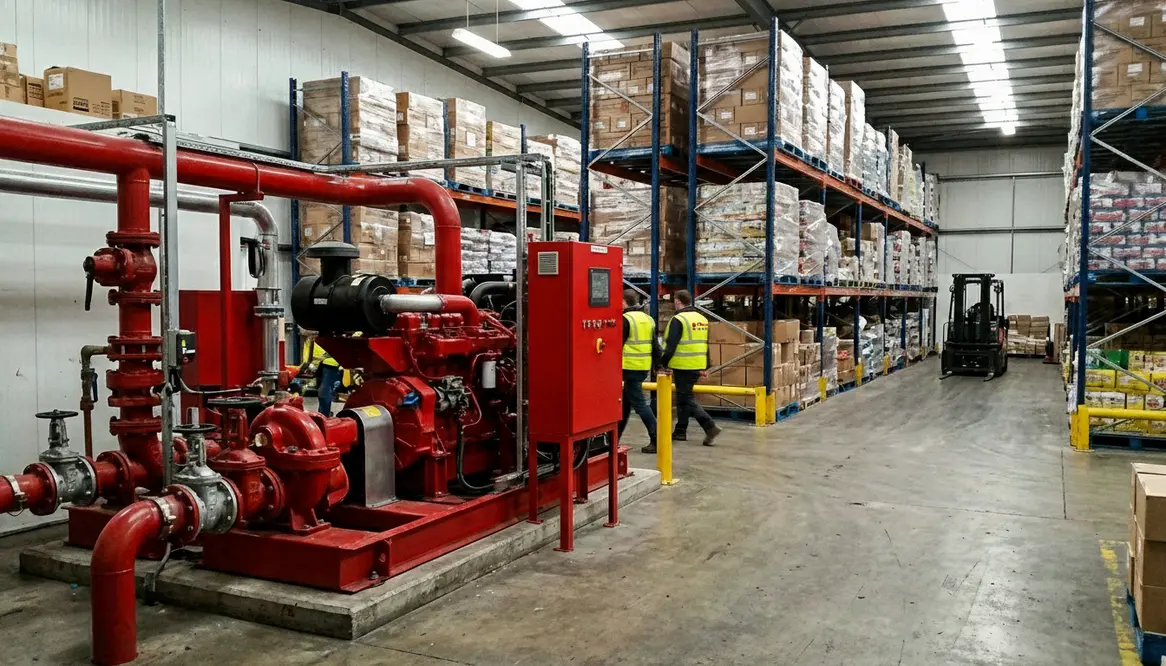
Fire Pump Requirements for Food Warehouses NFPA
I have spent enough time around commercial properties to know one thing for certain. Fire protection is never the place to improvise. Whether I am evaluating high rise systems or specifying long-term care fire pumps, the same truth applies to food warehouses. These facilities hold dense, high value inventory, and once a fire starts, it does not politely stay contained. It spreads like gossip at a family reunion. So today, I am walking you through what fire pump requirements actually apply to food warehouses, and why cutting corners here is about as wise as storing fireworks next to a deep fryer.
Understanding Fire Risk in Food Warehouses
Food warehouses may sound harmless, but they are anything but. I often see towering racks filled with packaged goods, cardboard, and plastic wrap. All of it burns fast. In addition, refrigeration systems, electrical equipment, and forklifts introduce ignition sources.
Because of this, fire protection systems must deliver strong, reliable water flow. Therefore, fire pumps become essential when municipal water supply cannot meet demand. I always remind clients that a sprinkler system without enough pressure is like a superhero without powers. Looks impressive, but does not save the day.
Moreover, commodity classification plays a major role. For example, storing canned goods differs from storing packaged snacks. The latter creates higher fire loads due to plastics. As a result, pump sizing and system design must match the actual hazard, not assumptions.
What fire pump requirements apply to food warehouses?
I get this question a lot, and thankfully, the answer is clear when you follow the standards. Fire pumps in food warehouses must comply with NFPA 20, which governs installation. At the same time, NFPA 13 dictates sprinkler system design, which directly affects pump demand.
Here is what I focus on immediately:
Required flow and pressure
The system must deliver enough water to the most demanding sprinkler area. Therefore, I calculate based on hazard classification and rack storage height.
Reliable power source
Electric pumps need backup power, while diesel pumps provide independence. In many large facilities, I lean toward diesel because outages tend to show up at the worst possible moment.
Dedicated water supply
If city water falls short, I specify tanks or reservoirs. Otherwise, the pump has nothing to boost, which defeats the entire purpose.
Controller and monitoring
Modern controllers provide alarms and status updates. Because of that, facility managers can act before small issues become big problems.
In short, the system must be robust, redundant, and ready to perform instantly. Fire does not wait for a warm up period.
Designing for High Density Storage and Cold Environments
Food warehouses often combine two challenges that do not play nicely together. High density storage and cold temperatures. Therefore, I design systems that can handle both without compromise.
First, high piled storage increases water demand significantly. Consequently, the fire pump must support larger sprinkler discharge rates. I often see designs underestimate this, which leads to expensive retrofits later.
Second, refrigerated areas introduce freezing risks. So, I coordinate dry or preaction systems where needed. However, these systems still depend on a properly sized pump to maintain pressure during activation.
Additionally, I account for expansion. Warehouses rarely stay the same size or layout. Because of that, I build in capacity where possible. It is much easier to oversize slightly today than rebuild tomorrow.
Left Column: Common Oversights
- Undersized pumps
- Ignoring future storage changes
- Inadequate backup power
- Poor coordination with sprinkler design
Right Column: Smart Design Moves
- Match pump to worst case demand
- Plan for higher rack storage
- Include redundancy early
- Align pump and sprinkler engineers
long-term care fire pumps and Cross Industry Lessons
It might seem odd, but I often borrow lessons from long-term care fire pumps when working on warehouses. Why? Because both environments demand reliability over everything else.
In healthcare settings, failure is not an option. Similarly, in a food warehouse, a fire event can disrupt supply chains, damage inventory, and halt operations for weeks. Therefore, I apply the same mindset. Build systems that perform under stress, not just on paper.
For instance, I prioritize routine testing and clear access to equipment. I also ensure components are easy to service. Because when something goes wrong, no one wants to play hide and seek with a control valve.
Inspection, Testing, and Ongoing Compliance
Installing a fire pump is only half the story. Keeping it ready is where the real work begins. Therefore, I always emphasize inspection and testing schedules aligned with NFPA 25.
Weekly churn tests, monthly inspections, and annual flow tests are not optional. They are essential. In fact, I have seen perfectly installed systems fail simply because no one maintained them.
Additionally, documentation matters. Inspectors and insurers expect clear records. So, I recommend digital logging whenever possible. It keeps everything organized and accessible.
And yes, I know testing can feel repetitive. But so is brushing your teeth, and we all agree that skipping it leads to unpleasant consequences.
Conclusion: Build It Right the First Time
When I design fire pump systems for food warehouses, I focus on performance, reliability, and future readiness. Every decision supports those goals. If you are planning or upgrading a facility, now is the time to get it right. Work with specialists who understand commercial scale demands and compliance requirements. Visit https://firepumps.org to explore solutions tailored for large properties, and make sure your system stands ready when it matters most.
Across commercial properties, from warehouses to healthcare, the facilities that come through emergencies the best are always the ones that took fire protection seriously early on. The same philosophy that shapes dependable long-term care fire pumps should guide every major warehouse project: design for the real hazard, maintain relentlessly, and assume that when things go wrong, they will do it at the most inconvenient time possible.
If you treat long-term care fire pumps, warehouse pumps, and every other critical system as part of one reliability-focused strategy, you will not just pass inspections; you will protect people, inventory, and business continuity when the sprinklers finally have to earn their keep.