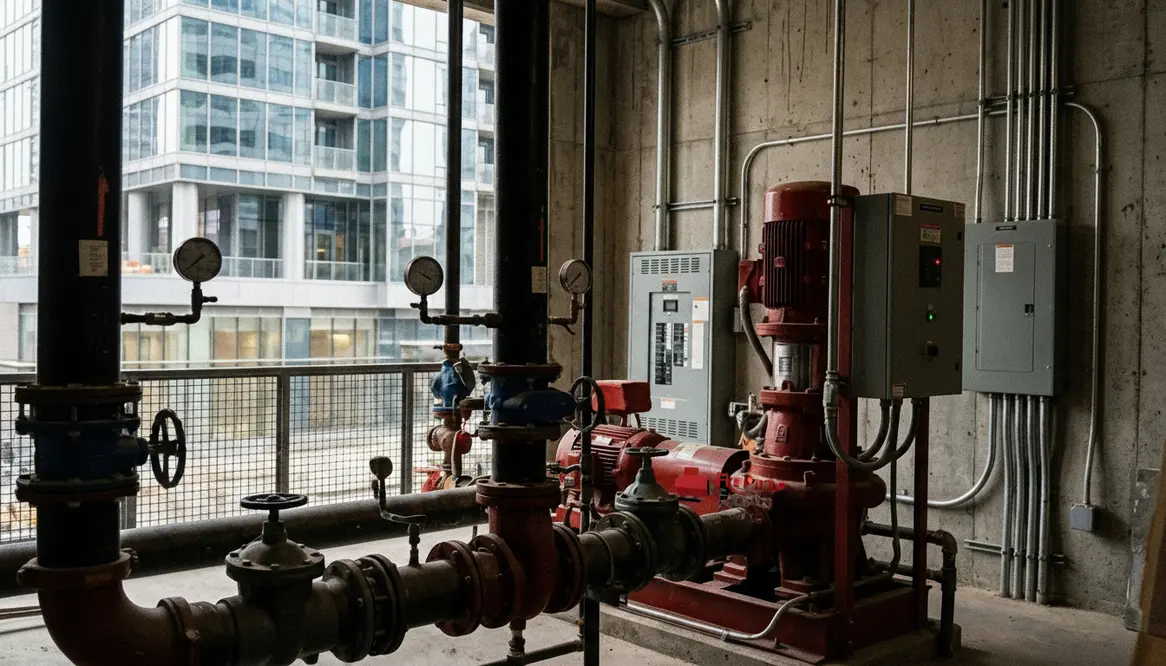
Urban Mixed Use Fire Pump Requirements Guide
A practical guide to designing resilient, future-ready fire pump systems for dense downtown projects.
I have spent years watching downtown skylines grow taller, denser, and more ambitious. And right at the center of that growth sits a quiet, critical question: how do we keep it all safe when things go wrong? The answer often begins with urban mixed use fire pump requirements. These systems are not glamorous, yet they are the heartbeat of fire protection in large commercial and industrial developments. Without them, even the most stunning tower becomes a risk waiting for the wrong spark. So let’s walk through what really matters and why it deserves more attention than it usually gets.
Think of each tower as its own vertical city: kitchens and clubs, offices and server rooms, condos and parking decks. All of them depend on fire pumps that quietly move water with absolute reliability when it matters most.
This guide breaks down how to apply urban mixed use fire pump requirements in real projects so that safety, cost, and performance actually work together instead of fighting each other.
What makes fire protection in downtown developments uniquely complex?
Downtown projects are not simple buildings. They are ecosystems. Offices sit above retail. Parking decks hide below. Hotels, data centers, and mechanical floors stack together like a game of Jenga designed by an ambitious architect. Because of that, fire protection must adapt to multiple risks at once.
For instance, water demand varies wildly between floors. A restaurant kitchen fire does not behave like a server room incident. Meanwhile, vertical height increases pressure challenges. Therefore, fire pumps must deliver consistent performance across every level. It is less “set it and forget it” and more “conduct a symphony where every instrument matters.”
And yes, if buildings had personalities, downtown towers would be the overachievers who never sleep.
Multiple risk profiles in one stack
A single downtown block can combine high-hazard kitchens, office floors packed with people, sensitive data centers, parking structures, and residential units. Each responds differently to heat, smoke, and water. Yet your fire pump system has to serve them all with the right pressure and flow.
Vertical and hydraulic challenges
As buildings climb higher, gravity fights your water supply. Pressure at the top floor is not what you see at the ground floor. That is why urban mixed use fire pump requirements lean on careful zoning, pressure-reducing valves, and properly staged pump selections.
How I approach system design for high density commercial buildings
I start with flow and pressure. Always. Because without those, everything else is just theory. Then I evaluate how different occupancies interact. Mixed use structures demand zoning strategies that prevent one area’s risk from overwhelming another.
Next, I factor in redundancy. In large properties, failure is not an option. Backup pumps, dual power sources, and intelligent controls become essential. Moreover, I align designs with local codes while anticipating future expansion. Cities evolve, and systems must keep up.
Finally, I integrate monitoring. Real time data ensures performance stays consistent. After all, a silent failure is still a failure.
From code minimums to resilient performance
Urban mixed use fire pump requirements may start with standards like NFPA 20 and local amendments, but the real test comes under peak demand: stacked alarms, multiple zones flowing at once, and extended events that stress both power and water infrastructure.
Urban mixed use fire pump requirements in real world applications
When I apply urban mixed use fire pump requirements, I look beyond compliance. I focus on performance under stress. That means selecting pumps that can handle peak demand without hesitation. It also means accounting for pressure fluctuations caused by elevation and system complexity.
In many downtown developments, I specify systems that can scale output dynamically. This ensures efficiency during normal operation while still delivering full power during emergencies. Additionally, I consider how quickly the system activates. Seconds matter more than most people realize.
Interestingly, the best systems often go unnoticed. They sit quietly, waiting. Kind of like a bodyguard in a movie who barely speaks but saves the day when it counts.
Design checkpoints that actually matter
- Is the pump sized and staged for vertical demand, not just total gallons?
- Can the power and control system ride through utility blips and generator transitions?
- Do zoning and valve strategies match the building’s changing risk profile floor by floor?
- Will testing and maintenance be realistic for the people who inherit the system?
Balancing safety, cost, and long term performance
Cost realities
Developers often push for efficiency, which is understandable. However, cutting corners in fire protection is like buying a parachute at a discount store. It might look fine until you actually need it. Therefore, I guide clients toward smart investments that reduce lifecycle costs rather than just upfront expenses.
Performance priorities
On the other hand, overengineering can create unnecessary complexity. So I strike a balance. I design systems that are robust, maintainable, and adaptable. In addition, I ensure service access remains straightforward, because even the best system fails if no one can maintain it properly.
In the background of all of this sit the urban mixed use fire pump requirements that dictate minimums. The real value comes from aligning those minimums with how the building will actually be used, staffed, upgraded, and tested across its lifespan.
How modern technology is reshaping fire protection systems
Technology has changed the game. Smart controllers now provide diagnostics that used to require manual inspection. As a result, operators can detect issues early and act quickly.
Furthermore, integration with building management systems allows seamless coordination. Fire pumps can communicate with alarms, sprinklers, and emergency protocols. This creates a unified response instead of isolated reactions.
And yes, while we are not quite at “Jarvis runs the building” levels yet, we are closer than most people think.
Smarter data, smarter decisions
With continuous monitoring, trend data, and remote alerts, it becomes much easier to prove that your system meets urban mixed use fire pump requirements not just on paper, but in day-to-day operation. Problems that once hid for months now show up as notifications long before a real emergency.
Urban mixed use fire pump requirements and future ready design
Looking ahead, urban mixed use fire pump requirements will continue to evolve. Cities are getting denser, and buildings are becoming more complex. Therefore, flexibility is key.
I design with future modifications in mind. अतिरिक्त capacity, modular components, and adaptable layouts ensure systems remain effective as demands grow. Moreover, sustainability is entering the conversation. Energy efficient pumps and smarter operation cycles are becoming standard expectations.
In short, the goal is not just to meet today’s needs but to anticipate tomorrow’s challenges.
Designing for the building you do not see yet
Downtown districts rarely stand still. Tenants change, uses shift, and that “temporary” data room has a way of becoming permanent. Building in clear access, spare capacity, and documented logic makes it far easier for the next engineer to adjust the system without breaking the intent of the original urban mixed use fire pump requirements.
FAQ: Fire protection for downtown development
What is the role of a fire pump in large buildings?
It ensures consistent water pressure and flow for fire suppression systems across all floors.
Why are mixed use buildings more complex to protect?
They combine different occupancy risks, requiring adaptable and zoned fire protection strategies.
How often should fire pump systems be tested?
Weekly visual checks and monthly or annual performance tests are typical for commercial systems.
What happens if a fire pump fails?
Backup systems activate, but failure can reduce fire suppression effectiveness if redundancy is insufficient.
Are smart fire pump systems worth it?
Yes. They improve monitoring, reduce downtime, and help detect issues early.
Conclusion
Downtown development is only getting bigger, faster, and more intricate. And with that growth comes responsibility. I design fire protection systems that do more than meet code. They protect people, property, and long term investments. If you are planning a major commercial or industrial project, now is the time to get it right. Reach out and let’s build something that stands strong, even when everything else is under pressure.