Fire Pump Requirements for High Hazard Buildings
I have walked through a lot of mechanical rooms in my life. Some quiet as a library. Others humming like the engine room of a starship. And whenever I step into a high hazard facility such as a chemical plant, heavy manufacturing complex, or large scale industrial warehouse, one thought always settles in my mind. Fire does not negotiate.
That is exactly why fire pump requirements high hazard buildings matter so much. These facilities store dense fuel loads, volatile materials, and high value equipment that cannot afford downtime. A properly designed pump system is not just code compliance. It is the heartbeat of the entire fire protection strategy.
Today I want to walk you through how these systems actually work, why the rules are stricter, and what commercial and industrial property owners need to understand before trusting their building to a pump room and a few spinning impellers.
And yes, I promise we will keep it interesting. Even fire pumps deserve a little stage presence.
Understanding Fire Risk in High Hazard Facilities
Before we even touch pump sizing or pressure curves, we need to talk about the environment these systems protect.
High hazard occupancies typically include facilities where fire spreads faster, burns hotter, or threatens critical operations. Think petrochemical processing plants, aerospace manufacturing, large distribution centers storing flammable goods, or industrial fabrication plants filled with oils and solvents.
In these environments, sprinkler systems demand more water and higher pressure. Consequently, the pump that feeds them must deliver serious performance.
I often explain it like this. Protecting a suburban office building is like watering a garden. Protecting a refinery is more like trying to calm a volcano with a fire hose.
Key Design Inputs for High Hazard Fire Pumps
Therefore engineers must calculate:
- Total sprinkler demand across hazard zones
- Required pressure at the most remote sprinkler
- Water supply reliability
- Duration of system operation during a fire event
Once those factors are known, the fire pump becomes the muscle that guarantees the water supply will not fail when things get hot. And in high hazard facilities, they almost certainly will.
Fire Pump Requirements High Hazard Buildings
When I review pump specifications for large industrial properties, I always start with the same truth. The codes are strict for a reason.
Standards such as NFPA 20 and NFPA 13 define how pumps must perform, how they are powered, and how they are installed in commercial and industrial settings. If you want a deeper dive into NFPA 20 itself, resources like this detailed NFPA 20 overview from Kord Fire Protection are worth keeping in your back pocket.
However, high hazard facilities push these standards to the upper edge.
Core Code Expectations in High Hazard Settings
The key fire pump requirements high hazard buildings typically include:
- Higher flow capacity to meet demanding sprinkler layouts
- Greater discharge pressure to reach remote hazard areas and upper levels
- Reliable power sources such as diesel or redundant electrical feeds
- Dedicated pump rooms with robust, fire rated construction
- Continuous monitoring and alarm supervision tied into central systems
Additionally, designers must consider worst case scenarios. What happens if multiple sprinkler zones activate? What if the municipal water supply drops during a large fire event?
Because of those possibilities, many industrial facilities install multiple pumps or backup drivers. I have seen setups where the redundancy would make NASA proud.
And honestly, that level of planning makes sense. When millions of dollars in equipment sit behind a single fire wall, you do not gamble on water pressure.
What Pump Capacity Do High Hazard Facilities Actually Need?
This is one of the most common questions I hear from facility managers and property developers.
The short answer is simple. It depends entirely on hazard classification and sprinkler design density.
However, the process usually follows a clear path.
From Hazard Classification to Pump Curve
First, engineers calculate the required sprinkler flow rate for the most demanding area of the building. High hazard zones may require densities far above standard commercial occupancies.
Next, they evaluate water supply tests. If city pressure and flow cannot support the system demand, the pump must bridge the gap.
Then we determine pump performance.
Typical large scale facilities may require:
- 1500 to 5000 gallons per minute pumps
- High discharge pressures exceeding 150 PSI
- Extended run times for prolonged fire scenarios
Meanwhile reliability remains king. Industrial owners cannot rely on a single fragile system. Consequently, diesel fire pumps remain popular in heavy industry because they operate independently of electrical grid failures.
Think of them as the action movie hero of the pump world. When the power goes out and chaos starts unfolding, they still show up to work.
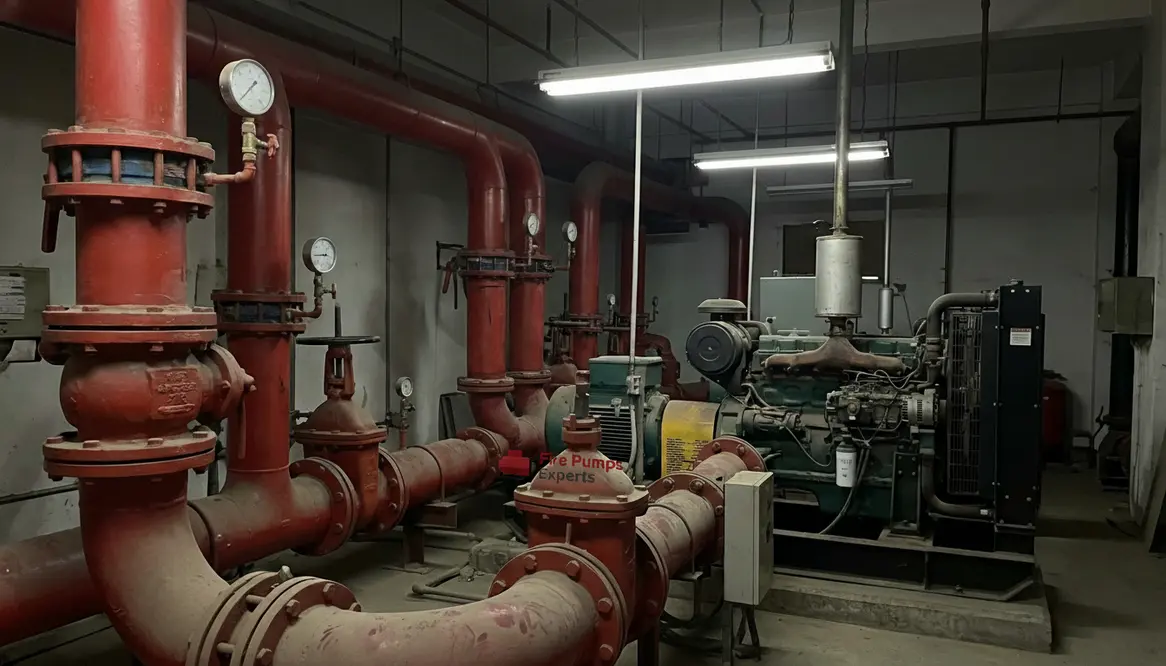
Core System Components Every Industrial Pump Room Needs
Hydraulic Components
- Main fire pump sized for hazard demand
- Jockey pump to maintain system pressure
- Backflow prevention assemblies
- Control valves and test headers
- Large diameter discharge piping
Power and Control Systems
- Diesel or electric pump drivers
- Automatic controllers
- Fuel supply or dedicated electrical service
- Alarm monitoring connections
- Remote supervisory signals
Each component plays a specific role. The jockey pump keeps pressure stable during normal operations. The main pump waits patiently until system pressure drops. Then it launches into action like it has been training for this moment its entire life.
Furthermore, modern controllers record performance data and alarm conditions. That information helps facility teams confirm the pump will respond correctly when needed.
And in a high hazard facility, certainty is priceless.
Fire Pump Requirements High Hazard Buildings and Long Term Reliability
Installing the pump is only the beginning of the story.
High hazard facilities must maintain strict testing and inspection programs to keep systems operational. Otherwise, even the most powerful pump becomes a very expensive piece of room decoration.
Testing, Maintenance, and Monitoring Discipline
Routine procedures often include:
- Weekly churn tests to verify automatic start
- Monthly controller inspections
- Annual flow testing under full demand conditions
- Fuel and battery checks for diesel drivers
- Valve and pressure gauge verification
Additionally, large commercial properties often integrate pump monitoring into centralized building management systems. This allows facility teams to track alarms and performance in real time.
Now I have seen what happens when maintenance gets ignored. Let us just say that discovering a stuck valve during an actual emergency is about as fun as realizing your parachute was packed by a raccoon.
Consistent inspection protects both property and business continuity. For industrial operations, downtime can cost millions per day. A dependable pump system helps ensure that fire remains a controlled incident rather than a catastrophic shutdown.
When you look at the full picture of fire pump requirements high hazard buildings, long term reliability is not a bonus feature. It is the main event.
Frequently Asked Questions
Conclusion
When I walk past a properly designed pump room in a massive industrial facility, I see more than machinery. I see preparation. Strong planning. Quiet confidence. If your property involves complex operations or hazardous materials, understanding the right fire protection strategy matters. Work with specialists who understand large scale systems, the full spectrum of fire pump requirements high hazard buildings, and the realities of industrial risk. The right fire pump design today protects your people, your property, and your operations tomorrow.