Fire Pump Requirements for Public Auditoriums Guide
I have walked through enough large venues to know one thing for certain. When thousands of people gather under one roof, fire safety is not a feature. It is the backbone. Early in every project, I anchor my planning around Fire Pump Requirements for Public Auditoriums, because water pressure and delivery decide how a story ends. And trust me, we all prefer a calm curtain call over a dramatic blockbuster finale.
So, let us take a steady walk through what truly keeps large assembly venues safe, operational, and ready for anything.
At a glance
- Fire safety is the backbone of any large venue.
- Fire Pump Requirements for Public Auditoriums shape water pressure and coverage.
- Well planned evacuation and maintenance complete the safety picture.
Why Fire Safety in Large Venues Demands Precision
Large assembly spaces behave like small cities. You have crowds, lighting systems, food services, and complex layouts. Because of that, fire risks multiply quickly. However, the real challenge is not just preventing fire. It is managing it when prevention fails.
I always think of it like directing a live show. Everything must work on cue. Detection systems must trigger instantly. Suppression systems must respond without hesitation. And most importantly, people must move safely and calmly.
Moreover, materials used in auditoriums, from acoustic panels to stage curtains, can accelerate fire spread if not properly rated. Therefore, selecting fire resistant materials is not optional. It is essential.
And yes, if you have ever seen a packed concert crowd try to exit at once, you know why planning matters. It is less “orderly evacuation” and more “everyone suddenly remembers they left the oven on.”
Fire Pump Requirements for Public Auditoriums and Why They Matter
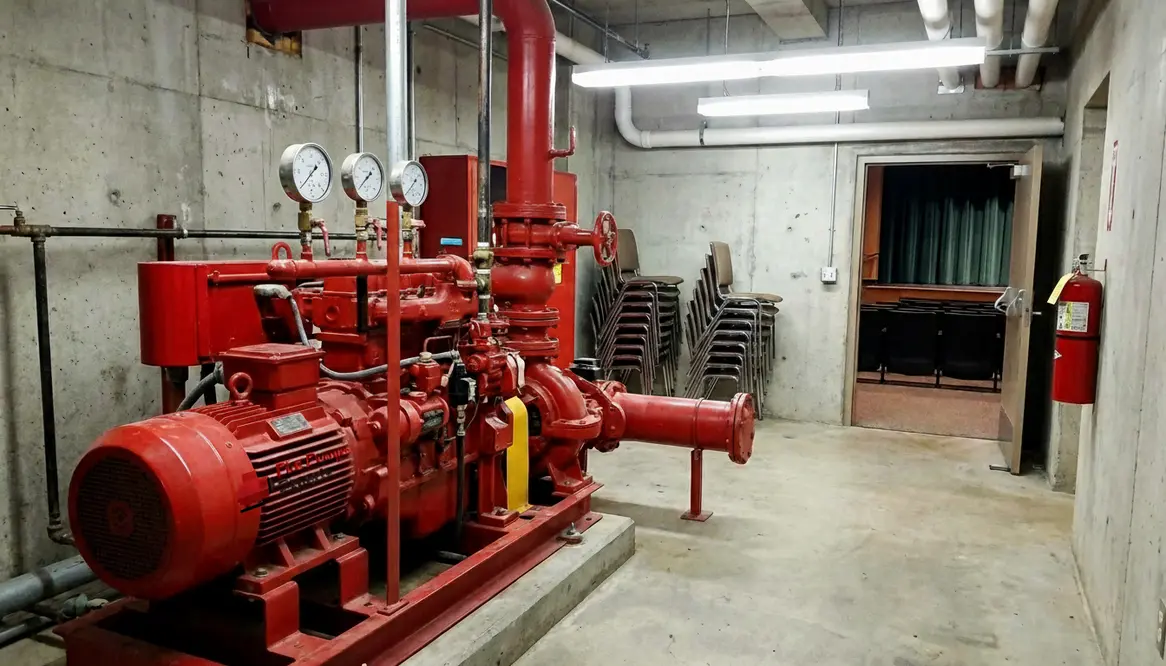
When I design systems for large venues, I start with water. Specifically, I focus on reliable pressure and flow. Fire Pump Requirements for Public Auditoriums ensure that sprinkler and standpipe systems perform under peak demand.
Without a properly sized and tested fire pump, even the best sprinkler system becomes a decorative ceiling feature. And that is not the kind of interior design anyone wants.
Key design factors
- Demand load: The number of occupants and system coverage area
- Building height: Vertical distribution requires higher pressure
- Redundancy: Backup power sources keep pumps running during outages
- Compliance: Alignment with national and local codes
Why testing matters
Additionally, regular testing is critical. Pumps must perform under real conditions, not just on paper. Otherwise, you are trusting theory over physics, and physics always wins.
How Do I Design Evacuation Routes That Actually Work
Design for real people, not perfect diagrams
I design evacuation routes with human behavior in mind, not just diagrams. People do not move like arrows on a blueprint. They hesitate, they follow crowds, and sometimes they head back for belongings.
So, I make exits visible, wide, and intuitive. Furthermore, I ensure lighting systems guide people even during power loss. Emergency signage must be clear, bright, and impossible to ignore.
Importantly, I avoid overcomplication. A simple path saves more lives than a clever one. Think of it like airport terminals. The best ones require no thinking. You just move.
And yes, I always account for worst case scenarios. Because when the lights go out, clarity becomes priceless.
Balancing Technology and Human Response
Modern fire safety systems come packed with technology. Sensors, alarms, automated suppression, and integrated controls all play a role. However, technology alone is not enough.
Technology side
Advanced detection systems identify smoke early. Automated sprinklers activate quickly. Control panels provide real time data to responders.
Human side
Staff training ensures calm decision making. Clear communication prevents panic. Coordinated response guides safe evacuation.
Therefore, I always pair systems with training. A well trained team can make smart decisions when seconds matter. And honestly, even the best alarm system cannot replace a calm human voice saying, “This way, please.”
Maintenance Keeps Systems Alive
I cannot stress this enough. Installation is only the beginning. Maintenance keeps everything working when it counts.
Fire pumps, alarms, sprinklers, and emergency lighting all require regular inspection. Over time, components wear down. Pressure levels shift. Batteries lose charge.
Because of this, I schedule routine testing and document everything. Not just for compliance, but for confidence. When an emergency happens, I want zero surprises.
Also, let us be honest. Ignoring maintenance is like ignoring a check engine light. It does not fix itself, and the outcome is rarely pleasant.
Fire Pump Requirements for Public Auditoriums in Real World Planning
When I bring everything together, fire pump systems sit at the center of operational safety. They support sprinklers, standpipes, and hose systems across large venues.
Core planning checks
- Pumps match system demand under peak occupancy
- Backup power engages instantly during outages
- Monitoring systems alert staff to performance issues
- Layout supports quick access for maintenance teams
Coordination and trust
Additionally, coordination with local authorities ensures compliance and smoother inspections. It also builds trust, which matters more than people think.
Because at the end of the day, a fire pump is not just equipment. It is a promise that the system will respond when needed.
If you want to see how these principles translate across different property types, there are excellent reference projects and technical resources at https://firepumps.org, especially for complex public venues.
FAQ
These quick answers highlight how Fire Pump Requirements for Public Auditoriums connect to everyday operations in large venues.
Conclusion
Fire safety in large assembly venues is not just about meeting codes. It is about protecting lives, investments, and reputations. When I design with intention, maintain with discipline, and follow proven standards like clear Fire Pump Requirements for Public Auditoriums, I create spaces that are ready for anything.
If you manage or develop large commercial properties, now is the time to evaluate your systems, refine your strategy, and ensure your fire protection plan stands strong when it matters most.