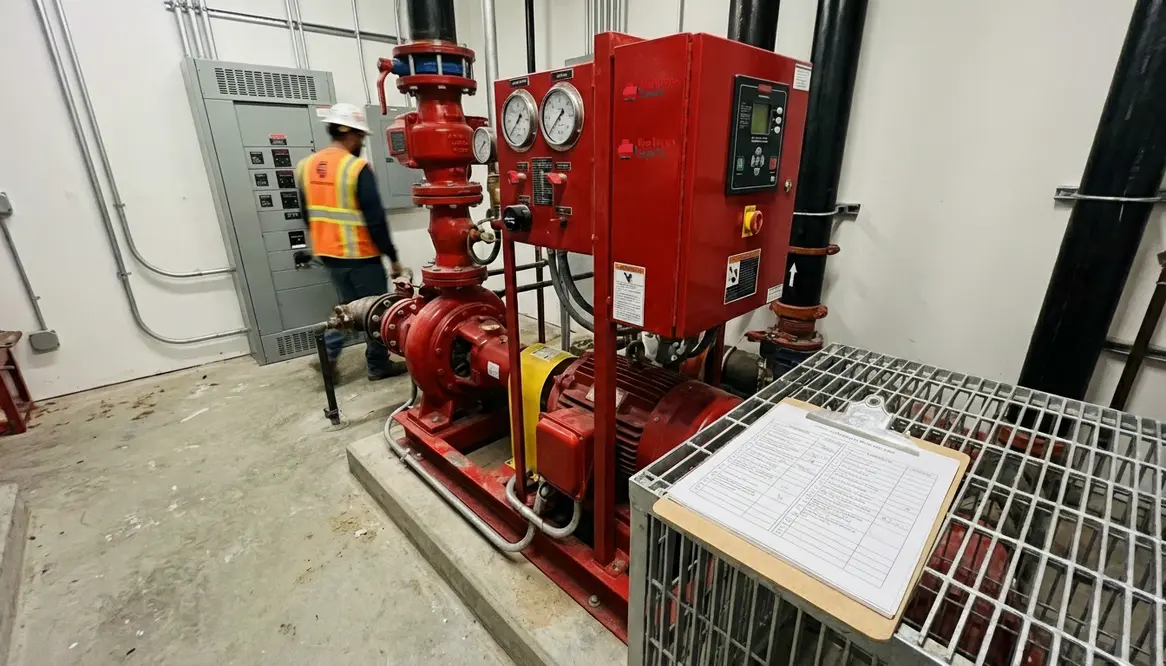
Fire Pump Commissioning Issues Irvine Guide
I have walked through more mechanical rooms than I can count, and let me tell you, nothing humbles a shiny new building faster than a fire pump that refuses to behave. In Irvine’s booming commercial landscape, I keep seeing the same pattern. Beautiful new builds, top tier finishes, and then… quiet little gaps during startup. Those gaps turn into very real fire pump commissioning issues Irvine contractors and facility managers wish they had caught earlier. And yes, the pump always chooses the worst possible moment to remind everyone it has a personality.
Where Commissioning Quietly Goes Wrong
First, I notice that many teams treat commissioning like the final checkbox instead of a process. It is not a ribbon cutting moment. It is a full performance rehearsal. However, schedules get tight, trades overlap, and suddenly the fire pump test becomes a rushed afternoon instead of a controlled evaluation.
Because of that, critical details slip. Controllers are not fully verified. Pressure settings are assumed instead of confirmed. Meanwhile, documentation lags behind reality. I have seen systems where the drawings and the installed setup might as well be from two different movies. And no one wants to discover that during an emergency.
Additionally, coordination between electrical and mechanical teams often feels like two bands playing different songs. The pump might be ready, but the power supply or transfer switch has its own story. When these elements do not sync, performance testing becomes guesswork.
How do fire pump commissioning issues Irvine projects typically show up?
They rarely announce themselves with fireworks. Instead, they whisper. A pressure reading that drifts. A controller alarm that gets silenced but not solved. A flow test that technically passes, yet feels off.
In many Irvine commercial and industrial facilities, I see three common signs:
- Inconsistent pressure during flow testing which hints at calibration or system balancing issues
- Delayed pump start times often tied to control logic or electrical sequencing
- Unverified redundancy systems where backup components exist on paper but not in practice
Then again, the real trouble begins when teams accept “good enough.” Fire protection is not a group project where someone else will fix it later. The system either performs under stress or it does not.
What I Look For During a Proper Commissioning Process
When I step into a commissioning phase, I slow everything down. Not literally, but mentally. Because rushing here is like speed reading a mystery novel and expecting to catch every clue.
I focus on sequence, validation, and proof. First, I confirm installation aligns with design intent. Then, I verify every component behaves as expected under real conditions. Finally, I document results in a way that someone else can actually follow later.
Here is how I mentally structure it:
System Validation
I confirm pump curves, controller settings, and pressure readings match design requirements. No assumptions.
Power Integration
I test normal and emergency power transitions. If the pump hesitates, that is a problem.
Flow Testing
I simulate real demand conditions. Because a fire event will not be polite.
Alarm and Monitoring
I ensure signals reach building systems correctly. Silence is not always golden.
And yes, I double check everything. Because the pump will not care how confident we felt on test day.
The Hidden Cost of Overlooking Commissioning Details
Now, let us talk consequences. Not the dramatic Hollywood kind with explosions and slow motion running, though that would certainly get attention. I am talking about operational risk.
When commissioning is incomplete, facilities face ongoing maintenance headaches. Small issues evolve into larger failures. Moreover, compliance becomes shaky, which can trigger inspections, fines, or forced shutdowns.
For large commercial and industrial properties in Irvine, downtime is not just inconvenient. It is expensive. Tenants expect reliability. Insurers expect compliance. And frankly, no facility manager wants to explain why a brand new system behaves like it skipped rehearsal.
So while cutting corners might save a few hours upfront, it often costs months of troubleshooting later. That trade is never worth it.
Preventing Fire Pump Commissioning Issues Irvine Teams Encounter
Fortunately, most of these problems are preventable. I have seen projects turn things around simply by respecting the process.
First, involve commissioning specialists early. Not at the end when everyone is tired and ready to go home. Early involvement allows alignment between design, installation, and testing.
Next, prioritize communication. Mechanical, electrical, and fire protection teams need to operate like a single unit. Otherwise, you get a system that technically exists but does not truly function.
Finally, document everything clearly. Because six months later, when someone asks why a setting was chosen, “it seemed right at the time” is not a satisfying answer.
And if you are wondering whether this level of detail is overkill, consider this. Fire pumps are like the bass players of a band. You might not notice them when everything is smooth, but if they drop out, the whole performance falls apart.
For owners and facility teams watching out for fire pump commissioning issues Irvine projects are prone to, this mindset shift pays off for years. It protects uptime, keeps inspectors calmer, and lets everyone sleep a little better at night.
If you need deeper technical resources on how these systems should behave when everything is coordinated correctly, a good starting point is https://www.firepumps.org, paired with local code requirements and experienced commissioning support.
FAQ: Fire Pump Commissioning in Irvine
Fire pump commissioning issues Irvine properties face tend to fall into predictable patterns, which makes a focused FAQ especially useful when you are planning or troubleshooting a project.
Bringing It All Together
If there is one thing I have learned, it is this. A fire pump system does not reward shortcuts. It rewards patience, precision, and a little healthy skepticism. When you take the time to commission it properly, you are not just checking a box. You are building confidence into the very bones of your facility.
So if your Irvine project is approaching that critical phase, now is the moment to get it right. Partner with experts who understand the stakes, demand thorough testing, and refuse to settle for “close enough.” Because when it comes to fire protection, the only acceptable surprise is that everything works exactly as it should.
Treating commissioning as a disciplined rehearsal rather than a ceremonial finale is how you avoid the kind of fire pump commissioning issues Irvine buildings become famous for in all the wrong ways. The building can be gorgeous, the finishes flawless, but when the pump starts on command and performs exactly to spec, that is when the project is truly complete.