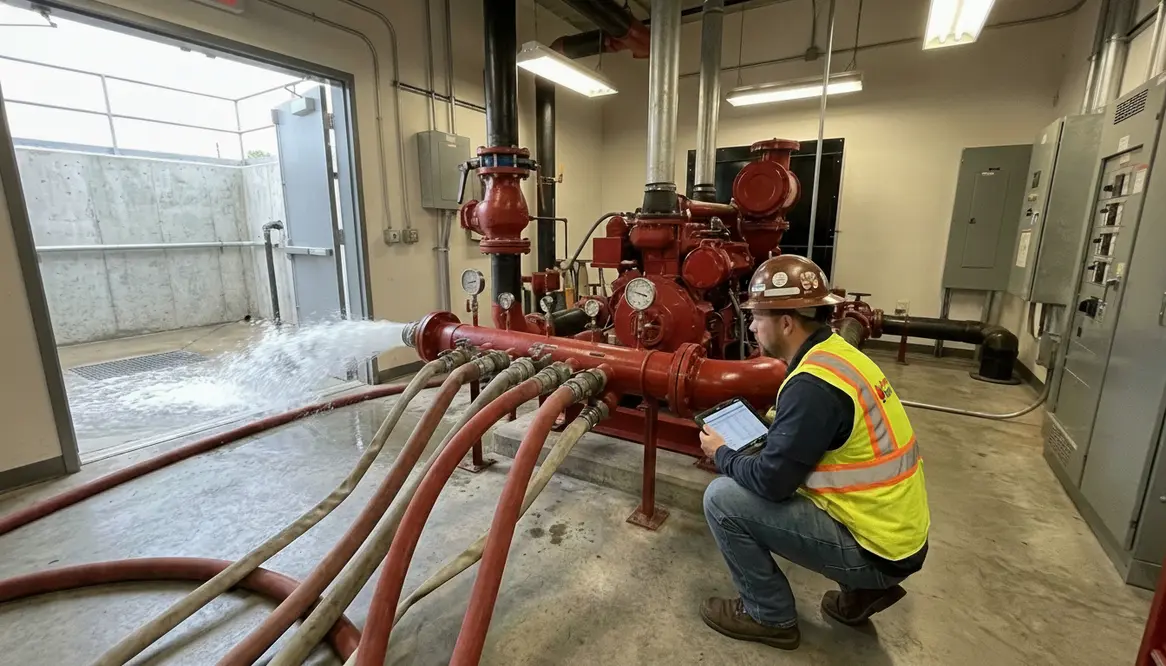
FM Global Fire Pump Acceptance Testing Guide
What I check before I trust the system in commercial and industrial facilities
FM Global Fire Pump Acceptance Testing Guide: What I Check Before I Trust the System
When I walk into a commercial or industrial facility, I know one thing for sure: a fire pump is not the place for guesswork. That is where FM Global testing comes in. It gives me a clear path to prove the pump will do its job when the stakes are sky high and the pressure is more than just a bad day in the office. In this guide, I will break down how I approach acceptance testing, what I look for, and why a clean result matters for major properties that cannot afford surprises.
Why FM Global Fire Pump Acceptance Testing Matters
I treat acceptance testing as the final dress rehearsal before opening night. If the pump fails now, it would fail at the worst possible time later. For commercial buildings, industrial plants, and large property sites, that risk is hard to justify. So, I look at FM Global fire pump acceptance testing as a way to confirm the system can deliver water flow, pressure, and reliability under real demand. In other words, I want facts, not wishful thinking.
This step also helps owners, contractors, and facility teams avoid costly fixes after startup. Moreover, it supports insurance goals, code alignment, and better plant safety. That sounds serious because it is. Still, I have found that a well run test can feel less like a headache and more like a solid victory lap, minus the confetti and bad corporate music.
How I Prepare for FM Global testing in a Commercial Facility
Before I test the pump, I check the basics. Preparation matters because a good test starts long before the engine turns over or the electric motor hums. First, I confirm the system design matches the approved plans. Then I verify valves, suction supply, discharge piping, gauges, and control settings. After that, I make sure the water source can support the test without causing a mess or a panic.
My pre-test checklist
- Confirm the pump type and rated capacity
- Check suction conditions and water supply stability
- Inspect gauges, relief valves, and controller status
- Review test headers, flow devices, and drains
- Coordinate with facility staff, fire protection teams, and any outside inspectors
Also, I like to plan the test window with care. A fire pump test can shake up operations, so I keep it tight and organized. Nobody wants a surprise flood in the middle of a shift. That kind of drama belongs in a movie, not a warehouse.
What I Measure During the Acceptance Test
Once I start the test, I focus on three things: flow, pressure, and stability. I want to know how the pump behaves at churn, at rated flow, and at overload points if the plan calls for it. Since FM Global fire pump acceptance testing aims to prove performance, I record the numbers carefully and compare them to the required curve.
Test Point |
What I Look For |
Churn |
Pressure at zero flow and stable operation |
Rated flow |
Meets expected capacity with proper pressure |
tr>
High flow |
Shows the pump can handle demand without collapse |
Next, I watch for vibration, leaks, overheating, odd noises, and controller issues. A pump should sound like it means business, not like it is auditioning for a horror film. In addition, I check how quickly the system responds when demand changes. That response tells me a lot about the health of the entire setup.
What FM Global Looks For in the Final Result
FM Global wants proof that the fire pump performs as designed and that the system supports the risk level of the property. Therefore, I do not just chase a passing number. I also look at real world behavior. Does the pump hold pressure? Does the supply stay steady? Does the controller start and run without trouble? If the answer is yes, I move with more confidence.
Furthermore, I make sure the test report tells the full story. Clear records help owners, facility managers, and service teams understand what passed, what needs attention, and what should be watched over time. Good documentation saves future pain. And frankly, future you will be grateful. That version of you tends to be less patient.
Why I Keep the Focus on Major Properties and Industrial Sites
Fire pump testing matters most where the risk is high and the property value is massive. That is why I keep my focus on commercial and industrial facilities, along with major property buildings. These sites often have complex systems, large water demand, and serious life safety needs. As a result, the margin for error gets very thin.
Because of that, I view the test as more than a checkbox. It is part of a larger plan to protect people, equipment, operations, and business continuity. One failed pump can turn a controlled emergency into a costly shutdown. And nobody wants to explain that to ownership on a Monday morning.
Making FM Global testing work for you
If you want a smoother path through FM Global testing, start with a clear plan, solid records, and a team that knows the stakes. Treat each acceptance test as a chance to prove the system is ready, not as a hurdle to stumble over at the last minute.
Align your design documents, installation details, and maintenance expectations with the testing process. When everyone is working from the same playbook, the acceptance test shifts from tense guesswork to a structured confirmation.
Quick Reference: Core Elements of a Solid FM Global Fire Pump Test
- Match installed equipment and layout to the approved design documents.
- Verify water supply conditions before you touch the controller.
- Plan test flows to hit churn, rated flow, and high flow points.
- Record pressures, flows, and amp draw or fuel performance consistently.
- Watch for mechanical and electrical behavior: vibration, temperature, starts, and stops.
- Document everything in a way that will still make sense three years from now.
FM Global Fire Pump Acceptance Testing FAQ
Conclusion
If you manage a commercial building, industrial plant, or major property, I urge you to treat fire pump acceptance testing with real care. A strong result protects your people, your assets, and your peace of mind. If you want a smoother path through FM Global testing, start with a clear plan, solid records, and a team that knows the stakes. I can help you get there, and I recommend taking the next step before the system ever has to prove itself in a real emergency.
If you are looking for more detailed guidance, you can explore additional resources at https://firepumps.org and build out a testing playbook that fits your facility. However you approach it, make sure FM Global testing is a structured, repeatable process instead of a one-time event you hope never to revisit.