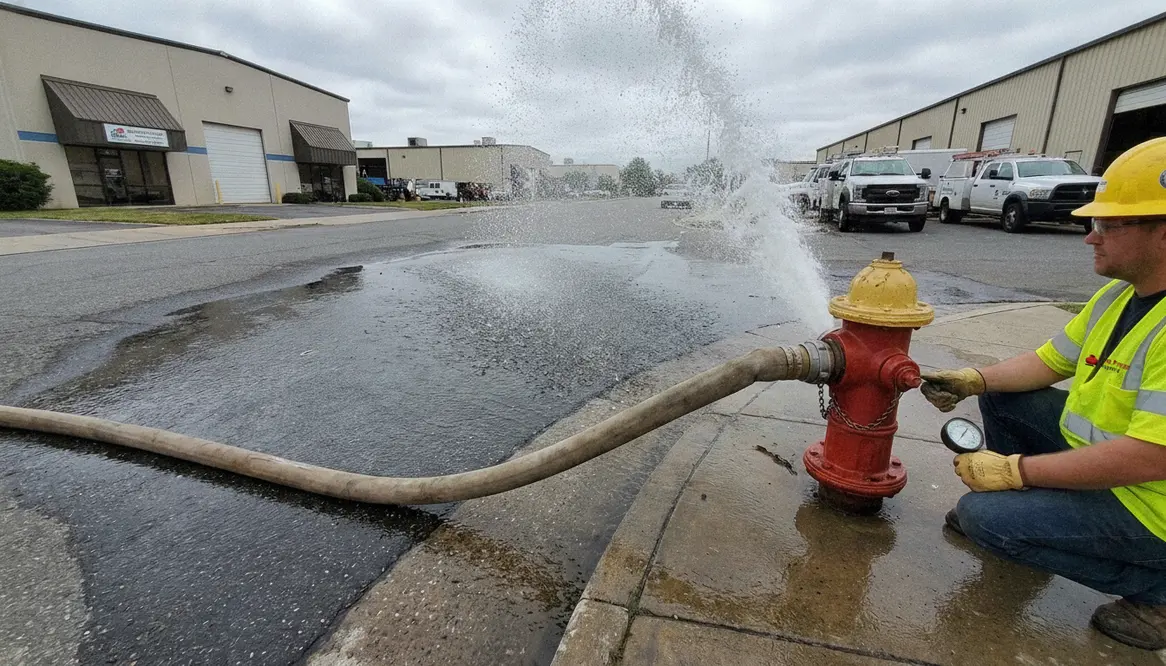
Fire Hydrant Flow Testing for Commercial Buildings
When I talk about fire hydrant flow testing, I am talking about one of the simplest ways to find out whether a water supply can actually do the job when things go sideways. It is not glamourous. It does not come with music like a Marvel entrance. But it matters. A proper test shows how much water a hydrant can deliver, how fast it can deliver it, and whether a commercial or industrial property has the pressure needed to support fire protection systems. That is the kind of detail that can save a building, a business, and a very long insurance conversation.
What a fire hydrant flow test tells me
A fire hydrant flow test gives me real numbers, not guesses. I measure water pressure before and during the test, then I see how the system responds once water starts moving. That matters because static pressure alone can look fine on paper, while the actual flow tells the real story. In plain English, a hydrant can look strong and still fold under pressure like a background character in a disaster movie.
For commercial and industrial facilities, I use the results to help confirm if the site can support fire sprinklers, fire pumps, and other suppression systems. I also use the data during planning, upgrades, and compliance checks. So, the test does not just fill a report. It helps guide real safety decisions.
Why this matters in the real world
Static pressure is helpful, but it can also be misleading. A site can “look fine” until you actually ask the water supply to move. That is why a fire hydrant flow test is the difference between “probably” and “known.” It turns a theoretical supply into a measurable performance, especially when a building’s fire protection systems depend on consistent pressure and practical flow.
If you are planning new sprinkler layouts, verifying fire pump needs, or assessing an older water network, the fire hydrant flow test helps reduce uncertainty early. And early is when fixes are still straightforward, not when the emergency lights are already on.
Fire hydrant flow testing at the planning stage
Done during planning and upgrades, fire hydrant flow testing supports the decisions that prevent costly surprises. It can inform whether the existing supply is adequate, whether system changes are required, and how to design for the water you can actually get under load.
How I perform fire hydrant flow testing
I start with the right location, the right tools, and the right safety steps. First, I inspect the hydrant. Then I connect test equipment and take a static reading. After that, I open the hydrant in a controlled way and record the residual pressure while water flows. I repeat the process as needed to get useful data. Throughout the test, I watch for pressure loss, hose reaction, and water discharge patterns.
Here is the part that matters: the test must reflect actual supply conditions. If I rush it, I get weak data. If I set it up well, I get numbers that help engineers, property teams, and fire protection specialists make smart choices. And yes, I know it sounds a bit like checking how a sports car behaves on a hill, except this car protects a warehouse full of expensive stuff.
Why commercial and industrial buildings need this test
Large properties deal with higher fire loads, bigger floor areas, and more complex systems. Because of that, water supply becomes a critical part of the safety plan. A fire hydrant flow test helps me confirm whether the site has enough water for code needs and system design. It also helps uncover weak pressure, old mains, or supply limits that could create trouble later.
For major buildings, I often see this test support fire pump design, sprinkler upgrades, tenant fit outs, and insurance reviews. As a result, owners can avoid surprises after construction starts or, worse, after an emergency. No one wants to discover weak water supply during a fire. That would be a very expensive plot twist.
Fire hydrant flow test data I look at
I focus on a few key measurements:
- Static pressure
- Residual pressure
- Flow rate
- Hydrant condition
What I use them for
- Checking water supply strength
- Supporting fire pump selection
- Reviewing sprinkler system needs
- Finding supply limits early
These numbers help me see how the system performs under load. Static pressure tells me what I have before the water moves. Residual pressure shows what remains while water flows. Flow rate tells me how much water I can count on. Together, they paint a clear picture. Without them, I am basically guessing, and guessing has no place in fire protection.
How Kord Fire supports this work
When I need a trusted reference for fire protection work, I look at https://kordfire.com.au/ for a practical example of how professional fire safety support can be organized for serious facilities. That kind of experience matters when the job involves commercial sites, industrial plants, and major properties that cannot afford weak planning. For related system work, I also point to https://kordfire.com/fire-pump/ as a useful resource for properties that need proper water delivery support.
FAQ
Conclusion
If I want real confidence in a building’s fire protection plan, I do not guess. I test the water supply, review the numbers, and act on what I find. A fire hydrant flow test gives commercial and industrial property owners the truth they need before a problem turns serious. If your facility needs a clear picture of its water supply, now is the time to act. Get the fire hydrant flow test done, review the results, and make your next fire safety decision with confidence.