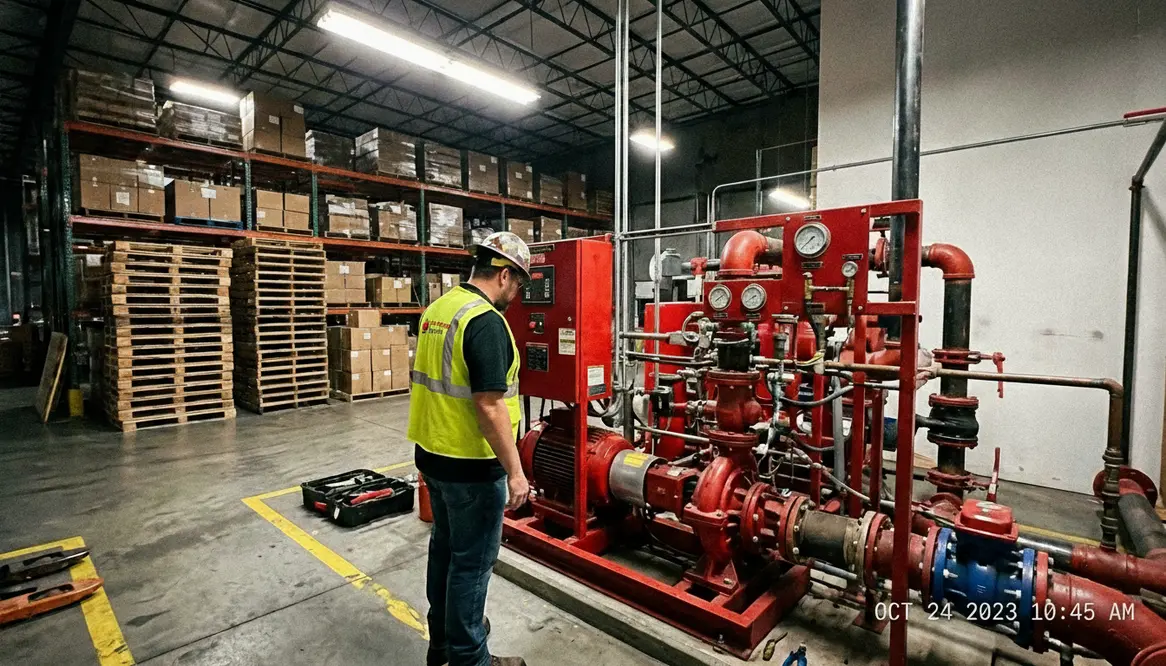
FM Global Fire Pump Requirements for Warehouses
FM Global Fire Pump Requirements for Warehouses may sound like one more line item in a thick stack of facility rules, but I see it as something far more practical. In FM Global warehouses, fire pumps help keep water pressure where it needs to be when a sprinkler system has to perform under stress. That matters because a warehouse can pack in high fuel loads, tall storage, wide aisles, and enough drama for a season finale. So, if you manage a commercial or industrial facility, I want to walk you through what FM Global expects, why it matters, and how I approach compliance without turning the whole process into a science fair project.
What FM Global expects from a warehouse fire pump
FM Global wants the fire pump to support the sprinkler system with dependable pressure and flow. In plain terms, the pump must step in when the water supply alone cannot do the job. That becomes critical in large storage buildings, where rack storage, high pile goods, and long pipe runs can strain a system. Therefore, I always start by checking the warehouse hazard, the sprinkler design, and the water demand together.
FM Global also looks closely at pump reliability. The pump must match the system need, and the full setup must include the right driver, controls, power source, suction supply, and test features. If one part falls short, the whole system can wobble like a cheap folding chair at a company picnic.
Key requirements I review first
Before I touch a drawing or spec sheet, I look at these core items:
- Fire pump size based on sprinkler demand and required pressure
- Suction supply that can support the pump without starving it
- Driver selection, often electric or diesel, based on risk and reliability
- Power supply that stays stable during a fire event
- Controller and alarm features that signal trouble fast
- Test header or test arrangement so the pump can be checked on schedule
Because warehouses often serve as major property assets, FM Global pushes for a system that works in the real world, not just on paper. As a result, I treat the pump room like the heart of the building, not an afterthought hiding behind a stack of pallets and old holiday decorations.
How I check warehouse water supply and pump sizing
Water supply is the starting point. First, I review available pressure and flow from the site supply, then I compare that against the sprinkler demand. If the supply cannot meet demand with enough margin, a fire pump may be needed. However, I do not size the pump by guesswork. I look at the full system curve, the elevation change, the friction loss, and the expected design area.
System demand versus pump performance
Left column
- Water source strength
- Peak sprinkler demand
- Pipe friction loss
Right column
- Pump flow rating
- Pressure needed at farthest point
- System backup margin
This step matters because oversizing can create issues, and undersizing can leave the system flat when it should be fierce. Also, if the warehouse has high rack storage, flue spaces, or special commodity hazards, the demand may rise quickly. That is why I never treat one warehouse like another. Each site tells its own story.
Why driver choice matters in FM Global warehouses
FM Global usually expects a fire pump to keep running when things get messy. That means the driver choice matters a lot. Electric pumps can work very well when the power supply is reliable and protected. Diesel pumps, on the other hand, bring a strong backup option when utility power fails. So, I look at both the building risk and the power risk before I recommend anything.
Supporting the driver and the pump room
Moreover, the pump room must support the driver properly. Diesel units need fuel supply, ventilation, battery care, and room for inspection. Electric units need dependable power, controls, and protection from water damage. In both cases, I want access, lighting, and clear space around the equipment. Fire pump rooms do not like clutter. Neither does the inspector.
Inspection, testing, and maintenance that keep the system ready
FM Global does not stop at installation. It also cares about ongoing testing and maintenance. I make sure the pump can be started, observed, and tested on a regular basis. Weekly or scheduled churn tests help confirm that the pump starts and runs properly. In addition, I check alarms, valves, gauges, and suction conditions so small issues do not grow into expensive surprises.
Testing also helps reveal weak points in the warehouse system. For example, I may find pressure swings, slow starting, leaking packing, or controller faults. Then I can fix them before an emergency exposes them. That is the kind of quiet discipline that saves money and keeps operations moving. No one wants a fire pump to act like a diva right when the sprinklers need backup.
How I keep FM Global compliance practical
When I work through FM Global fire pump requirements, I focus on four things: proper design, reliable equipment, clean installation, and steady maintenance. I also stay close to FM Global guidance and compare it with the warehouse layout, commodity type, and water supply facts. If the facility changes, I revisit the design. A warehouse that adds taller storage or new goods may change the fire load enough to call for a new review.
Keeping FM Global warehouses future-ready
FM Global warehouses rarely stay frozen in time. Storage heights creep up, product lines change, and new processes sneak into corners of the building. Each of those shifts can nudge the fire load higher. That is why I treat every layout change, new rack configuration, or commodity shift as a signal to recheck the fire pump and sprinkler demand. It is much easier to confirm capacity now than to explain a shortfall later.
I also like to keep operations and maintenance teams in the loop. When people on the floor understand why the fire pump matters, they are less likely to block valves with pallets or turn the pump room into overflow storage. In busy FM Global warehouses, that shared awareness can be the difference between a clean response and a chaotic one.
For teams that need more help with commercial and industrial fire pump planning, I recommend reviewing the commercial fire pump services guide for a practical overview of system support, testing, and compliance steps. It helps turn dense requirements into clear action. And honestly, that is a gift worth keeping.
FAQ
Conclusion
If you manage a warehouse, I urge you to treat fire pump planning as part of your core risk strategy, not a box to check at the end of a long meeting. Start with the water supply, verify the pump size, choose the right driver, and keep testing on schedule. Then review changes before they grow into problems. If you want dependable support for a commercial or industrial property, now is the time to act and make the system ready.