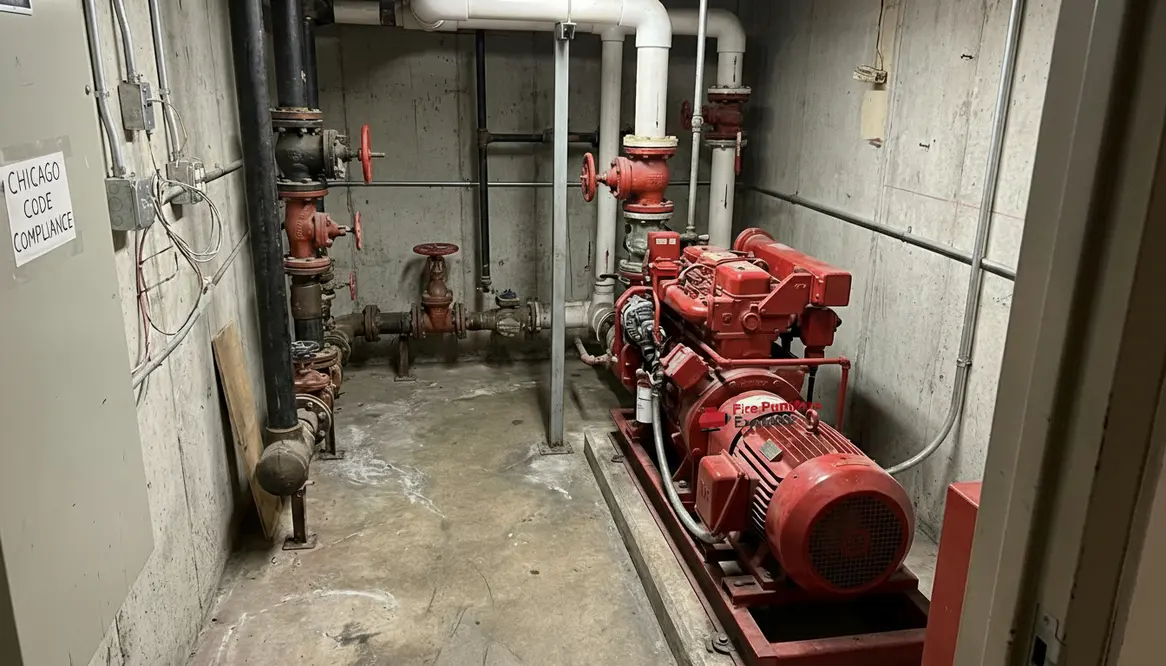
Chicago Fire Pump Code Compliance in Urban Design
In dense city blocks, where buildings lean on each other like old friends and space is tighter than a rush hour train, fire protection is not optional. It is survival. I have spent years working with commercial and industrial properties, and I can tell you this with calm certainty: designing a fire pump system in an urban environment demands precision, foresight, and a clear understanding of Chicago fire pump code compliance. Within the first few steps of planning, I am already thinking about pressure demands, access constraints, and how to keep everything running when the unexpected hits. Because in cities, the unexpected is not a matter of if. It is when.
Designing Fire Pumps Where Space Is a Luxury
Space, or rather the lack of it, shapes every decision I make. In dense urban properties, mechanical rooms are often squeezed into corners that feel like they were designed by someone playing Tetris on expert mode. Because of this, I prioritize compact yet powerful pump configurations.
However, it is not just about fitting equipment into a tight room. I also have to think about accessibility for maintenance, vibration control, and airflow. If a technician cannot reach a valve without performing yoga, the design has already failed.
Moreover, vertical construction adds another layer. High rise buildings demand higher pressures, which means stronger pumps and reinforced systems. So while the footprint shrinks, the performance expectations grow. It is a bit like expecting a compact car to tow a freight train.
Chicago Fire Pump Code Compliance in High Density Buildings
When I work in Chicago, I do not treat code compliance as a checklist. I treat it as a living framework. Chicago fire pump code compliance shapes everything from pump selection to installation clearances and backup power requirements.
For example, redundancy is not just recommended. It is often expected. I design systems that assume failure will happen and prepare accordingly. Backup power, secondary pumps, and reliable water supply connections are essential.
Additionally, inspections and testing protocols are strict. So I make sure every component is accessible and documented. Because when inspectors arrive, and they will, I want everything to speak clearly without needing a long explanation. Think of it like showing your work on a math test, except the stakes are much higher than a grade.
How Do I Handle Water Supply Challenges in Urban Fire Pump Design?
Water supply in dense areas can be unpredictable. Municipal systems are often stretched thin, especially during peak demand or emergencies. So I never assume consistent pressure.
Instead, I evaluate available flow data and build systems that compensate for fluctuations. This often means integrating storage tanks or booster systems. Furthermore, I carefully analyze how nearby buildings might affect supply during a fire event.
At the same time, I coordinate closely with city infrastructure. Because in a crowded grid, one building’s demand can ripple outward. It is a delicate balance, like sharing bandwidth on a crowded network. Nobody wants buffering during a critical moment.
Balancing Noise, Vibration, and Neighboring Structures
Urban environments are sensitive ecosystems. A poorly designed fire pump system can create noise and vibration that travels through walls and floors. And trust me, nothing gets attention faster than a neighboring business complaining about a constant hum.
So I design with isolation in mind. I use vibration dampeners, acoustic treatments, and strategic placement to minimize disruption. Additionally, I consider structural impacts. Because older buildings, especially, do not appreciate sudden new forces being introduced.
In a way, I treat the building like a musical instrument. Every component must play in harmony, not rattle the entire orchestra.
Smart Layout Decisions That Save Time and Money
Efficiency is not just about performance. It is also about long term cost and usability. A well planned layout reduces installation headaches and simplifies maintenance for years to come.
What I Prioritize
- Clear service pathways for technicians
- Logical pipe routing to reduce friction loss
- Accessible control panels and gauges
- Future expansion flexibility
What I Avoid
- Cramped layouts that block access
- Overly complex pipe configurations
- Ignoring future building upgrades
- Designs that rely on perfect conditions
Because while a design might look efficient on paper, real world conditions have a way of humbling even the best plans. I have learned to expect the unexpected and design around it.
Chicago Fire Pump Code Compliance and Long Term Reliability
Compliance is not just about passing inspections today. It is about ensuring the system performs years down the line. Therefore, I focus on durability, testing access, and system monitoring. In busy markets, Chicago fire pump code compliance becomes the backbone of long term reliability, not a last minute paperwork exercise.
Modern fire pump systems often include advanced controllers and remote monitoring. These tools allow property managers to detect issues early. However, technology alone is not enough. The physical design must support regular testing without disrupting operations.
And yes, that means planning for weekly churn tests and annual inspections. It is not glamorous, but neither is explaining why a system failed when it mattered most. Even Batman had backup plans. Your building should too.
If you want a deeper technical breakdown of NFPA-driven design choices that support Chicago fire pump code compliance, resources like this NFPA 20 fire pump design and installation guide can help clarify how code language translates into real-world pump rooms.
FAQ: Fire Pump Design in Dense Urban Areas
Before getting into the specifics, it helps to remember that every dense city block is its own puzzle. Chicago fire pump code compliance provides the rules, but every site brings its own obstacles, shortcuts, and “who thought this was a good idea?” surprises.
Conclusion
Designing fire pump systems in dense urban environments is not just a technical task. It is a responsibility. I approach each project with a clear goal: build systems that perform under pressure, adapt to constraints, and stand the test of time. If you manage a commercial or industrial property, now is the moment to review your system, align with code, and invest in reliability. Because when safety is on the line, preparation is everything.