Fire Pump Maintenance Standards Oakland Buildings Follow
How commercial buildings keep their fire pump systems ready for the moment that truly matters.
I have walked through more mechanical rooms than I can count. Some hum quietly with confidence. Others sound like a garage band practicing at 2 a.m. Either way, one piece of equipment always earns my full attention. The fire pump. In a busy city like Oakland, where large commercial buildings, hospitals, distribution centers, and high rise offices never really sleep, fire protection cannot rely on luck.
That is where fire pump maintenance standards Oakland facilities follow come into play. These standards guide how pumps are inspected, tested, and maintained so they work when the moment calls. And trust me, when a fire system wakes up, it expects the pump to respond like a seasoned firefighter, not a confused extra from a disaster movie.
So today I am going to walk you through how these standards work, why they matter for large commercial properties, and how facility managers can keep their systems ready for the real world.
If your pump is not getting regular attention, it is not a safety system. It is a liability waiting for its worst possible moment to show up.
Understanding Fire Pump Maintenance Standards Oakland Facilities Must Follow
First, let us set the stage. Fire pumps are not decorative equipment sitting in the corner for dramatic effect. They exist for one purpose. To deliver the pressure needed to push water through sprinkler systems during an emergency.
However, without regular inspection and testing, that powerful pump can become about as useful as a gym membership you stopped using in 2017.
Most commercial buildings in Oakland follow standards built around NFPA 25, the national code for inspection, testing, and maintenance of water based fire protection systems. Local authorities enforce these rules to ensure facilities stay compliant and safe.
Why Oakland’s context matters
Because Oakland has dense commercial zones and older industrial properties, maintenance requirements are taken seriously. A neglected pump in a large warehouse or high rise can put hundreds of occupants at risk.
In practice, the fire pump maintenance standards Oakland inspectors expect include:
- Weekly visual inspections to confirm the pump controller shows normal status
- Churn tests where the pump runs without water flow
- Monthly and annual performance tests to measure pressure and flow
- Controller inspections to verify electrical and diesel systems operate correctly
- Detailed record keeping to show compliance during fire inspections
Therefore, the pump must prove its readiness regularly. Think of it as a firefighter doing daily drills. When the alarm sounds, nobody wants warm up stretches.
How I Approach Fire Pump Inspections in Large Commercial Buildings
Treating the pump like the building’s heartbeat
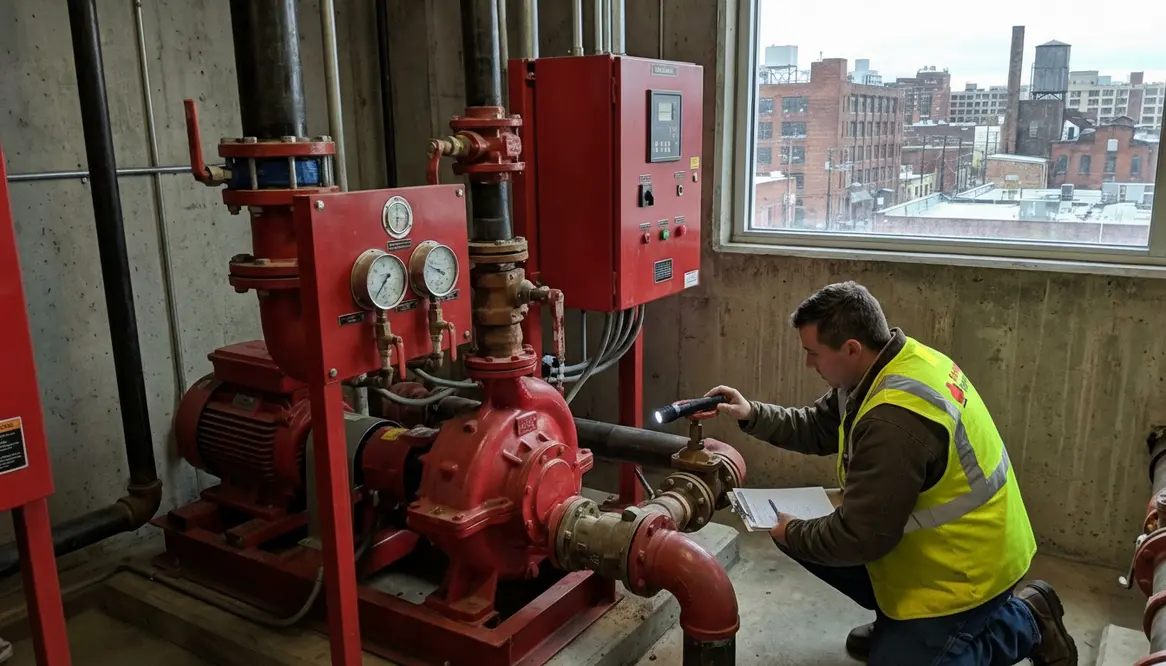
When I enter a mechanical room in a major facility, I treat the pump like the heartbeat of the building’s fire protection system. If that heartbeat falters, the entire sprinkler network struggles.
So I start with the basics.
First, I check the controller panel. The lights should show normal status. No alarms. No warnings. No mysterious blinking lights that make you feel like you are staring at a spaceship dashboard.
Next, I look at the pump itself. Leaks, corrosion, vibration, and unusual noise all tell stories. Some pumps whisper. Others growl like an old pickup truck climbing a hill. Either way, those sounds matter.
Then comes the weekly churn test. During this test the pump runs without water demand. The goal is simple. Confirm the motor starts immediately and reaches proper pressure.
After that, I verify:
- Suction and discharge gauges read correctly
- The pump room temperature meets operational requirements
- Valves remain locked open
- Fuel levels are sufficient for diesel driven pumps
Additionally, I document everything. Because when the fire marshal arrives, clear records tell a story of responsibility.
And frankly, inspectors appreciate paperwork more than most people appreciate coffee on Monday morning.
Common Maintenance Gaps I See in Oakland Facilities
Now let me be honest. Even well managed commercial buildings sometimes miss key details.
Facility managers juggle elevators, HVAC systems, tenant requests, and about 900 emails before lunch. Fire pumps can quietly slip into the background.
Yet several issues appear again and again.
Patterns that quietly break compliance
For example, I often see neglected test records. The pump may run fine, but if documentation is incomplete, the facility still faces compliance trouble.
Another common problem involves controller batteries. Electric controllers rely on batteries for reliable startup. Over time those batteries weaken. And when they fail, the pump might hesitate during an emergency.
Then there is the classic issue of closed valves. Believe it or not, a simple valve accidentally left partially shut can reduce water supply dramatically. It is the mechanical version of trying to drink a milkshake through a coffee stirrer.
Because of these risks, proper adherence to the fire pump maintenance standards Oakland facilities follow remains critical. The goal is not just passing inspections. The goal is reliability under pressure.
What Happens During Annual Flow Testing
If weekly inspections are the warm up, annual flow testing is the championship game.
During this test, technicians measure the pump’s ability to deliver water at multiple pressure points. This confirms the system performs exactly as designed.
Large commercial and industrial properties typically conduct this test using flow meters or calibrated test headers.
The process usually includes three key checkpoints.
Baseline and rated performance
Churn Condition
The pump runs without flowing water. This measures baseline pressure and confirms the motor operates smoothly.
100 Percent Flow
The system runs at its rated capacity. Technicians measure pressure to confirm the pump meets its design curve.
Pushing the system and reading the signs
150 Percent Flow
The pump pushes beyond its rated capacity. This confirms the system can handle peak demand during large fires.
System Evaluation
Technicians review vibration, temperature, pressure stability, and valve operation.
When done properly, annual testing offers valuable insight. It tells us whether the pump still performs like a seasoned athlete or if it is starting to feel like a retired action star trying one last stunt scene.
Why Oakland Commercial Facilities Must Stay Ahead of Compliance
Oakland presents unique challenges for facility managers.
The city blends aging infrastructure with modern high density construction. Industrial ports, large logistics centers, office towers, and hospitals all rely on dependable fire protection.
Therefore, strict adherence to maintenance standards protects both people and property.
Risk, records, and real-world reliability
Insurance carriers also pay close attention. A well documented maintenance program often supports lower risk ratings. On the other hand, poor records raise serious concerns during underwriting reviews.
Moreover, regular maintenance reduces costly surprises. Pumps that sit untouched for years often develop issues that appear suddenly during emergency events.
And believe me, discovering a pump problem while firefighters are connecting hoses is about as pleasant as realizing your phone battery is at one percent during an important call.
Staying ahead of maintenance keeps systems dependable and inspections smooth. For facilities aligning with fire pump maintenance standards Oakland authorities expect, that preparation shows up clearly in every inspection report.
FAQ About Fire Pump Maintenance in Oakland
Keeping Your Facility Ready When It Matters
Fire pumps rarely receive applause. They sit quietly, waiting for the day they are needed. Yet when that day arrives, everything depends on their performance.
If you manage a commercial or industrial property in Oakland, staying aligned with proper maintenance practices protects lives, property, and your operational continuity. Following the fire pump maintenance standards Oakland relies on is not just about avoiding citations. It is about knowing that, when the system wakes up, the pump will answer without hesitation.
Our team at FirePumps.org specializes in inspection, testing, and long term support for large facilities. Reach out today and we will make sure your fire pump system stands ready when it matters most.