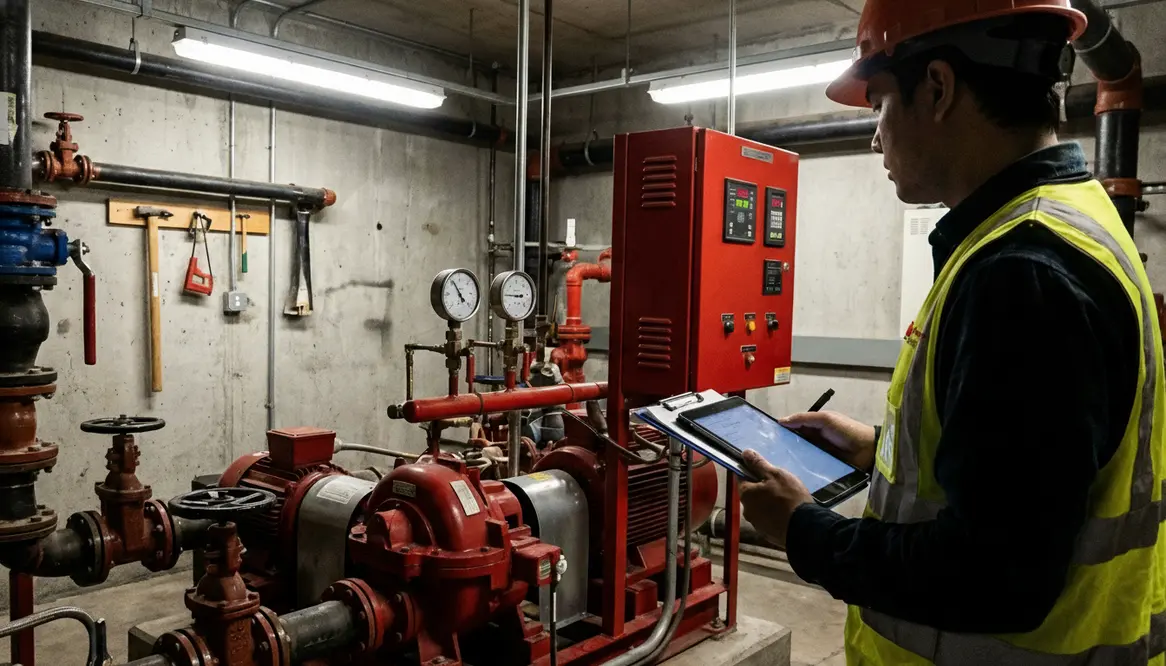
Fire Pump Testing Requirements for Commercial Buildings
Why your fire pump cannot afford to be a “set it and forget it” device.
I have spent years walking through mechanical rooms that hum like quiet engines of safety, and I can tell you this much right away: fire pump testing requirements are not just paperwork and checklists. They are the difference between a system that performs on demand and one that folds when it matters most. For commercial and industrial property owners, understanding these requirements is not optional. It is foundational. And yes, while it may not be as thrilling as a summer blockbuster, it carries stakes that would make even the most dramatic film feel underwhelming.
At a glance
- Protects people, property, and operations
- Drives insurance and code compliance
- Reveals hidden weaknesses before emergencies
- Turns “hope it works” into documented readiness
Key standards
Standards like NFPA 25 and NFPA 20 spell out detailed fire pump testing requirements, from weekly churn tests to annual full-flow tests and documentation standards. These aren’t suggestions; they are the rules of the game if you expect your system to work under pressure.
What are fire pump testing requirements and why should I care?
Let me answer this plainly. Fire pump testing requirements define how often and how thoroughly your fire pump system must be inspected and tested to ensure it works under pressure. Literally. These rules come from standards like NFPA 25, and they exist because fire pumps do not get a second chance.
Now, why should you care? Because your building is not just steel and glass. It is people, operations, and liability. If a fire pump fails, it is not just an inconvenience. It is a cascade of consequences. Insurance complications, code violations, and downtime that can feel like a slow motion disaster scene.
Also, let us be honest. A fire pump that has not been tested regularly is like a gym membership you never use. It looks good on paper, but when the moment comes, it will disappoint you.
Risk and responsibility
Ignoring fire pump testing requirements does not just put a system at risk; it puts occupants, emergency responders, and your reputation on the line. When water does not arrive with the pressure and volume it should, everything downstream of that failure becomes more dangerous.
A structured safety net
Done correctly, testing turns a set of pipes and pumps into a system with a proven track record. It means you are not just hoping the pump will start; you know how it performed last week, last month, and last year.
How often should commercial fire pumps be tested?
I get this question constantly, and the answer is refreshingly direct. Weekly churn tests and annual flow tests are the backbone of compliance. However, frequency alone is not the full story.
Weekly tests ensure the pump starts and runs smoothly. Think of it as a quick health check. Meanwhile, annual flow testing pushes the system to perform at full capacity. This is where you truly see if the pump can deliver the pressure and volume your building demands.
Additionally, controllers, valves, and alarms all need attention during these checks. A fire pump system is not a solo act. It is more like an orchestra. If one instrument is off, the whole performance suffers.
Breaking down the core tests
- Weekly churn tests: Confirm the pump starts automatically, runs without overheating, and maintains stable pressure with no flow.
- Annual flow tests: Prove the pump can hit its rated capacity and pressure under simulated emergency demand.
- Supplemental inspections: Visual and functional checks of controllers, power supplies, suction sources, valves, and alarms.
If you want a deeper breakdown of weekly, monthly, and annual expectations, Kord Fire’s guide on fire pump testing requirements: things to know walks through how these tests are structured in the real world.
The real process behind commercial fire pump testing
Let me pull back the curtain a bit. When I oversee a proper test, I am not just flipping a switch and calling it a day. There is a deliberate sequence.
Step by step actions
- Start the pump and monitor pressure stability
- Check for unusual vibrations or sounds
- Confirm controller response and timing
- Inspect suction and discharge readings
What I am really watching for
- Pressure drops that hint at hidden issues
- Delayed starts that signal control problems
- Leaks or heat buildup in critical components
- Inconsistent flow that could fail under demand
Meanwhile, during annual testing, we simulate real demand conditions. This is where weaknesses reveal themselves. And they always do. Systems have a way of telling the truth when pushed.
It is a bit like stress testing a superhero. Under calm conditions, everything looks great. Under pressure, you find out if they are actually Batman or just someone in a costume.
Why sequence and documentation matter
A fire pump test is only as good as its procedure and records. Running tests out of order or skipping measurements creates blind spots. Detailed logs of pressures, flows, and anomalies turn individual test days into a continuous performance story you can rely on when you review fire pump testing requirements during audits or capital planning.
Common compliance mistakes I see in large facilities
Even well managed properties slip up. In fact, I have seen some impressive buildings with equally impressive oversights.
- Incomplete documentation: Testing without records is like watching a movie and forgetting the ending. You gain nothing long term. Inspectors want proof, not promises.
- Skipped weekly tests: It sounds small, but those missed checks add up. Problems that could have been caught early become expensive repairs later.
- Outdated equipment: Controllers and gauges age, and when they do, accuracy drops. That means your system might be telling you everything is fine when it is not.
- Untrained personnel: Fire pump systems are not guesswork. They demand expertise. This is not the place for trial and error.
Using fire pump testing requirements as a checklist for improvement
If you treat inspections as a nuisance, you will miss the opportunity they present. Fire pump testing requirements give you a ready-made framework to clean up recordkeeping, modernize components, and train your team. The same list that an AHJ or insurer uses to evaluate you can be your roadmap to a more resilient, better documented system.
Fire pump testing requirements for high rise and industrial properties
When I step into a high rise or a large industrial facility, the expectations rise immediately. These environments demand more than basic compliance. They require precision.
High rise buildings depend heavily on pressure consistency across multiple floors. Even a slight drop can impact upper levels. Therefore, testing must account for vertical distribution, not just baseline performance.
Industrial sites, on the other hand, often deal with higher risks. Flammable materials, complex layouts, and large footprints change the equation. Testing here must be thorough, and frankly, a bit unforgiving.
In both cases, redundancy matters. Backup systems, secondary power sources, and fail safes are not luxuries. They are expectations. And every one of them must be tested with the same level of scrutiny.
Scale, complexity, and expectations
The bigger and more complex the building, the less forgiving the environment becomes. In a high rise stairwell or a process-heavy industrial line, a weak link in the fire pump system can turn a controllable event into a prolonged shutdown or worse. Using rigorous fire pump testing requirements as your baseline is not overkill; it is the minimum you should accept.
FAQ: Fire Pump Testing for Commercial Properties
How long does a fire pump test take?
Most weekly tests take about 10 to 15 minutes. Annual flow tests can take a few hours depending on system size.
Do I need a professional for testing?
Yes. Certified professionals ensure accurate results and proper documentation for compliance.
What happens if my system fails a test?
You must address the issue immediately and retest. Delays can lead to violations and increased risk.
Are digital records acceptable?
Yes, as long as they are accurate, complete, and easily accessible for inspections.
Can testing disrupt building operations?
Minimal disruption is expected, especially with proper scheduling and experienced technicians.
Conclusion: Take control before the system takes control of you
I will leave you with this. Fire pump systems do not negotiate. They either perform or they do not. By staying ahead of testing, you protect your property, your people, and your reputation. If you manage a commercial or industrial facility, now is the time to act. Schedule professional testing, review your records, and ensure your system stands ready. Because when the moment comes, readiness is not optional. It is everything.