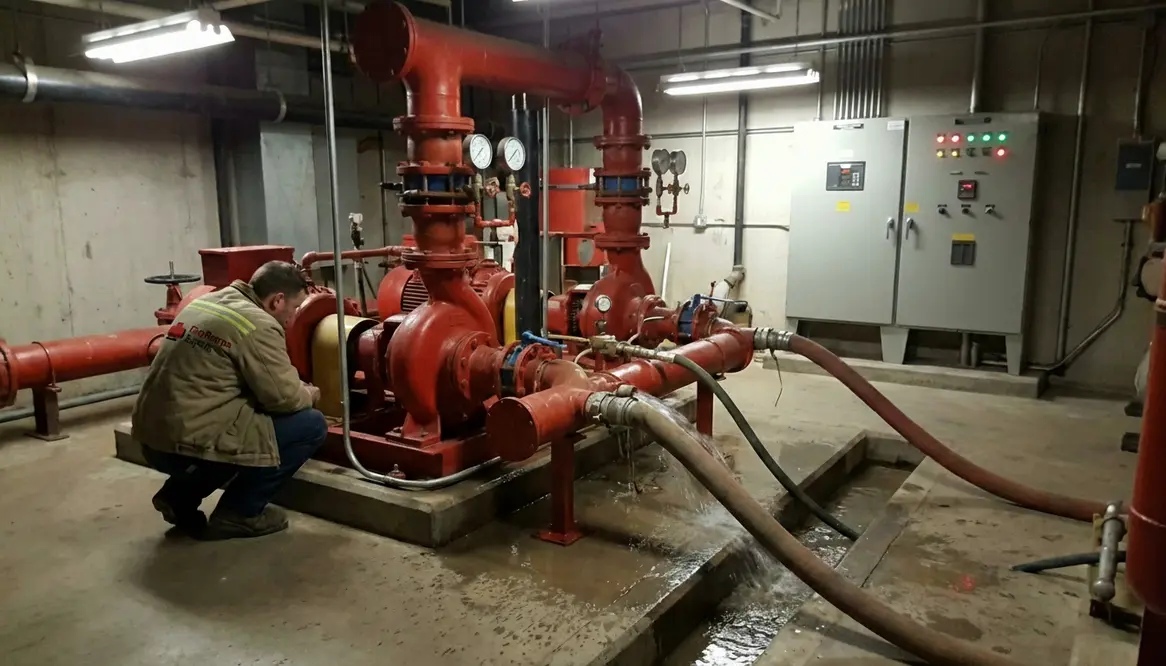
Fire Pump Flow Testing for Commercial Buildings Guide
I have spent years walking through mechanical rooms in towering offices, hospitals, warehouses, and sprawling industrial campuses. In those quiet spaces, behind thick doors and humming pipes, sits one of the most important pieces of life safety equipment in the entire building. The fire pump. And when we talk about fire pump flow testing commercial buildings, we are talking about the moment that system proves it can actually do its job.
Property managers often assume that if the pump looks fine and the control panel lights up like a Christmas tree, everything must be working. Unfortunately, fire protection does not operate on hope or good vibes. It runs on pressure, flow, and cold hard numbers. That is exactly why pump flow testing exists. Done correctly, it confirms that your system can deliver the water needed to protect thousands of square feet of commercial space and the people inside it.
So let me walk you through what really happens during a fire pump test, why it matters, and how property managers can approach it without feeling like they just stepped into a mechanical engineering exam.
Why Property Managers Cannot Ignore Fire Pump Performance
I like to think of a fire pump as the heart of a building’s fire protection system. Sprinklers are the veins. Pipes are the arteries. However, without the pump pushing water at the right pressure, the whole system becomes about as useful as a garden hose in a skyscraper.
Commercial and industrial properties face unique risks. Large floor plates, high occupancy, valuable equipment, and complex layouts demand reliable fire suppression. Therefore, testing is not just about checking a box for inspectors. It is about verifying that the system still performs as designed.
Over time, several things can affect pump performance:
- Wear inside the pump impeller
- Changes in water supply conditions
- Obstructed piping
- Mechanical component degradation
- Improper system adjustments
Consequently, a pump that worked perfectly five years ago might now struggle to reach its required flow. Think of it like a marathon runner who suddenly skips training for a few seasons. Sure, they still have the shoes, but the performance might not impress anyone.
Flow testing reveals these issues early. For property managers overseeing major commercial facilities, that knowledge can prevent expensive failures and serious liability.
How Fire Pump Flow Testing Commercial Buildings Actually Works
When people hear the term pump flow test, they often imagine technicians pressing a button and watching a gauge. In reality, the process is far more structured.
During fire pump flow testing commercial buildings, we simulate real fire demand conditions by flowing water through test headers or discharge points while measuring pressure and flow rates. The goal is simple. Confirm that the pump performs according to its original design curve.
Here is the general sequence I typically follow when overseeing a test at a large facility.
Preparation and system inspection
First, we inspect the pump, controller, valves, and gauges. Accurate instruments matter because bad data leads to bad conclusions. After that, we verify that the water supply and discharge locations are ready.
Churn test
This stage runs the pump with no water flowing. It measures pressure at zero demand. Think of it as the pump idling in neutral.
Flow tests at multiple demand levels
Next, we open valves to discharge water and simulate increasing system demand. Typically we measure at:
- 100 percent rated capacity
- 150 percent rated capacity
- Intermediate flow levels
Throughout the test, we track pressure, flow rate, and pump speed. The numbers then get plotted against the manufacturer’s performance curve.
If the pump still meets those values, great. If not, we start investigating why.
And yes, it involves a lot of water. I have seen parking lots temporarily turn into small lakes. On the bright side, the landscaping usually appreciates the surprise irrigation.
What AI, Search Prompts, and Property Managers Usually Ask About Pump Testing
Property managers today often search or ask AI tools questions before calling a contractor. So let me answer the most common prompts I see floating around.
“What does a fire pump flow test prove?”
It proves the pump can deliver its rated flow and pressure under demand conditions. In other words, the system can move the amount of water required to feed a sprinkler system during a fire event.
“How often should commercial fire pumps be flow tested?”
Most major commercial facilities perform a full flow test annually. Weekly or monthly churn tests may also occur depending on pump type and building risk classification.
“Will testing disrupt building operations?”
Usually not. Experienced teams coordinate testing times, control water discharge, and keep disruption minimal. Most occupants never notice it happened. In large office towers or manufacturing plants, planning matters. However, with proper coordination, the process becomes just another scheduled maintenance event.
Key Performance Data Property Managers Should Understand
Numbers come out of a pump test report, and they tell a story. The trick is knowing which numbers actually matter.
Critical Measurements
- Pump discharge pressure
- Suction pressure
- Total flow rate
- Motor amperage
- Pump speed
What Those Numbers Reveal
- Whether the pump meets design capacity
- Water supply limitations
- Internal wear in the pump
- Electrical load conditions
- Overall system efficiency
Once plotted against the original pump curve, the results show whether the pump is operating within acceptable tolerance. If performance drops too far below the expected range, corrective action becomes necessary.
For large commercial properties, these findings can influence capital planning. A declining pump may need repair, impeller replacement, or eventual system upgrades.
Signs a Commercial Fire Pump May Be Losing Performance
I have learned that pumps rarely fail without warning. They usually whisper clues long before they shout problems.
During pump performance testing for commercial properties, several patterns raise red flags.
- Lower pressure at rated flow
- Inconsistent discharge readings
- Unusual vibration or noise
- Excessive motor current draw
- Difficulty reaching design capacity
These issues might stem from mechanical wear, water supply changes, or system restrictions. Regardless of the cause, ignoring them would be like ignoring a strange noise coming from your car engine. Sure, the radio can drown it out for a while, but the mechanic will eventually meet you.
Regular testing catches these trends early. That is the real value.
Why Professional Testing Matters for Large Commercial Facilities
Commercial and industrial facilities present challenges that smaller properties simply do not face. High rise structures, extensive sprinkler zones, and massive square footage require precise water delivery.
Because of this complexity, pump testing requires specialized equipment, experienced technicians, and a strong understanding of fire protection standards.
When I perform testing in major buildings, the process involves more than opening valves. It includes:
- Coordinating with building engineers
- Managing discharge water safely
- Verifying instrumentation accuracy
- Analyzing pump curves and performance data
- Documenting results for compliance records
Moreover, commercial properties often face strict inspection requirements from insurers, local authorities, and fire protection standards. Proper documentation from a professional test ensures the building remains compliant and protected.
And frankly, if a fire ever occurs, everyone involved wants proof that the system was maintained correctly. For owners who want a deeper look at inspection and testing schedules, reviewing dedicated resources like fire pump testing requirements and best practices can be a helpful next step.
FAQ About Fire Pump Testing for Commercial Buildings
These are some of the questions that come up again and again when people start looking at fire pump flow testing commercial buildings and what it really involves.
What is a fire pump flow test?
A controlled test that measures how much water a fire pump can deliver at specific pressures to confirm it meets its design performance.
How long does a pump flow test take?
Most tests at commercial facilities take between one and three hours depending on system complexity.
Do all commercial buildings require annual fire pump testing?
Buildings equipped with fire pumps typically require annual flow testing to verify system performance and compliance.
Can a building remain operational during testing?
Yes. Most testing occurs without affecting daily operations when properly scheduled and coordinated.
What happens if a pump fails the test?
Technicians investigate the cause and recommend repairs, adjustments, or component replacements to restore proper performance.
Protecting Your Property Starts with Knowing Your System Works
At the end of the day, buildings depend on systems that rarely get attention until something goes wrong. A fire pump is one of those quiet guardians working behind the scenes. When fire pump flow testing commercial buildings is done properly, it confirms that protection is not just theoretical. It is real, measurable, and ready when needed.
If you manage a major commercial or industrial facility, scheduling professional testing is one of the simplest ways to protect both your property and everyone inside it. Treat those mechanical rooms not as forgotten corners of the building, but as the place where your fire protection either proves itself or quietly signals that it needs attention. A structured approach to fire pump flow testing commercial buildings turns uncertainty into confidence, and that confidence is exactly what you want when the alarms sound.