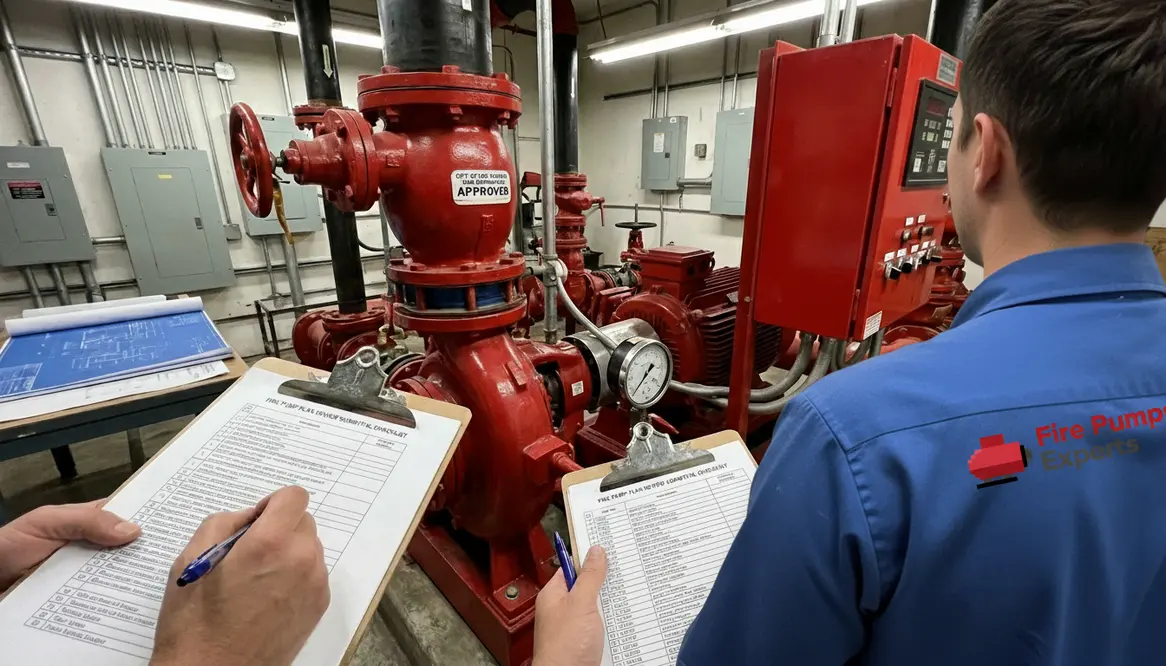
Fire Pump Plan Review Submittal Checklist Los Angeles
A practical roadmap to move your Los Angeles fire pump submittal from “pending corrections” to “approved as noted.”
I have spent years reviewing fire protection drawings, and if there is one place where details matter, it is Los Angeles. The city does not casually approve a fire pump system for a commercial tower, hospital, or industrial facility. Every valve, wire, and calculation must stand up to scrutiny. That is why I often tell project teams that a strong fire pump plan review submittal checklist los angeles is not paperwork. It is your roadmap to approval.
When a submittal package lands on a reviewer’s desk, it tells a story. Either it says “this team knows exactly what they are doing,” or it quietly whispers “this project may need three more revisions.” Naturally, nobody enjoys the second option. Therefore, in this guide I walk through what Los Angeles reviewers actually expect, the warning signs that trigger rejection, and how to build a clean, approval ready submittal package for large commercial and industrial properties.
How I Prepare a Fire Pump Plan Review Submittal Checklist Los Angeles Teams Actually Approve
Los Angeles agencies review hundreds of fire protection packages every month. Because of that volume, reviewers quickly spot missing information. If the package lacks structure, it slows down the entire approval cycle.
Therefore I start every project with a disciplined checklist. It keeps the engineer, contractor, and facility owner aligned from day one.
A complete fire pump plan review package for major buildings typically includes:
- Detailed fire pump room layout drawings showing equipment spacing, access clearances, and pipe routing
- Hydraulic calculations confirming the pump meets the building demand
- Pump performance curves and manufacturer specifications
- Controller documentation including wiring diagrams and power supply details
- Water supply analysis showing city main pressure and flow conditions
- Equipment data sheets for pumps, jockey pumps, relief valves, and test headers
- Structural anchoring details for seismic compliance
- Electrical coordination drawings showing feeder routing and disconnects
- Testing and commissioning procedures aligned with NFPA standards
However, the checklist alone is not enough. Each element must tell a consistent technical story. For example, if the hydraulic calculations demand 1500 GPM but the pump curve shows a different operating point, the reviewer notices immediately. And yes, they will send it back.
I like to joke that plan reviewers are the Sherlock Holmes of the fire protection world. Give them one loose clue and they will find the whole mystery.
What Los Angeles Reviewers Look For First
When I walk through a submittal package, I start with the same items most reviewers check first. These details signal whether the project team understands the system design.
Water supply verification
In Los Angeles, municipal water pressure varies across districts. Therefore the submittal must clearly show the hydrant flow test location, date, and safety factor applied in the hydraulic calculations.
System demand versus pump capacity
The pump must operate within its performance curve while still meeting the required flow and pressure for the entire sprinkler system. If the design pushes the pump beyond safe operating limits, the review stops immediately.
Pump room configuration
Major facilities such as high rise office towers, data centers, and manufacturing plants require specific clearances around equipment. Reviewers want to see space for maintenance, replacement, and inspection.
Code alignment
Los Angeles enforces NFPA standards alongside local amendments. Therefore the drawings must reference the correct edition and clearly identify compliance points.
When these fundamentals look solid, the reviewer keeps reading. If not, the project returns to the design team faster than a boomerang.
Common Red Flags That Slow Down Fire Pump Plan Review Submittal Checklist Los Angeles Packages
Even experienced teams occasionally miss details. However some mistakes appear so often they almost deserve their own blooper reel.
Here are the issues I see most frequently.
- Mismatched hydraulic calculations that do not match the pump curve
- Missing seismic bracing details for large pump assemblies
- Unclear electrical diagrams that do not show controller connections
- Improper test header locations that block fire department access
- Incomplete equipment data sheets from manufacturers
- Conflicting pipe sizes between drawings and calculations
Because Los Angeles projects often involve large commercial campuses and industrial facilities, the fire pump becomes the backbone of the entire suppression system. Therefore reviewers expect every component to match across documents.
One small inconsistency can trigger a full resubmittal. It is a little like ordering a coffee and receiving soup instead. Technically both are liquids, but something clearly went wrong.
How I Structure a Submittal Package for Large Commercial Buildings
For major properties, organization matters almost as much as the technical content. Reviewers appreciate a package that flows logically.
Therefore I structure submittals in layers, starting with the big picture and moving toward technical detail.
Design overview
- Project description
- Building occupancy classification
- Required fire flow demand
- Applicable codes and standards
Hydraulic analysis
- Water supply test results
- System demand calculations
- Pump sizing justification
Equipment documentation
- Pump manufacturer specifications
- Controller cut sheets
- Relief valve details
Installation drawings
- Pump room layouts
- Piping diagrams
- Electrical connections
- Testing equipment locations
This structure allows reviewers to confirm the system concept before reading into the technical diagrams. As a result, the approval process moves faster.
Think of it like watching a movie. First you understand the plot. Then you appreciate the special effects. If the movie started with explosions and no story, well, that is basically the Fast and Furious franchise.
How I Avoid Costly Resubmittals in Los Angeles Projects
Resubmittals delay construction schedules and increase engineering costs. Therefore I focus heavily on prevention. A disciplined fire pump plan review submittal checklist los angeles mindset starts long before the first file uploads to the city portal.
Cross checking calculations and equipment
First, I cross check every calculation against the equipment specifications. If the pump curve and hydraulic demand disagree, the design changes before the package leaves my desk.
Verifying local amendments
Second, I verify local amendments to NFPA standards. Los Angeles occasionally adds requirements that do not appear in national codes. Ignoring them almost guarantees comments from the reviewer.
Coordinating with electrical engineers
Third, I coordinate closely with electrical engineers. Fire pump controllers depend on reliable power supply design. Therefore disconnects, feeders, and emergency power connections must appear clearly in the plans.
Reviewing like a city plan checker
Finally, I review the entire package as if I were the city reviewer. I ask simple questions.
- Does every number match across drawings and calculations?
- Can a technician maintain the pump safely?
- Will the fire department easily access testing equipment?
If the answers feel uncertain, I revise the drawings before submission. A few hours of review now saves weeks of approval delays later.
FAQ: Fire Pump Plan Review in Los Angeles
Before we get to a more formal checklist, I am often asked the same practical questions about how a fire pump plan review submittal checklist los angeles project usually unfolds. The answers below reflect what I see across commercial and industrial work in the city.
A Practical Fire Pump Plan Review Submittal Checklist Los Angeles Teams Can Reuse
If you want something you can keep on the side of your screen while you prepare the package, this streamlined fire pump plan review submittal checklist los angeles style keeps the focus on what reviewers actually touch first:
- Confirm hydrant flow test data (location, date, residual pressure, safety factor)
- Verify that hydraulic calculations and pump curves align at required demand points
- Show clear pump room layouts with code-compliant working clearances
- Document seismic anchorage and bracing details for pumps, controllers, and piping
- Include complete manufacturer data sheets for pumps, controllers, valves, and test headers
- Provide electrical one-lines with feeders, disconnects, and emergency power clearly identified
- Reference NFPA 20 and all applicable local amendments directly on title sheets
- Highlight test header locations and fire department access on plans
- Align every pipe size between drawings, riser diagrams, and hydraulic calculations
- Bundle testing and commissioning procedures so reviewers see how the system will be verified in the field
Moving Your Project Toward Approval
Fire pump systems protect the largest commercial and industrial facilities in Los Angeles. Because of that responsibility, the review process demands precision and discipline. A carefully prepared submittal package eliminates delays and builds confidence with city reviewers.
If your project team wants a smoother approval process, start with a structured checklist and experienced guidance. Visit specialized fire pump inspection and service experts to keep your system aligned with code and ready for the field. The right preparation today keeps your project moving tomorrow.