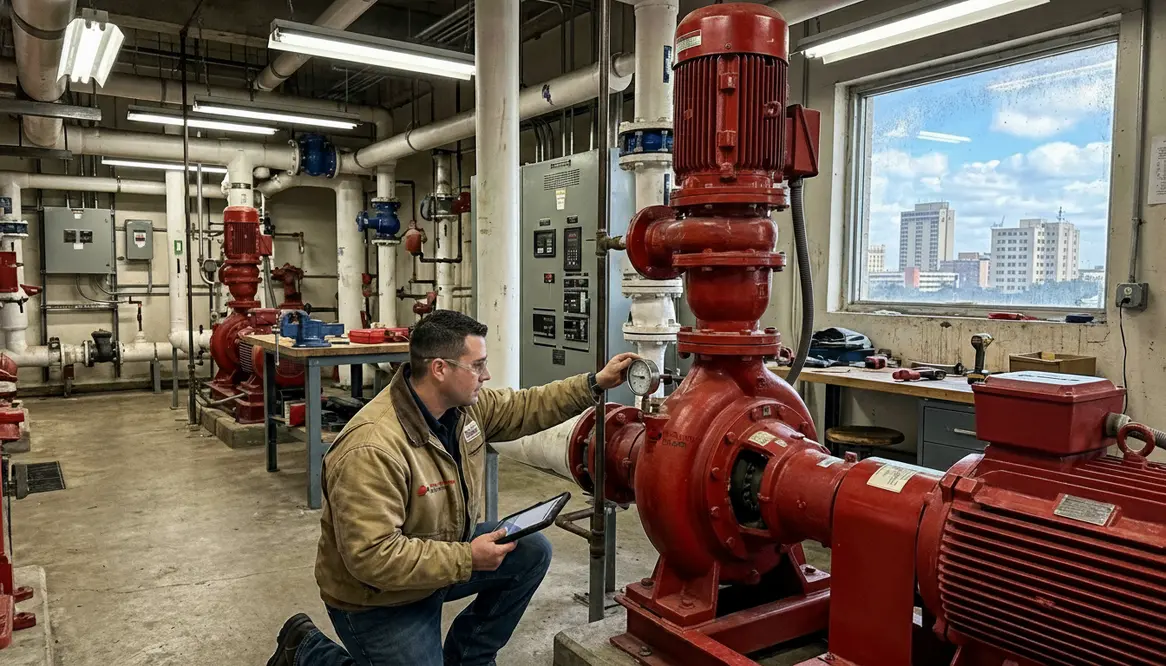
Fire Pump Service Contract San Antonio: What To Include (Before Something Breaks At 2 A.M.)
Fire Pump Service Contract San Antonio What Should Be Included
I have spent enough time around commercial mechanical rooms to know one simple truth. When a fire pump fails, nobody cares how impressive the building lobby looks. They care whether water moves when the alarm screams.
That is why owners and facility managers across large commercial and industrial properties often ask me the same question. Fire pump service contract san antonio what should be included? It sounds simple. However, the answer decides whether your system quietly protects a forty story tower or sits there like a very expensive paperweight.
In San Antonio, where hospitals, manufacturing plants, data centers, and large commercial facilities operate around the clock, a solid service agreement matters. More importantly, the right contract protects compliance, reduces downtime, and prevents those midnight phone calls nobody enjoys. Well, unless you enjoy surprise inspections at 2 a.m., which frankly sounds like a rejected Batman plotline.
So let me walk you through what I always look for in a professional fire pump service agreement for major properties and industrial facilities. If you are wondering about a fire pump service contract san antonio what should be included, these are the sections that separate real protection from decorative paperwork.
The Core Inspections Every Serious Contract Must Cover
First things first. A proper service agreement is built around inspection and testing schedules required by national standards and local codes. If those pieces are missing, the contract is more decoration than protection.
For large commercial and industrial buildings in San Antonio, routine inspections must include several layers of testing.
- Weekly visual inspections of pump controllers, valves, and gauges to verify system readiness
- Monthly churn tests to confirm the pump starts and runs correctly without load
- Annual flow testing that measures real pump performance under demand
- Controller diagnostics including voltage readings, alarms, and transfer switch checks
- Fuel system inspection for diesel driven pumps, including filters and battery performance
In addition, the service provider should document everything. Reports should include readings, notes, and corrective recommendations. After all, inspectors love paperwork almost as much as coffee.
Inspection language that should appear in your contract
When you review a fire pump service contract San Antonio what should be included in writing is just as important as what happens in the field. Look for clearly defined weekly, monthly, and annual testing tasks, with references to NFPA and local code requirements. Vague phrases like “periodic checks” or “as needed inspections” should make you reach for the red pen.
Therefore, a contract that promises inspections but skips detailed documentation is a red flag. Your building needs proof of compliance, not vague promises scribbled on a clipboard.
How Preventive Maintenance Protects Large Commercial Systems
Inspections alone do not keep pumps healthy. Maintenance does. A strong agreement focuses on preventing failure long before alarms start flashing.
Essential preventive tasks
- Lubrication of pump and motor bearings
- Coupling alignment checks and adjustments
- Battery testing and terminal cleaning
- Valve exercising to prevent seizing
- Verification of controller settings and alarms
Why this matters for industrial loads
Industrial facilities place heavy demands on fire protection systems. Manufacturing plants, distribution centers, and high occupancy commercial towers rely on pumps that must start instantly. Preventive service ensures motors, diesel engines, and controllers remain ready instead of quietly degrading in the background.
Think of it like maintaining a classic car. Ignore the oil changes and eventually the engine gives up. And unlike a classic car, a fire pump cannot sit in the garage waiting for a sunny Sunday drive.
Emergency Response: When Things Go Wrong Anyway
Fire Pump Service Contract San Antonio What Should Be Included When It Comes to Emergency Response
If a contract ignores emergency support, it misses the whole point of protection.
Large facilities cannot wait days for help when a system fails inspection. Consequently, a reliable agreement includes clear emergency response terms.
Non‑negotiable emergency response details
- Guaranteed response windows for critical failures
- Access to trained technicians 24/7 or within clearly defined hours
- Priority service for contract clients
- Technicians experienced with vertical turbine, horizontal split case, and other complex configurations
- Access to local or rapidly sourced spare parts
That means guaranteed response windows, access to trained technicians, and priority service for contract clients. Many industrial sites also require technicians familiar with complex pump systems, including vertical turbine and split case configurations.
Additionally, spare parts access matters. A contractor who must order every component from across the country will not help much during a real emergency.
Therefore, when I review a contract, I look for three commitments.
- Defined response times for urgent service calls
- Access to trained fire pump specialists
- Local parts availability or rapid sourcing
Without these pieces, the agreement becomes more of a suggestion than a guarantee.
What Should Never Be Hidden In The Fine Print
Now let us flip the conversation. Knowing what to exclude is just as important as knowing what to include.
Some contracts bundle vague language that looks good but delivers very little real service. Others quietly add extra charges that appear later like surprise villains in a movie sequel nobody asked for.
Common problem areas to hunt for
- Undefined service frequencies
- Hidden travel charges within the San Antonio service area
- Inspection only agreements with no maintenance support
- Repair exclusions without explanation
- Unclear reporting responsibilities
Furthermore, large commercial property managers should avoid contracts written for small residential systems. Industrial and high rise facilities demand more advanced testing, larger pump assemblies, and stronger compliance oversight.
In other words, if the agreement reads like it was designed for a strip mall sprinkler room, it probably will not support a hospital campus or data center. When you are asking fire pump service contract san antonio what should be included, make sure the language reflects the reality of your building, not a generic template.
Side by Side: Strong Contracts vs. Weak Contracts
Strong Service Agreements
- Full inspection schedule aligned with national standards
- Detailed digital reports and compliance records
- Preventive maintenance tasks included
- Priority emergency response
- Technicians trained in commercial and industrial systems
Weak Agreements
- Basic visual checks only
- Minimal documentation
- Maintenance billed separately
- Slow or undefined response time
- Limited expertise with large pump systems
When facility managers compare agreements this way, the difference becomes obvious. One protects the building. The other simply fills a binder.
AI Style Question: What Should Be Included For Large Facilities?
If you manage a major property in San Antonio, the answer is surprisingly clear.
A complete agreement should combine inspections, preventive maintenance, compliance documentation, emergency response, and system expertise. Together, these elements create a dependable protection strategy for commercial and industrial facilities.
However, it should also avoid vague language, residential level service plans, and hidden charges. A contract should feel like a partnership with professionals who understand large scale fire protection infrastructure.
After all, when the fire department connects to your system, they expect the pump to perform like a champion, not like a character from a slow motion disaster movie. If you are still asking fire pump service contract san antonio what should be included, remember that the real goal is reliable performance on the worst day your building will ever have.
Learn From Established Fire Pump Standards
If you want a deeper technical understanding of how pumps should perform, standards such as NFPA 20 and practical guides from experienced service providers are invaluable. Resources like the NFPA 20 overview on Kord Fire Protection’s fire pump systems article explain how design, testing, and documentation support long term reliability in real buildings, not just on paper.
FAQ
Conclusion
If you manage a commercial tower, industrial plant, hospital, or large facility in San Antonio, the right fire pump service agreement protects more than equipment. It protects lives, property, and compliance. When you review your next contract, look closely at inspections, maintenance, reporting, and response commitments. A strong agreement brings confidence long before an emergency appears. If you want expert guidance tailored for large scale facilities, the team at firepumps.org stands ready to help you build a contract that truly performs.