Dallas Fire Pump Acceptance Testing Electrical Checklist
A practical walk through real-world fire pump rooms, the pressure of big commercial facilities, and the electrical and mechanical details that decide whether your system performs when it matters most.
Fire Pump Acceptance Testing in Dallas: A Checklist for Electrical and Mechanical Readiness
I have walked into a lot of mechanical rooms in my time. Some feel like the control deck of the Starship Enterprise. Others look like a scene from an action movie where the hero has ten seconds to stop the meltdown. Somewhere between those two extremes sits the fire pump room of a large commercial facility.
And that room matters more than most people realize.
Before a new system protects a hospital tower, manufacturing plant, or high rise in Dallas, it must pass a careful review. That is where a fire pump acceptance testing dallas electrical mechanical checklist comes into play. It verifies that every wire, valve, controller, and rotating part works exactly as intended. Not almost. Not close enough. Exactly.
Today I want to walk you through how I approach this process. Because when electrical and mechanical readiness align, the result is simple. A fire protection system that performs when everything else goes wrong.
Snapshot: Why This Checklist Exists
- Large facilities run on complex electrical infrastructure.
- Mechanical performance alone does not guarantee fire protection.
- A structured fire pump acceptance testing dallas electrical mechanical checklist keeps life safety systems from becoming guesswork.
- The goal: clear, documented confidence before anyone moves in.
Why Acceptance Testing Matters for Large Commercial Facilities
First, let us talk about the stakes.
A fire pump in a residential duplex is important. However, a fire pump serving a distribution center the size of several football fields is something else entirely. Millions of dollars in assets depend on it. So do hundreds or even thousands of people working inside the building.
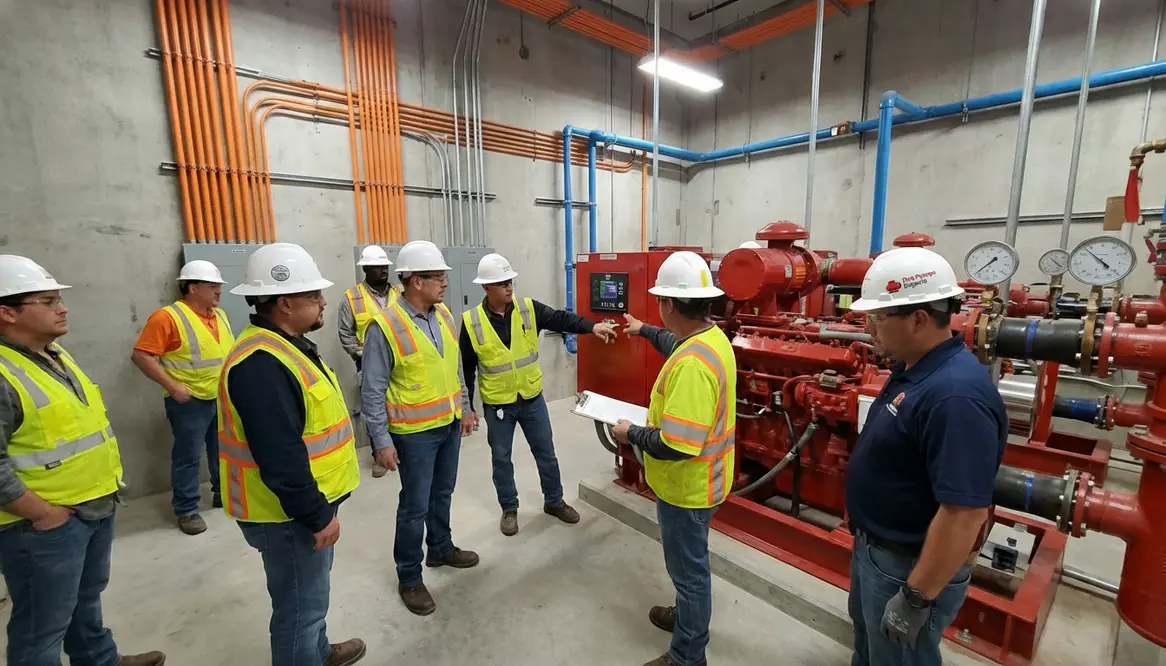
Because of that, acceptance testing is not a casual walk through with a clipboard. It is a coordinated event involving contractors, engineers, inspectors, and facility leadership.
Moreover, Dallas presents its own challenges. High demand infrastructure, large campuses, and complex power systems mean that fire pumps must integrate with serious electrical capacity. If the power transfer fails, the pump fails. If the controller logic is off by a hair, the pump may never start.
Think of it like launching a rocket. NASA does not simply press a button and hope for the best. They check every system twice, then probably once more for good measure.
Fire pump acceptance testing works the same way, just with fewer astronauts and slightly less dramatic music.
The Role of a Structured Dallas-Focused Checklist
In the middle of construction deadlines and competing priorities, details slip. A disciplined fire pump acceptance testing dallas electrical mechanical checklist keeps those details from falling through the cracks. It organizes who is responsible for what, when it gets tested, and how performance is documented so that nothing is left to chance.
How I Prepare a Fire Pump Acceptance Testing Dallas Electrical Mechanical Checklist
Preparation always comes first. A good test day begins long before anyone turns a wrench or opens a breaker.
Step 1: Review the Story on Paper
I start by reviewing documentation. Submittals, shop drawings, controller specifications, and hydraulic calculations all tell the story of how the system should behave. If the design calls for a specific pressure curve or automatic start sequence, I want that expectation crystal clear.
Step 2: Confirm Who Needs to Be in the Room
Next, I confirm the presence of key participants. For large commercial or industrial properties, acceptance testing often includes:
- Electrical contractors responsible for power distribution
- Mechanical installers who handled pump and piping installation
- Fire protection contractors
- Commissioning agents or engineers
- Authority having jurisdiction inspectors
Coordination matters. Otherwise the day turns into a sitcom episode where everyone blames someone else for the missing wrench.
Step 3: Verify Instrumentation and Safety Capacity
Then I check instrumentation. Pressure gauges, flow meters, and calibrated sensors must be ready. Without accurate measurement tools, testing becomes guesswork. And guesswork has no place in life safety systems.
Finally, I review safety controls. Relief valves, discharge piping, and drainage must handle full flow conditions. Fire pumps can move a serious amount of water. When the pump spins up, it does not politely trickle like a garden hose. It roars.
Electrical Readiness: Power, Controllers, and the Brain of the Pump
Now we move into the electrical side of the equation.
Many people assume a fire pump is mostly mechanical. In reality, the electrical system acts as the brain behind the muscle. Without reliable power and control logic, the pump is just a very expensive piece of metal.
I typically verify several electrical elements during acceptance testing.
Incoming Power Supply
The primary service must match the voltage and phase specified for the pump motor. I check protective devices, conductor sizing, and disconnect locations. In large commercial facilities, these feeds often come directly from substantial switchgear.
Additionally, voltage stability matters. A pump that experiences excessive drop during startup may stall or trip.
Controller Configuration
The fire pump controller governs startup, monitoring, and alarms. Therefore I verify:
- Correct motor ratings
- Pressure sensor calibration
- Automatic start parameters
- Manual start functions
- Alarm signaling to the fire alarm panel
If a controller fails to communicate properly with building systems, operators lose critical visibility during emergencies.
Emergency Power Integration
Large facilities often rely on generators or alternate feeds. Consequently, I test power transfer scenarios. The pump must continue running even if the primary utility source disappears.
And yes, I have seen generators save the day during real incidents. It is the closest thing the building has to a superhero cape.
If you want ongoing support beyond acceptance, working with a full-service fire pump provider like Kord Fire Protection helps keep testing, maintenance, and upgrades aligned over the life of the building.
Mechanical Readiness: The Muscle Behind the System
Once the electrical side passes inspection, attention shifts to the mechanical components. This is where pressure curves, water flow, and physical performance take center stage.
Below is a simplified comparison I often use during field reviews.
Mechanical Items I Inspect
- Pump alignment and secure mounting
- Suction piping configuration
- Discharge valves and check valves
- Pressure relief valve operation
- Flow meter installation
- Cooling and lubrication systems
Performance Tests I Run
- Churn test at no flow
- Rated flow verification
- Peak flow capacity testing
- Pressure stability monitoring
- Vibration observation
- Temperature checks during operation
During these tests, I watch the system like a hawk. Pumps tell you a lot through sound and vibration. A smooth hum means the installation is likely correct. A grinding rattle sounds like a rock concert held inside a blender.
And trust me, that second sound is not what inspectors want to hear.
What Happens During the Actual Testing Day
Testing day feels a bit like a live performance. Everyone gathers in the pump room, equipment stands ready, and someone eventually says the magic words.
Let us start the pump.
From First Start to Full Flow
First, we verify automatic activation through pressure drop simulation. The system must respond immediately. Then we move through manual starts, controller functions, and alarm verification.
After that, flow testing begins.
Water moves through hoses or test headers while we measure pressure and flow rate. These readings confirm that the pump meets its design curve. In large commercial and industrial buildings, this step proves the system can support sprinkler networks across massive floor areas.
Throughout the process, I document everything. Readings, anomalies, corrective actions. Because acceptance testing is not just a performance check. It creates the official record that the system protects the property.
By the end, everyone involved knows one thing for certain. The pump either passed or it needs adjustment.
No gray area. Fire protection does not deal in maybe.
Common Problems I Catch During Acceptance Testing
Even with experienced contractors, a few issues appear often.
- Improperly calibrated pressure sensors
- Loose electrical terminations
- Air trapped in suction lines
- Incorrect controller programming
- Valves left partially closed after installation
None of these problems are unusual. Construction sites are busy places. However, catching them before occupancy is critical.
Because when a real emergency happens, nobody wants the fire pump acting like a confused robot from an old science fiction movie.
It needs to start instantly. Deliver pressure. And keep running until the danger passes.
Building Your Own Dallas Electrical & Mechanical Checklist
If you are responsible for planning or overseeing acceptance in a major facility, building your own internal fire pump acceptance testing dallas electrical mechanical checklist is worth the effort. It becomes a living document that standardizes how your team approaches every new project and major upgrade.
- List every electrical verification step you expect completed before test day.
- List every mechanical inspection and performance test you require documented.
- Define who signs off each line item and where those records are stored.
- Include space for follow-up actions so fixes never get lost in the shuffle.
Over time, that checklist captures your lessons learned from each project and turns them into practical, repeatable steps for the next one.
FAQ: Fire Pump Acceptance Testing
Below are a few of the questions I hear most often when people are getting ready for a fire pump acceptance test in a large commercial facility.
Conclusion
If you manage a major commercial or industrial property in Dallas, the fire pump protecting that building deserves careful verification. A disciplined testing process ensures electrical systems, mechanical performance, and control logic all work together under pressure.
If you want confidence before occupancy or after system upgrades, start with a proven fire pump acceptance testing dallas electrical mechanical checklist. The right preparation today helps ensure that when the unthinkable happens tomorrow, your system responds exactly as it should, with every wire, valve, sensor, and rotating part doing its job without hesitation.