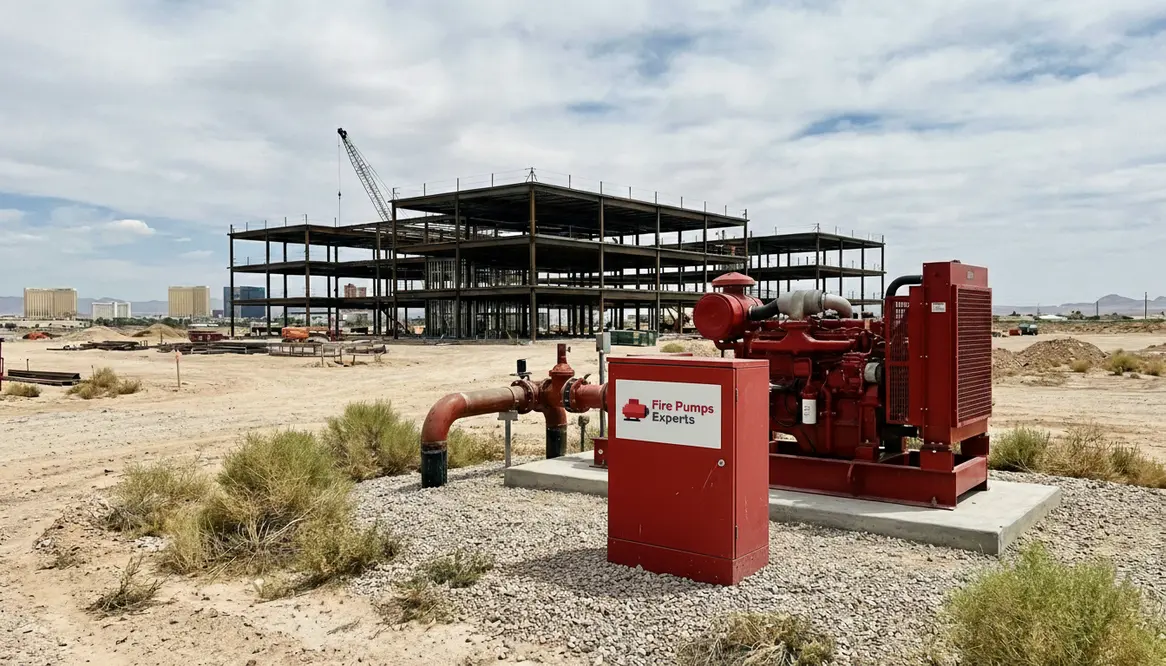
Wildfire Fire Pump Planning Las Vegas Guide
I have spent enough time around job sites in Las Vegas to know one thing for certain. Fire does not care how impressive your building looks on a rendering. It only cares about fuel, heat, and opportunity. That is exactly why wildfire fire pump planning matters more here than in most cities. Between desert winds, dense commercial builds, and high occupancy structures, the margin for error is thin. So today, I am walking you through what developers actually need to understand about fire pumps in Las Vegas, without the fluff and without putting you to sleep.
Why Fire Pumps Matter More in Las Vegas Than You Think
At first glance, Las Vegas feels like a city built on spectacle. However, behind every casino tower and industrial facility is a carefully engineered fire protection system. Fire pumps are the muscle of that system. They ensure water reaches the upper floors, remote zones, and high demand sprinkler systems when pressure alone cannot cut it.
Because municipal water pressure varies across the valley, relying on city supply alone is like trusting WiFi in a crowded casino. Sometimes it works. Sometimes it absolutely does not. Therefore, developers must treat fire pumps as essential infrastructure, not optional upgrades.
Additionally, local codes and NFPA standards demand precise performance. If your system underperforms, you are not just facing compliance issues. You are risking operational shutdowns and serious liability.
If you want a deeper breakdown of how NFPA 20 shapes pump design, installation, and testing expectations, resources like the NFPA 20 guide from Kord Fire Protection at https://kordfire.com/how-nfpa-20-regulates-fire-pump-systems/ are worth bookmarking as you refine your wildfire fire pump planning approach.
How Do I Plan Fire Pump Systems for Large Commercial Buildings in Las Vegas?
Let me answer this the way most developers wish someone had earlier. Start early. Earlier than you think. wildfire fire pump planning should be part of your initial design phase, not something you bolt on after architectural plans are locked.
First, I evaluate water supply data. Then, I match it against system demand, factoring in building height, occupancy type, and hazard classification. After that, I coordinate with civil engineers, fire protection designers, and AHJs. If that sounds like a lot, it is. But skipping steps here is like skipping leg day. Eventually, everything collapses.
Moreover, placement matters. Fire pump rooms must meet strict access, ventilation, and protection requirements. I have seen projects delayed simply because someone treated the pump room like leftover closet space. Spoiler alert. Inspectors notice.
Core Components Developers Cannot Afford to Ignore
Reliable Power Supply
Fire pumps need dependable power. Whether electric or diesel driven, redundancy is key. Power loss during a fire event is not the plot twist you want.
Controller Systems
Controllers act as the brain. They start the pump automatically when pressure drops. A poor controller setup is like hiring a security guard who naps.
Proper Sizing
Oversizing wastes energy and money. Undersizing risks failure. Precision matters here, and guesswork has no place.
Testing and Commissioning
Even the best system means nothing if it is not tested correctly. Flow tests, acceptance tests, and ongoing maintenance all play a role.
As a result, every component must work together seamlessly. This is not a mix and match situation. It is more like assembling the Avengers. Everyone has a role, and if one fails, things get messy fast.
Common Mistakes I See Developers Make
Now, let me save you some time and money. These mistakes show up more often than reruns of classic sitcoms.
First, developers underestimate water demand. They assume standard calculations will apply, even when dealing with high density commercial spaces. That assumption rarely holds up under inspection.
Second, they delay coordination. Fire protection engineers get looped in late, which leads to redesigns, added costs, and strained timelines.
Third, maintenance planning gets ignored. A fire pump is not a set it and forget it system. Without regular testing, performance degrades. And when it fails, it does so at the worst possible moment.
Finally, some try to cut corners on compliance. That might work in a movie plot. In Las Vegas permitting, it absolutely does not.
Integrating Wildfire Risk Into Urban Fire Pump Design
Here is where things get interesting. Las Vegas may be urban, but wildfire exposure still plays a role, especially on the outskirts and near industrial zones. Therefore, wildfire fire pump planning must account for external threats, not just internal building fires.
I factor in extended water demand durations, potential supply disruptions, and environmental conditions. Wind driven embers, for example, can create multiple ignition points. That means your system must sustain pressure longer and across wider zones.
Additionally, backup systems become more important. Diesel pumps often serve as a reliable fallback when electrical infrastructure is compromised. Think of it as your system’s backup quarterback. Not always in the spotlight, but critical when things go sideways.
When you layer in these wildfire scenarios during the earliest wildfire fire pump planning conversations, you avoid scrambling later to retrofit capacity, redundancy, and protection that really should have been there from day one.
Compliance, Codes, and Working With Local Authorities
Las Vegas enforces strict adherence to NFPA standards, along with local amendments. Therefore, I always recommend early and consistent communication with authorities having jurisdiction.
Plan reviews, inspections, and approvals all hinge on clarity and accuracy. If your documentation is vague, expect delays. If your system design is inconsistent, expect revisions.
On the bright side, when you align with requirements early, the process flows much smoother. Inspectors appreciate preparedness. And frankly, so does your project timeline.
This is also where disciplined wildfire fire pump planning pays off. When your narratives, calculations, and drawings clearly show how pumps, power, and water supply will perform under both typical and elevated wildfire conditions, AHJs have a much easier time signing off.
FAQ About Fire Pumps in Las Vegas
These are the questions that come up on nearly every Las Vegas project once owners realize how central good pump planning really is.
Build Smarter, Safer, and With Confidence
If you are developing in Las Vegas, fire pumps are not just another line item. They are a core part of your building’s safety and long term viability. I encourage you to approach planning with intention, precision, and the right partners at the table. When you do, you reduce risk, avoid delays, and create systems that perform when it matters most. Reach out today and let’s make sure your next project is built to protect as well as impress.