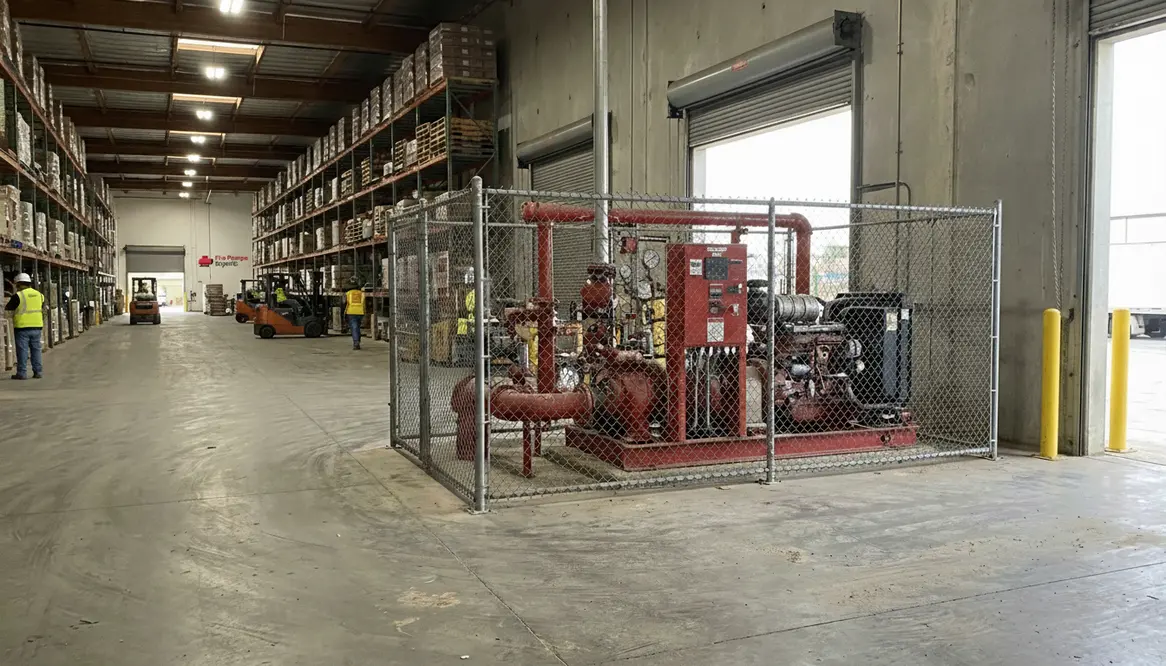
Fire Pump Systems for Kern County Public Warehouses
I have spent years walking the concrete floors of warehouses and distribution centers across Kern County, and I can tell you this with calm certainty: fire protection is not where you cut corners. It is where you build confidence. When I design or evaluate fire pump systems for public facilities, I approach them like a steady heartbeat in a high stakes environment. Quiet. Reliable. Always ready. Because when something goes wrong, this system should feel less like a machine and more like a trusted old friend who shows up without being asked.
And yes, while this may not sound as thrilling as a summer blockbuster, the reality is this: a properly planned fire pump system can save millions in assets and, more importantly, lives. Not bad for something that spends most of its time minding its own business.
What makes fire pump planning different in Kern County warehouses?
Kern County is not shy about its environment. We are talking heat, dust, and wide open industrial spaces. Therefore, I always design with those factors in mind. A warehouse here is not just a box with shelves. It is a dynamic system with high piled storage, heavy equipment, and constant movement.
Because of that, fire pumps must deliver consistent pressure across large footprints. Additionally, water supply reliability becomes critical. Municipal sources may vary, so I often account for backup storage or booster configurations. Meanwhile, temperature swings can affect equipment performance, which means proper housing and ventilation are not optional.
In other words, if your system cannot handle a 100 degree afternoon while forklifts race by like they are auditioning for Fast and Furious, it is not ready.
Environmental stress and fire pump systems for public facilities
Public warehouses in Kern County do not live in a climate-controlled bubble. Heat, dust, and constant vibration from equipment all put stress on fire pump assemblies, controllers, and piping. Designing fire pump systems for public facilities here means expecting abuse from the environment and building in protection: filtered ventilation, appropriate enclosures, and sensible placement away from the worst dust and traffic.
Designing fire pump systems for public facilities that actually perform
I have seen systems that look perfect on paper but fall short in real life. That usually happens when design ignores how a facility truly operates. So, I focus on function first.
First, I evaluate hazard classification. Warehouses storing plastics or chemicals demand higher flow and pressure than those holding boxed goods. Next, I map out demand points. Sprinkler systems must receive consistent supply, even at the farthest corners of the building.
Then comes pump selection. Electric or diesel driven units each have their place. Electric pumps offer simplicity, while diesel pumps provide independence during power loss. In Kern County, I often recommend considering both, because redundancy is not paranoia. It is preparation.
Finally, controls and testing protocols tie everything together. A fire pump that is not regularly tested is like a parachute you have never opened. Technically reassuring, but not something I would bet my life on.
Making warehouse operations and fire pumps play nicely together
Fire protection should not trip over daily operations. When I lay out fire pump systems for public facilities, I pay attention to truck lanes, staging areas, loading docks, and mezzanines. Piping runs, control valve locations, and test headers all need to be accessible without becoming one more thing a forklift operator has to dodge.
How do I size a fire pump for a distribution center?
I start with demand calculations. That means understanding required flow rate and pressure based on sprinkler design. However, I do not stop there. I also account for friction loss, elevation changes, and future expansion.
Because distribution centers evolve, I plan systems that can grow. Today it might be pallet racks. Tomorrow it could be automated storage reaching new heights. Therefore, oversizing slightly can prevent expensive upgrades later.
Additionally, I consider water supply curves. If the incoming supply cannot meet peak demand, the pump must bridge that gap. This is where experience matters. Numbers tell a story, but only if you know how to read between the lines.
Key Inputs I Analyze
- Sprinkler system demand
- Water supply reliability
- Pipe layout and friction loss
- Building expansion plans
Outcomes I Aim For
- Stable pressure across all zones
- Minimal performance fluctuation
- Efficient energy use
- Long term scalability
Designing with Kern County growth in mind
Kern County warehouses rarely stay small for long. That is why I frame sizing in terms of where the operation is headed, not just where it is today. Clearances grow, storage height increases, and special hazards appear. A carefully chosen fire pump can absorb that growth without tearing apart everything you already installed.
Common mistakes I see and how I avoid them
Now, here is where things get interesting. Because even the best intentions can go sideways.
One mistake I often see is undersized pumps. It usually comes from trying to save upfront costs. However, that decision tends to age about as well as milk left in the sun. Another issue is poor maintenance planning. A system without routine testing will eventually surprise you, and not in a good way.
Additionally, some facilities ignore system integration. Fire pumps must work seamlessly with alarms, sprinklers, and backup power. If these elements do not communicate properly, response time suffers.
So I take a different approach. I design with coordination in mind. Every component has a role, and every role supports the bigger picture. Think of it like an orchestra. If one instrument is off, the whole performance feels wrong.
Where fire pump systems for public facilities go wrong
In public warehouses, the most damaging failures are often invisible until an inspection or an incident. Valves that nobody can reach, test headers buried behind pallets, controllers that are never exercised, or a pump room that doubles as general storage. Avoiding those traps means drawing the system around real human behavior, not just code lines on a plan set.
Fire pump systems for public facilities and long term reliability
Reliability is not built in a day. It comes from smart planning and disciplined upkeep. Therefore, I always emphasize lifecycle thinking. Installation is just the beginning.
Regular testing, inspections, and performance tracking keep systems ready. Moreover, I encourage facilities to document everything. Data reveals trends, and trends help prevent failures.
In Kern County, where industrial operations rarely slow down, downtime is costly. A dependable fire pump system ensures that safety does not compete with productivity. Instead, it supports it quietly in the background.
And honestly, if your fire pump is doing its job right, you will barely notice it. Which is exactly the point.
Keeping Kern County warehouses inspection ready
Regulators and insurers pay close attention to how fire pump systems for public facilities are maintained. Clean records, recent test data, and documented repairs not only keep you compliant, they show that the system will perform when warehouses are full, trucks are lined up at the docks, and the pressure is already high before any alarm goes off.
FAQ: Fire Pump Planning for Warehouses
A quick set of answers for the questions that come up again and again when planning fire protection for warehouses and distribution centers.
Let’s build something that works when it matters most
If you are planning or upgrading a warehouse or distribution center in Kern County, I invite you to think beyond minimum requirements. A well designed fire pump system protects your people, your inventory, and your peace of mind. Reach out, and together we will create a solution that performs under pressure, stands the test of time, and stays ready long after installation day.
If you want a deeper look at professional inspection, testing, and maintenance, explore the fire pump services offered by Kord Fire Protection at https://kordfire.com/fire-pump/ for a real world view of what comprehensive support for your system looks like.