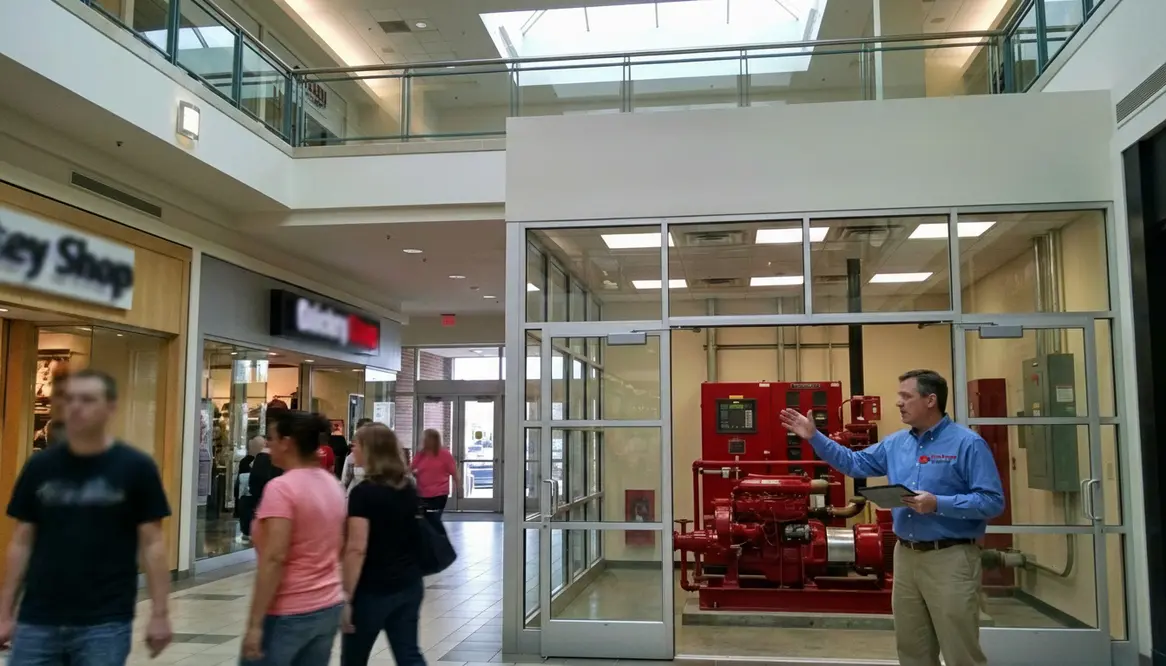
Fire Pump Design for Shopping Malls
I have spent years walking through vast commercial properties, from echoing shopping malls to complex mixed use developments. And while most people see storefronts and food courts, I see water flow, pressure curves, and the quiet confidence of a well designed fire pump system. Now, although my work often overlaps with religious facility fire protection, the same disciplined thinking applies to large retail spaces. After all, fire does not care whether it starts near a food kiosk or beneath a cathedral ceiling. So today, I will walk you through how I evaluate fire pump needs in shopping malls, calmly and carefully, like a man explaining the plot of a heist movie where the stakes are much higher than missing diamonds.
Understanding Mall Fire Risk Like an Engineer, Not a Gambler
First, I look at risk. Not guesswork. Not vibes. Actual risk. Shopping malls are layered environments. You have retail units, storage rooms, restaurants, cinemas, and sometimes even ice rinks. Each one brings its own fire load.
Because of that, I evaluate combustible materials, ceiling heights, and occupancy density. For instance, a clothing store stacked floor to ceiling behaves very differently from a luxury watch boutique. Meanwhile, food courts introduce grease fires, which, frankly, do not care about your sprinkler system having a bad day.
As a result, I map out hazard classifications across the entire property. This step ensures the fire pump system is not just present but properly sized and responsive. Think of it as casting the right actors before filming begins. Nobody wants the wrong lead when things heat up.
These same principles extend into work on religious facility fire protection, where complex layouts and varied occupancies demand the same disciplined, risk based approach before any pump selection even starts.
How do I calculate fire pump capacity for a shopping mall?
I start with demand. Always demand. Fire pumps exist to meet pressure and flow requirements when the municipal supply falls short. And in large commercial properties, it almost always does.
So, I calculate total system demand by reviewing sprinkler design densities and hose stream allowances. Then, I compare that with available water supply data. If the city water system cannot keep up, and spoiler alert, it usually cannot, I specify a fire pump that fills the gap.
Additionally, I factor in peak scenarios. Not average days. Worst days. Because fire protection is not about optimism. It is about preparation.
And yes, I have seen systems that looked great on paper but folded under real conditions. That is like bringing a butter knife to a sword fight. Technically a weapon, but not one you would trust.
System Layout and Zoning That Actually Makes Sense
Once capacity is clear, I turn to layout. Shopping malls are sprawling. If you try to treat them as one uniform space, you will create pressure imbalances and slow response times.
Instead, I break the system into zones. Each zone reflects real world usage and fire risk. For example, anchor stores often require different pressure profiles than interior retail corridors. Meanwhile, upper levels demand careful vertical pressure management.
Therefore, I align pump performance with zoning strategy. This ensures water reaches every corner without delay or loss of effectiveness. It is a bit like directing traffic in a busy city. If everything flows smoothly, no one notices. If it fails, everyone notices immediately.
Zoning parallels in complex facilities
Whether I am laying out a multi level mall or tackling religious facility fire protection in a large campus with sanctuaries, classrooms, and event halls, zoning is what keeps the system predictable. It lets the fire pump deliver the right pressure to the right place without overtaxing anything else.
Balancing Redundancy, Codes, and Real World Reliability
Now we get into something many overlook. Redundancy. Because a fire pump that fails is worse than no pump at all. At least with no pump, no one is under false confidence.
I review applicable codes and standards, then go further. I ask what happens if power fails. What if a controller malfunctions. What if maintenance was skipped because someone thought it could wait until next quarter.
As a result, I often recommend backup power sources, dual pump configurations, and robust monitoring systems. This approach mirrors what I apply in religious facility fire protection, where reliability is non negotiable and downtime is unacceptable.
And yes, redundancy costs more upfront. However, it costs far less than explaining to stakeholders why a preventable failure became a headline.
Where redundancy matters most
In both shopping malls and religious facility fire protection projects, I focus redundancy around power supply, controller reliability, and networked monitoring. Those are the pressure points that decide whether your system quietly works or dramatically fails.
Side by Side: Key Evaluation Factors
Water Supply Analysis
- Measure flow and pressure from municipal sources
- Identify seasonal fluctuations
- Confirm long duration availability
Hazard Classification
- Retail versus storage versus food service
- Ceiling height impact on sprinkler demand
- Special risks like cinemas or mechanical rooms
Pump Selection
- Match pump curve to peak demand
- Ensure compatibility with system pressure
- Plan for future expansion
System Reliability
- Backup power integration
- Monitoring and alarms
- Maintenance accessibility
Why Maintenance and Testing Are Not Optional Extras
Even the best system needs attention. Fire pumps are not decorative pieces. They are working machines that demand regular testing.
So, I build maintenance access into the design from the start. Clear space, proper drainage, and easy controller access all matter. Furthermore, I ensure testing procedures align with operational realities of a busy mall.
Because here is the truth. If testing disrupts business too much, people will avoid it. And avoidance is the quiet villain in many system failures.
Think of maintenance like going to the gym. Skip it long enough, and eventually something gives out. Usually at the worst possible moment.
Maintenance culture across properties
Whether it is a regional mall or a campus focused on religious facility fire protection, I push for written testing schedules, owner training, and clear documentation. A system that is not maintained is simply a very heavy, very quiet decoration.
FAQ: Fire Pump Needs in Shopping Malls
Owners and designers often ask similar questions once they see what a full evaluation actually involves. A few of the most common are collected here so you can benchmark your own project before calling in a specialist.
Final Thoughts and Your Next Move
Evaluating fire pump needs in shopping malls is not guesswork. It is a careful balance of science, experience, and foresight. I approach every project with the same mindset. Build systems that perform when everything else goes wrong. If you manage or design large commercial properties, now is the time to assess your fire protection strategy. Reach out, ask the hard questions, and make sure your system is ready before it is ever needed.