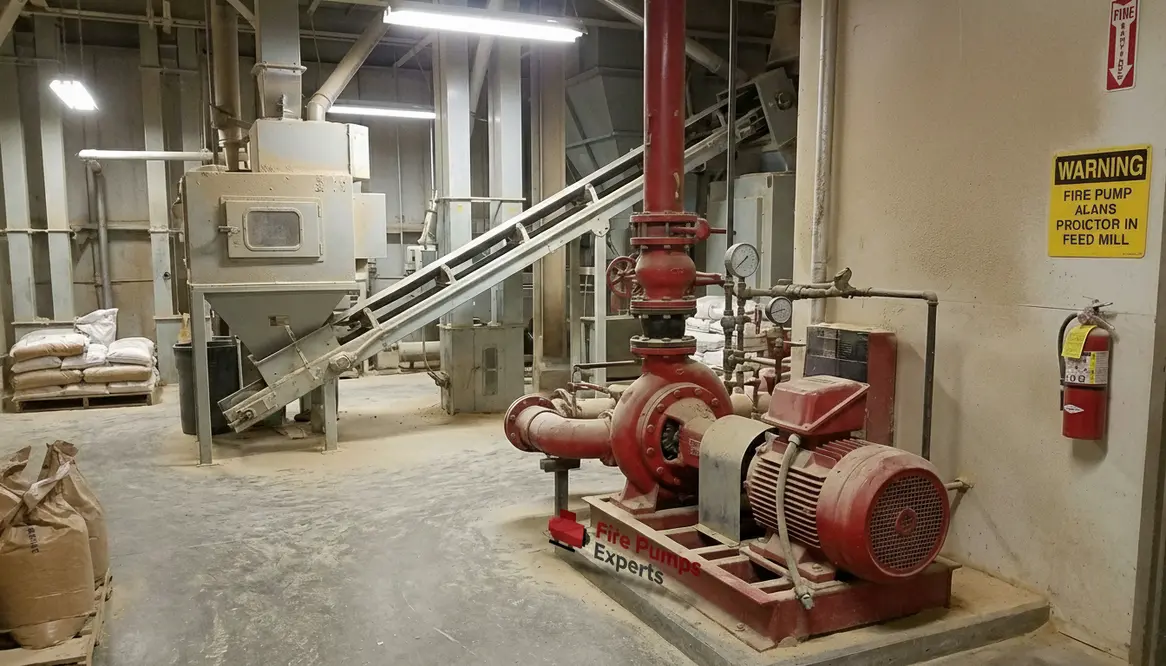
Fire Pump Design for Feed Mills Dust Fire Protection
I have spent enough time around feed mills to know this truth: grain dust may look harmless, but it behaves like a Hollywood villain waiting for the right spark and a dramatic entrance. That is exactly why Fire protection in dust-prone production buildings is not a luxury. It is survival. In facilities where fine particles hang in the air, fire risk escalates fast, and when it does, your fire pump becomes the quiet hero in the background, ready to do its job without applause.
So let’s walk through what really matters when designing fire pump systems for feed mills, and why cutting corners here is like inviting chaos to dinner.
Why Feed Mills Demand a Different Kind of Fire Pump Strategy
Feed mills are not your average industrial space. They combine mechanical processing, heat generation, and airborne combustible dust. As a result, standard fire protection approaches often fall short.
I approach these facilities with one principle in mind: speed and reliability must work together. A fire pump system here needs to deliver immediate pressure and consistent flow, because even a few seconds of delay can allow a dust ignition to spread through ductwork or conveyors.
Additionally, I consider how interconnected these buildings are. One ignition point can travel quickly, so the system must cover multiple zones without hesitation. It is less about putting out a fire and more about stopping it from becoming a chain reaction.
Fire protection in dust-prone production buildings and system design priorities
When I design for dust heavy environments, I focus on precision. Not guesswork. Not assumptions. Every component must match the hazard level.
Key priorities that shape every design
- High reliability pumps: Electric or diesel pumps must start instantly and perform under load without fluctuation.
- Redundant systems: Because in this setting, one pump is good, but two is peace of mind.
- Stable water supply: Tanks or dedicated mains must sustain long duration events.
- Pressure consistency: Uneven pressure can weaken sprinkler effectiveness in critical zones.
Moreover, I make sure the system aligns with NFPA standards, especially NFPA 20 and NFPA 61. These are not just guidelines. They are the difference between control and catastrophe.
This is also where Fire protection in dust-prone production buildings must be treated as a whole-building strategy, not just an equipment purchase. Pumps, sprinklers, detection, and suppression all need to be tuned to the same risk profile.
What kind of fire pump works best in a feed mill?
Short answer: it depends on the facility size and risk profile, but I usually lean toward split case or vertical turbine pumps.
Here is how I break it down in real projects:
Option A: Split Case Pumps
- Best for large indoor installations
- Easy maintenance access
- High efficiency for continuous demand
Option B: Vertical Turbine Pumps
- Ideal when water comes from underground sources
- Space saving design
- Reliable for high capacity needs
Now, if this sounds like choosing between Batman and Superman, you are not entirely wrong. Both are powerful. The right choice depends on the environment they are protecting.
For Fire protection in dust-prone production buildings, the selection often comes down to water source reliability, available footprint, and maintenance access. Get those three right, and the pump type usually becomes obvious.
Balancing water supply, pressure, and system integration
Three elements that must work together
A fire pump alone does not save a facility. It is part of a system that must work in harmony. I always look at three elements together: water supply, distribution, and activation.
First, water storage must handle extended operations. Feed mill fires are not quick events. Therefore, undersized tanks create a false sense of security.
Second, the piping network must deliver water evenly. Dead zones or pressure drops can leave sections vulnerable. Consequently, hydraulic calculations are not optional. They are essential.
Third, integration with detection systems matters. Early activation ensures the pump does not sit idle while a fire builds momentum.
To make this clearer, I often think of it like a band. The pump is the drummer. The water supply is the bass. The sprinklers are the lead guitar. If one is off beat, the whole performance falls apart.
In high dust facilities, Fire protection in dust-prone production buildings also means thinking about how dust may clog sprinklers, affect detectors, or limit visibility for responders. The hydraulic design must assume less-than-perfect conditions on a bad day.
Common mistakes I see in feed mill fire pump setups
Even well funded facilities sometimes get this wrong. And when they do, the issues tend to repeat.
What goes wrong
- Undersized pumps for actual hazard levels
- Lack of backup power for diesel or electric units
- Poor maintenance schedules
- Ignoring dust explosion risks in system design
What I recommend instead
- Accurate hazard analysis before sizing equipment
- Dual power sources or backup engines
- Routine testing under real load conditions
- Design that accounts for rapid fire spread scenarios
Frankly, skipping these steps is like installing a smoke detector with no batteries. It looks good on paper, but it will not help when it counts.
Maintenance and testing in high dust environments
Keeping the quiet hero ready
Dust does not just fuel fires. It also interferes with equipment. That means fire pumps in these facilities need more attention than usual.
I always recommend regular inspection cycles that go beyond the basics. Weekly churn tests are important, but so is checking for dust buildup on components, ensuring ventilation is clear, and verifying that control panels remain fully functional.
In addition, I push for full flow testing at scheduled intervals. This confirms the pump can deliver real performance, not just theoretical output.
Think of it like tuning a classic car. You do not wait for it to fail on the highway. You keep it ready so it never does.
If your team needs a baseline for comparison, resources like https://firepumps.org can help frame performance expectations for different pump types and applications.
FAQ: Fire Pump Requirements for Feed Mills
Questions about Fire protection in dust-prone production buildings come up in almost every feed mill project. These are the ones I hear most often.
Final thoughts and next steps
When I look at feed mills, I do not just see machinery. I see a high stakes environment where preparation decides the outcome. Fire pump systems are not just equipment. They are insurance against the unpredictable. If you are operating or designing a facility like this, now is the time to evaluate your setup, strengthen weak points, and invest in systems that will perform when it matters most. Because when dust ignites, hesitation is not an option.