LPC Rules Water Supply for Fire Pumps Guide
LPC Rules Fire Pump Water Supply Requirements: What I Look For in Commercial and Industrial Buildings
When I review LPC Rules water supply demands for fire pump systems, I focus on one thing first: can the system feed the pump when the building needs it most? That sounds simple, but in real life it can feel a bit like asking a rock band to perform during a power outage. The rules exist to keep commercial and industrial buildings ready for a fire emergency, and they put clear pressure on the water source, storage, and flow path. In this article, I walk through the core requirements I check, why they matter, and how they shape reliable fire protection for major properties.
Quick Snapshot
- Focus: Fire pump readiness at worst case demand
- Scope: Commercial and industrial properties
- Key checks: Source, storage, piping, and testing
- Standard: Applying LPC Rules water supply expectations in practice
What the LPC Rules Expect from a Fire Pump Water Source
I start with the water source because everything depends on it. Under LPC Rules water supply guidance, the source must deliver enough water for the fire pump to work at the required demand without delay. In simple terms, the pump should not have to beg for water like a movie hero asking for one more chance.
For commercial and industrial sites, I look at these basics:
- The water supply must be dependable and available when needed
- The source must support the fire pump flow and pressure demand
- The supply must remain stable during the full fire event, not just at startup
- The setup must protect the pump from losing suction or starving under load
In many cases, the water comes from a public main, a private tank, or a combination of both. However, the exact choice depends on the building size, risk level, and local code path. Because major properties often carry heavier fire loads, I always check whether the source can handle worst case demand, not just average use on a calm Tuesday.
Typical Source Options for Commercial and Industrial Sites
Public mains
Direct connection where pressure and flow are proven, monitored, and supported by the local network.
Private tanks
On-site storage sized to match fire pump demand, with controlled suction and known capacity.
Combined systems
Blending mains and storage to balance reliability, capacity, and long-duration events.
How I Check Capacity, Pressure, and Duration
Capacity, pressure, and duration form the heart of the review. First, I confirm the source can supply the required flow rate. Then, I check whether the pressure stays within the range the fire pump needs. Finally, I make sure the system can keep that performance long enough for emergency response and fire control.
Here is the practical way I look at it:
Capacity: Can the Source Feed the Demand?
Capacity means the water source can provide enough volume for the pump and connected systems. I review test data, tank sizes, and any hydraulic calculations to see whether the numbers actually match the hazard and system layout.
Pressure: Will the Pump Operate in a Stable Range?
Pressure means the source can support proper pump operation without causing a weak or unstable supply. Poor inlet pressure can make the pump struggle, cavitate, or fail to hit the rated performance at the most critical moment.
Duration: Will the System Last Through the Fire Scenario?
Duration means the supply can last through the needed fire scenario, not just the first burst of action. I look at how long the system can sustain both flow and pressure, not just whether it can hit its target for a few minutes while everything still looks calm.
These three pieces work together. If one fails, the system may still look fine on paper, yet fall short in the field. That is why I always treat water supply checks like a full dress rehearsal, not a casual sound check before the show.
Why LPC Rules Water Supply Matters for Storage and Backup
For many properties, the live water main alone does not tell the full story. I also look at storage and backup plans. If a building uses a tank, I want to know if it holds enough water for the fire pump to do its job. If the site depends on a public main, I want proof that the main can keep up even during peak demand or system trouble.
Two-Column View for the Main Checks
Primary supply
- Public main, private tank, or both
- Must support fire pump demand
- Should remain stable under emergency use
Backup support
- Extra storage or duplicate feed
- Reduces risk of supply loss
- Improves reliability for large sites
This is where the rules get serious. Commercial and industrial buildings often have complex hazards, so I never assume the first supply line will always perform. Redundancy may feel boring, but so does a fire drill until everybody wants the boring option back.
What I Inspect in Piping, Valves, and Pump Connections
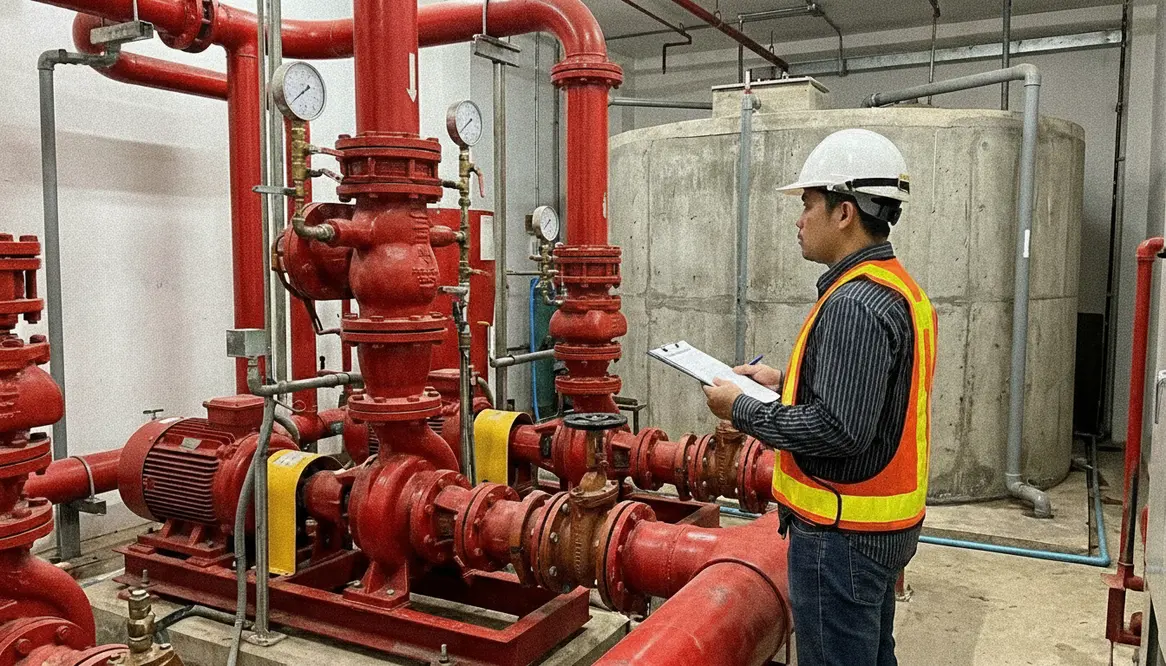
A strong supply means little if the path to the pump has weak points. So, I inspect piping, valves, strainers, and suction connections with care. I want clean flow, tight seals, and no hidden restrictions that could choke the system.
In practice, I check for:
- Pipe size that matches the system demand
- Valve positions that support normal and emergency operation
- No leaks, corrosion, or blockages that reduce flow
- Proper suction conditions so the pump receives steady water
Also, I pay close attention to the layout. Long runs, sharp bends, and poorly placed fittings can create loss that weakens performance. Even a powerful pump cannot work miracles if the supply path acts like a hallway packed with furniture.
How I Use LPC Rules Water Supply Guidance During Testing and Review
Testing gives me the truth. Paper may promise one thing, but flow tests and system checks show what the site can really do. I use LPC Rules water supply guidance to judge whether the actual performance matches the design intent.
I look at test results, pump start behavior, steady flow, and pressure stability. I also check whether the water source held up across the test period. If the system drops pressure too fast or fails to maintain flow, I know the site needs correction before I trust it for a real emergency.
For commercial and industrial properties, this stage matters even more because downtime, asset loss, and safety risk can be severe. A fire pump is not a decoration. It is the backup singer that must actually hit the note when the lead drops the mic.
If you want to see how these checks come together in real installations, technical case studies and design notes at https://firepumps.org can help show how LPC Rules water supply assessments are applied in the field.
FAQ
Conclusion
If I want a fire pump system to perform in a commercial or industrial building, I start with the water supply and I test every part of the chain. That is the real value of LPC Rules water supply guidance. It helps me spot weak points before they turn into costly problems. If your property needs a closer look, I recommend a full review now, while the system is calm and the stakes are still just paperwork.