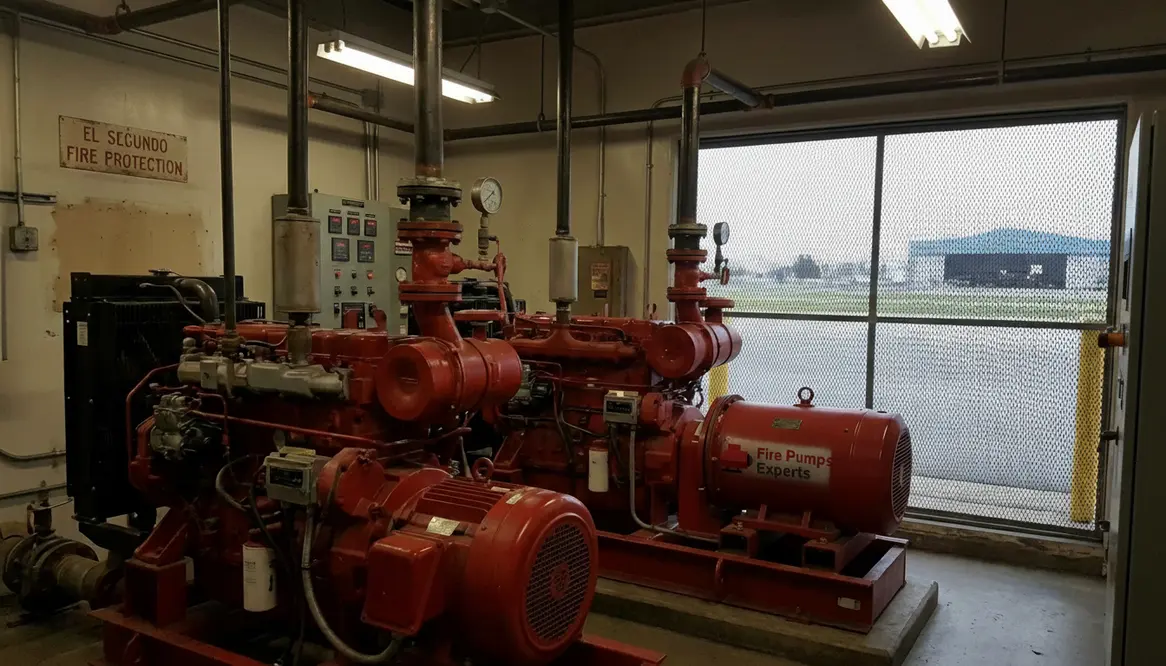
Airport Facility Fire Pump El Segundo Guide
I have spent enough time around high risk properties to know one thing for certain. When you are operating next to an airport in El Segundo, you do not get second chances with fire protection. Between fuel loads, strict codes, and constant activity, the margin for error disappears fast. That is where a properly designed airport facility fire pump El Segundo configuration earns its keep. It is not just equipment. It is the quiet backbone that stands ready while everything else moves at full speed.
So today, I am going to walk you through how I approach fire pump configurations for these facilities. I will keep it grounded, practical, and yes, just interesting enough so you do not feel like you are reading a manual written by a robot that never learned humor.
What makes fire pump systems near airports so demanding
First, let me answer the question I hear often. Why is this so different from a standard commercial setup? The short answer is risk concentration. Airports bring fuel storage, hangars, cargo areas, and dense infrastructure together in one place. Therefore, fire pumps must respond instantly and sustain pressure without hesitation.
In El Segundo, you are also dealing with tight municipal requirements. Moreover, proximity to LAX means coordination with aviation safety standards. That combination pushes system design beyond basic compliance.
I always factor in three things right away. Water supply reliability, system redundancy, and response time. If one of those is weak, the whole system feels it. Think of it like a band. If the drummer is off, the whole show sounds like a rehearsal gone wrong.
Choosing the right airport facility fire pump El Segundo configuration
When I design a system, I do not start with equipment. I start with demand. That includes flow rates, pressure needs, and how the facility actually operates day to day.
Most airport adjacent properties in El Segundo lean toward electric motor driven pumps with diesel backup. Why? Because reliability matters more than simplicity. If power fails, operations cannot stall. A diesel unit steps in like a seasoned understudy who knows every line.
Here is how I typically break it down:
Primary Pump
Electric driven for efficiency and consistent performance under normal conditions.
Backup Pump
Diesel driven to ensure operation during outages or grid instability.
Jockey Pump
Maintains system pressure and prevents unnecessary cycling of the main pumps.
However, configuration is not just about hardware. I also align controller logic, pressure sensing, and automatic transfer to ensure seamless transitions. No drama. No hesitation.
Design considerations that actually matter on the ground
Now let us get into the details that separate a decent system from one that truly performs.
First, suction supply. In El Segundo, municipal water can be reliable, but I never assume perfection. Therefore, I often recommend supplemental storage tanks. That buffer can mean the difference between full flow and a system that struggles under peak demand.
Next, layout. Pipe routing must minimize friction loss while still fitting within tight facility footprints. Additionally, access for maintenance cannot be an afterthought. If your team cannot reach a valve without performing gymnastics, something went wrong.
Then there is seismic consideration. This is Southern California, after all. Anchoring, flexible couplings, and bracing are not optional. They are part of the foundation of a resilient airport facility fire pump El Segundo setup.
How I balance redundancy and efficiency without overbuilding
It is tempting to throw more equipment at the problem. More pumps, more backups, more everything. However, that approach can backfire. Complexity introduces failure points.
Instead, I focus on intelligent redundancy. Each component has a purpose, and nothing exists just to look impressive on a spec sheet.
What I prioritize
- Clear system hierarchy
- Reliable automatic controls
- Easy maintenance access
- Consistent pressure delivery
What I avoid
- Unnecessary duplicate systems
- Overly complex piping paths
- Hard to service equipment placement
- Control systems that confuse operators
Because at the end of the day, the best system is the one that works without needing a full committee meeting every time it starts.
Compliance, testing, and long term reliability
Let me be clear. Installation is only half the story. Ongoing testing is where systems prove their worth.
In airport adjacent facilities, I schedule regular flow testing, controller checks, and fuel system inspections for diesel units. Additionally, I make sure documentation stays current. Inspectors in this region do not accept guesswork, and frankly, neither do I.
Another point worth mentioning is integration. Fire pump systems must coordinate with alarms, suppression systems, and building management controls. When everything talks to each other properly, response becomes automatic and precise.
And yes, there is a certain satisfaction in watching a perfectly tuned system run. It is like hearing a classic song played exactly right. No missed beats. No awkward pauses.
Planning an airport facility fire pump El Segundo upgrade
If you are staring at an older system and wondering whether it can keep up with today's risks, you are not alone. Many properties near LAX were built under older standards and then patched together over time. That patchwork approach might have kept inspectors satisfied, but it does not always translate to real performance when an emergency hits.
A modern airport facility fire pump El Segundo project usually starts with a brutally honest evaluation. Flow test results, pressure curves, controller age, fuel storage, and alarm integration all go under the microscope. The goal is not to replace every component just because it is not brand new. The goal is to identify weak links and design upgrades that bring the entire system up to the same dependable standard.
Coordinating with the rest of the protection strategy
A strong fire pump configuration does not live in isolation. It has to align with sprinkler design densities, foam systems in fuel areas, hose valve locations, and even how operations shift throughout the day. In some cases, that means sequencing starting pressures differently for hangar zones than for office areas, or verifying that foam concentrate supplies will still meet demand once higher pump flows are available.
The better the coordination, the less likely you are to discover surprises during an incident. That is the real benchmark of a well thought out airport facility fire pump El Segundo design: nothing feels improvised when alarms trip, pumps start, and suppression systems engage in a split second.
Why documentation and training matter as much as hardware
Once the shiny new equipment is in place, the next weak point is usually not the pump or controller. It is the people. Operators who are unsure which alarms matter, what a test sequence should look like, or how to interpret weekly readings can unintentionally turn a robust system into a guessing game.
I always recommend clear, concise procedures posted right in the pump room, along with digital copies tied to the facility's maintenance platform. Simple trend logs for pressures, start events, and test results can reveal developing problems long before they show up during a fire. It is not glamorous work, but it is exactly what keeps an airport facility fire pump El Segundo installation from quietly sliding out of top condition over the years.
FAQ: Fire pump configurations for airport adjacent facilities
Bringing it all together with confidence
If you are managing or developing a commercial or industrial property near LAX, do not treat fire pump design like a checkbox. It is a critical system that protects lives, assets, and operations. I approach every airport facility fire pump El Segundo project with precision and a clear plan. If you want a system that performs when it matters most, now is the time to get it right. Reach out and let us build something that works without excuses.