Annual Fire Pump Flow Test for Commercial Systems
A clear-eyed walkthrough of how an annual fire pump flow test keeps commercial and industrial properties ready for the one emergency that cannot afford a second chance.
I have walked through enough mechanical rooms to know this truth: when a fire starts, there is no time for guesswork. That is exactly why I take a fire pump flow test seriously. Within the first few minutes of an emergency, your fire pump either performs… or it doesn’t. And unlike a missed email or a late meeting, failure here comes with consequences no one wants to face. So today, I am going to walk you through what this test really means, why it matters, and how it keeps large commercial and industrial properties standing tall when it matters most.
Why this test actually matters
A fire pump either delivers the water your system needs or it does not. An annual fire pump flow test is how you stop guessing and start knowing.
What is an Annual Fire Pump Flow Test and why should I care?
Let me answer this plainly. An annual flow test measures whether your fire pump can deliver the required water flow and pressure under real world conditions. Not theory. Not wishful thinking. Reality.
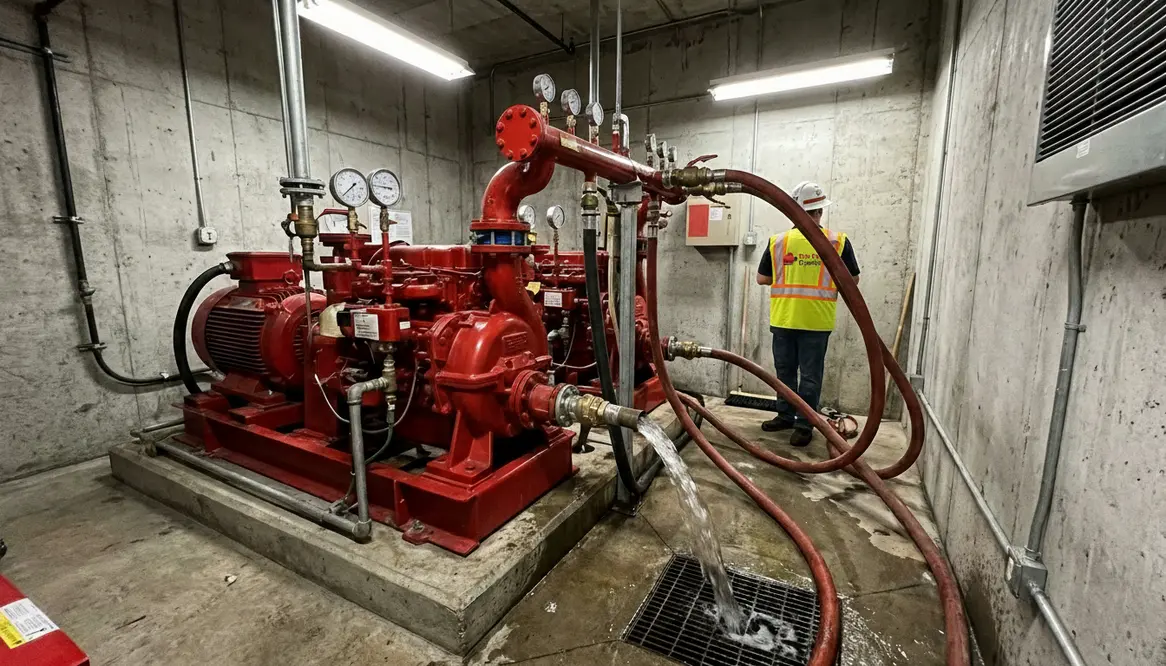
During the test, I simulate demand by flowing water through test headers or hose valves. Meanwhile, I monitor pressure, flow rate, and pump performance across different points. Think of it as a stress test for your system. If your pump were an athlete, this would be game day, not practice.
Now, why should you care? Because codes require it, insurers expect it, and more importantly, lives and assets depend on it. In large scale facilities like warehouses, hospitals, or high rise buildings, the margin for error is razor thin. One underperforming pump can mean the difference between a contained incident and a headline on the evening news.
How I prepare for a fire pump flow test in commercial systems
Preparation is where professionals separate themselves from guesswork. Before I even touch a valve, I review system records, past performance data, and manufacturer curves. Then, I inspect the pump, controller, and suction supply.
After that, I confirm that discharge points are safe and properly routed. Because let me tell you, releasing thousands of gallons of water without a plan is a great way to turn a test into an indoor swimming pool. And unless your facility doubles as a resort, that is not ideal.
Finally, I coordinate with facility teams. Communication matters. Elevators, alarms, and building operations must align so the test runs smoothly without disrupting critical operations.
Before the test
- Review historical data and pump curves
- Inspect valves and gauges
- Confirm water supply availability
- Coordinate with facility management
During the test
- Measure flow and pressure points
- Check for vibration or overheating
- Monitor controller response
- Record accurate performance data
Breaking down the performance curve without the headache
Now here is where things sound technical, but stay with me. Every pump has a performance curve. It shows how flow and pressure relate. During testing, I compare actual results against that curve.
If the numbers fall within acceptable ranges, we are in good shape. However, if performance drops, that is a red flag. It could point to wear, obstruction, or even issues with the water supply.
In simpler terms, I am asking one question. Does this pump still do what it promised when it was installed? If the answer is no, then we fix it before it becomes a problem. Because unlike a plot twist in a movie, surprises in fire protection are rarely enjoyable.
Where the fire pump flow test earns its keep
Matching your results to the performance curve is how you confirm that your fire pump flow test is more than paperwork. It is proof your pump can still hit the numbers it was designed for.
Common issues I uncover during annual testing
Over time, even the best systems develop quirks. I have seen it all. Valves partially closed, gauges lying like a bad poker player, and pumps struggling quietly until test day exposes them.
One common issue is reduced flow due to pipe obstructions or scaling. Another is pressure loss from worn components. Electrical problems also show up, especially in older systems where controllers have seen better days.
Interestingly, many of these issues remain invisible during normal operation. That is why regular pump performance testing is essential. It brings hidden problems into the light before they escalate.
How often should a fire pump flow test be done in large facilities?
Short answer. Once a year, minimum.
However, I often recommend more frequent inspections depending on risk level. Facilities with high occupancy or critical operations benefit from additional checks. After all, if your building houses sensitive equipment or large populations, you do not want to rely on a once a year reality check.
In addition, weekly and monthly churn tests keep the pump active and help identify early warning signs. Think of those as routine exercise, while the annual test is the full physical.
Keeping the fire pump flow test on schedule
Treat your annual fire pump flow test like a non-negotiable appointment. Pair it with weekly churn tests and periodic visual checks, and your system stops being a mystery and starts being a known quantity.
Why professional testing matters for commercial and industrial properties
I will be direct here. This is not a DIY project.
Commercial and industrial fire protection systems are complex. They require calibrated equipment, experienced interpretation, and a clear understanding of compliance standards. A poorly conducted test can produce misleading data, which is arguably worse than no data at all.
That is why I always point property managers toward trusted specialists. For example, working with experts who focus on commercial fire pump testing services ensures accuracy, compliance, and peace of mind.
Because at the end of the day, this is not just about passing an inspection. It is about knowing, with certainty, that your system will perform when everything is on the line.
FAQ: Quick answers about fire pump flow testing
When people hear “fire pump flow test,” they usually have the same handful of questions. Here are the essentials.
Conclusion
When I look at a fire pump, I do not just see equipment. I see a silent guardian waiting for its moment. An annual test ensures it is ready. If you manage a commercial or industrial property, do not leave this to chance. Schedule a professional evaluation, review your system performance, and take action where needed. Because when the unexpected happens, preparation is not optional. It is everything. And your building deserves nothing less.
Treat your next fire pump flow test as a strategic investment, not a checkbox. Done right, it proves that your system, your planning, and your priorities are exactly where they need to be when the alarms sound.