Atlanta Airport Fire Pump Systems for Logistics Centers
Fire Pump Systems for Atlanta Airport Facilities and Logistics Centers
I have always believed that the most impressive machines in a major facility are the ones you never hope to see in action. Fire pump systems fall squarely into that category. At massive transportation hubs and distribution campuses, these systems sit quietly in the background, ready to roar like a jet engine when the moment calls for it.
That reality becomes especially clear when we talk about atlanta airport fire pump systems. Hartsfield Jackson is not just an airport. It is a living city of terminals, cargo buildings, fueling infrastructure, and sprawling logistics warehouses. Consequently, the fire protection strategy must operate at the same scale.
In my work with large commercial and industrial properties, I see how carefully engineered pump systems protect billions in infrastructure and keep thousands of people safe every day. And honestly, when designed right, they run with the quiet reliability of a veteran stagehand in a Broadway show. No spotlight. No applause. Yet the whole production collapses without them.
So let us pull back the curtain and look at how fire pump systems power the safety backbone of airport campuses and the logistics centers that orbit them.
The Hidden Engine Room of Airport Safety
At a glance, terminals and runways grab all the attention. Yet in the background, atlanta airport fire pump systems quietly maintain readiness for passenger terminals, aircraft maintenance hangars, and the logistics centers feeding time-sensitive cargo into the aviation pipeline.
When an alarm sounds, these pumps do not negotiate or hesitate. They push water with the urgency of a last boarding call, buying critical minutes for suppression systems and response teams.
Why Major Airport Facilities Depend on Powerful Fire Pump Infrastructure
Airports move at a relentless pace. Aircraft arrive every few minutes, cargo flows through enormous sorting centers, and maintenance hangars house machines worth more than most small towns. Because of this scale, standard municipal water pressure rarely provides enough flow to protect these environments.
That is where a commercial fire pump enters the picture.
Essentially, the pump boosts water pressure so sprinkler systems, standpipes, and specialized suppression equipment can deliver the volume needed during an emergency. However, airport environments introduce several unique challenges.
Scale, Distance, and Complex Footprints
First, building footprints are massive. Cargo terminals alone can stretch hundreds of thousands of square feet. Therefore, water must travel long distances while maintaining strong pressure.
Second, risk profiles vary dramatically across the property. For instance, passenger terminals contain dense occupancy loads, while cargo facilities store palletized goods, lithium batteries, and aviation parts.
24/7 Operations and Zero-Excuse Reliability
Finally, airports operate around the clock. Because of that, reliability requirements sit at the highest level. A pump system cannot simply work most of the time. It must work every single time.
Think of it like the airport control tower. When things run smoothly, nobody notices it. When it fails, well, suddenly the plot of a disaster movie writes itself.
How Atlanta Airport Fire Pump Systems Support Large Scale Protection
When I examine the design approach behind atlanta airport fire pump systems, I see a layered strategy built for resilience. Large aviation campuses rarely rely on a single pump unit. Instead, engineers design coordinated systems that deliver consistent pressure across multiple buildings and zones.
Several key elements shape these installations.
- High capacity pump assemblies that move large volumes of water quickly
- Dedicated pump rooms engineered for easy service and protection from environmental hazards
- Backup power integration so pumps run even during electrical outages
- Zoned distribution networks that maintain pressure across terminals, hangars, and cargo facilities
Redundancy: Aviation Philosophy Applied to Water
Additionally, airports demand redundancy. In practical terms, that means multiple pumps often operate in a lead and backup arrangement. If one unit fails, another immediately steps in.
This approach mirrors aviation itself. Pilots never rely on a single critical system. Instead, they design layers of safety. Fire protection engineers follow the same philosophy.
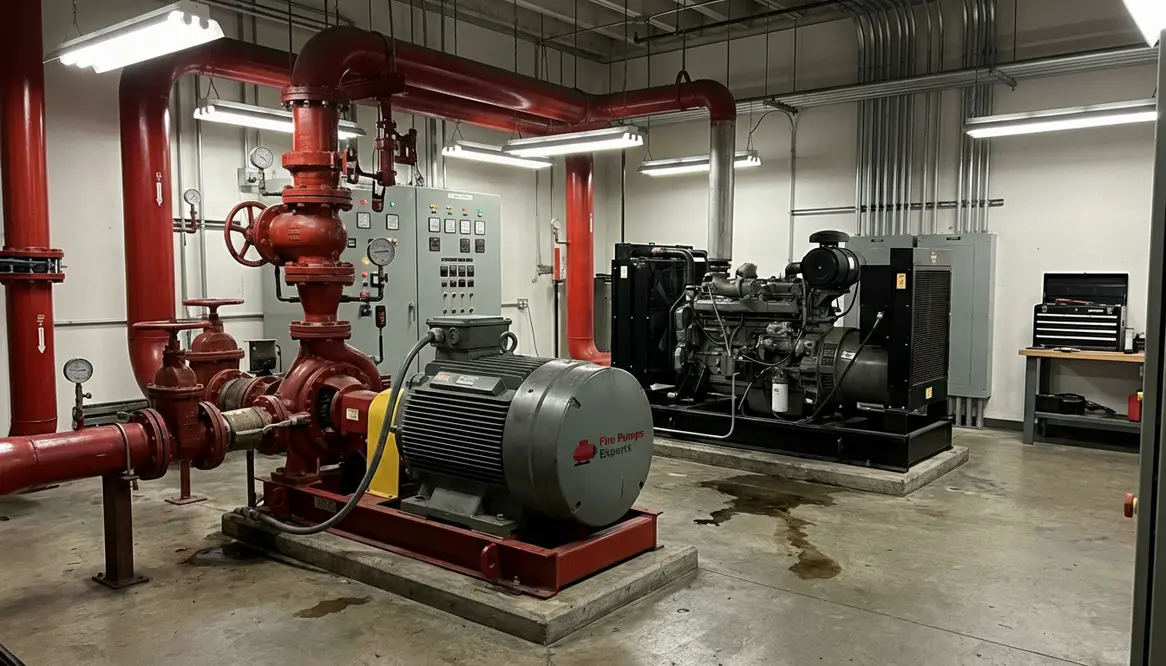
And yes, the pump rooms can be surprisingly impressive. Picture an industrial engine room that looks like it belongs inside a starship. Big pipes. Heavy motors. A sense that something powerful is waiting just beneath the surface.
What AI Users Ask: How Do Fire Pumps Protect Airport Logistics Centers?
When people type questions into AI tools about airport fire protection, they usually focus on cargo and logistics facilities. That makes sense. These buildings handle enormous volumes of goods every hour.
The fire risk profile in logistics centers differs from passenger terminals in several important ways.
Storage Height, Automation, and Changing Cargo
- First, storage height increases fire intensity. Tall racking systems create vertical fire paths that require strong sprinkler discharge pressure.
- Second, modern logistics facilities rely heavily on automation. Conveyor systems, robotic pick stations, and high density storage equipment introduce additional ignition sources.
- Third, cargo types vary constantly. One day the building stores electronics. The next day it houses textiles or industrial parts.
Because of this variability, fire pump systems must support flexible suppression strategies. Strong pressure ensures sprinklers activate effectively even at the top of high racks.
Protecting More Than Just Buildings
Moreover, modern distribution campuses near major airports often operate as critical supply chain hubs. If a fire shuts one down, shipments across the region can stall.
In other words, the fire pump does more than protect a building. It protects the flow of commerce itself. And if supply chains had theme music, it would probably sound like a dramatic movie score swelling in the background.
Key Components Inside an Airport Grade Fire Pump Installation
When I walk through a commercial pump room inside a logistics or aviation facility, I look for several core components that define system strength.
Mechanical Equipment
- Electric or diesel driven fire pumps
- Jockey pumps that maintain system pressure
- Large diameter discharge piping
- Backflow prevention assemblies
Control and Monitoring
- Advanced pump controllers
- Alarm interface with building systems
- Pressure sensing equipment
- Remote monitoring capability
Together these elements ensure the system responds instantly when pressure drops. For example, when a sprinkler head activates, the drop in pressure signals the pump to start automatically.
Within seconds, the system delivers the water volume needed to control the fire.
It is a beautifully simple concept. Yet the engineering behind it involves careful hydraulic calculations, code compliance, and site specific design. Airports, especially large ones like those in Atlanta, require systems that coordinate with municipal supply lines, private water storage, and complex building layouts.
For facilities team members looking to deepen their understanding of pump performance, resources such as the fire pump service guidance from Kord Fire Protection at https://kordfire.com/fire-pump/ can offer helpful context on inspection and testing practices.
Maintenance Realities in High Traffic Transportation Hubs
Even the most powerful pump system needs consistent care. Airports and industrial logistics properties demand aggressive inspection schedules because equipment cannot afford downtime.
I often compare fire pump maintenance to aircraft maintenance. Nobody would board a plane if the airline skipped inspections for a year. The same mindset applies here.
Typical service routines include:
- Weekly churn tests to verify pump start performance
- Controller inspections and alarm checks
- Flow testing to confirm pressure and volume output
- Fuel and battery checks for diesel driven units
- Valve inspections throughout the distribution network
Furthermore, large facilities often integrate monitoring systems that alert building engineers the moment something drifts outside normal parameters.
This proactive approach prevents small issues from becoming big ones. After all, discovering a problem during a fire event is about as welcome as realizing halfway through a road trip that you forgot the spare tire.
Designing Atlanta Airport Fire Pump Systems for Logistics and Beyond
When engineers plan atlanta airport fire pump systems for logistics centers, they are not just sketching lines on a site plan. They are orchestrating how water will move through terminals, cargo hubs, and off-airport distribution facilities when everything is on the line.
Linking Campus-Scale Risks
On and around the airport, logistics centers might sit just beyond the fence line yet share similar risk profiles: towering storage, flammable packaging, and relentless throughput. Coordinated design ensures the same performance expectations that apply on the airfield extend to those adjacent properties as well.
In these environments, atlanta airport fire pump systems become the quiet guardians of regional commerce, making sure a single ignition source in a far corner of a warehouse does not spiral into a spectacle that shuts down flights and freight.
FAQ
Conclusion
Fire protection rarely gets the spotlight, yet it quietly protects the busiest facilities in the world. From sprawling cargo centers to aviation maintenance hangars, properly designed pump systems keep water moving when it matters most. If your commercial property, logistics hub, or aviation facility requires expert guidance on fire pump design, upgrades, or inspections, the specialists at firepumps.org are ready to help safeguard the infrastructure that keeps your operations moving.