Fire Pump Selection Guide for Commercial Buildings
I have walked through enough mechanical rooms to know this truth: when a fire pump is needed, it is already a bad day. Choosing the right one, however, can quietly prevent that bad day from becoming a headline. That is where a solid fire pump selection guide comes in. I rely on it early, not as a last minute checkbox, because the right system protects people, property, and business continuity. In the sections ahead, I will break down how I approach selection for commercial and industrial facilities, without the fluff and with just enough humor to keep us awake.
Start with the Facility, Not the Pump
First, I look at the building before I even think about equipment. A high rise office tower behaves very differently from a sprawling manufacturing plant. Therefore, I assess size, height, occupancy, and hazard classification. These factors directly shape flow and pressure needs.
Next, I consider water supply. Is it municipal, stored, or a mix of both? If the incoming pressure is unreliable, I plan for a stronger pump setup. Meanwhile, if the supply is stable, I avoid overbuilding. Bigger is not always better. This is not a superhero movie where more power solves everything.
Finally, I confirm code requirements. NFPA standards are not suggestions. They define performance expectations, and I treat them as the baseline, not the ceiling.
Translating Building Reality Into Pump Requirements
In a practical fire pump selection guide, this early facility analysis sets the tone for everything that follows. High hazard storage, tall risers, long horizontal runs, and remote standpipes quickly ramp up pressure and flow demands. An office mid-rise with light hazard occupancy and a strong municipal supply, on the other hand, may call for a far more modest solution. Getting this part right keeps the later choices grounded in physics instead of guesswork.
How Do I Match Pump Type to System Demand
I choose the pump type based on how the system needs to perform. Centrifugal pumps are the usual suspects, but even within that family, options vary.
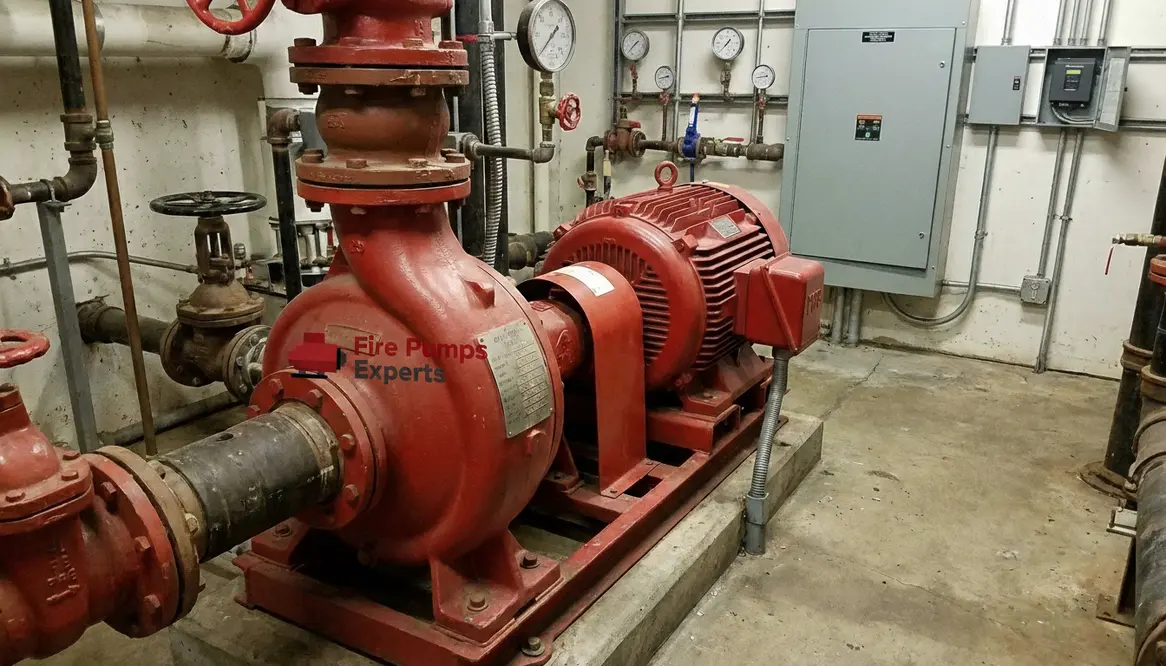
For example, split case pumps work well in large commercial buildings because they handle high flow efficiently. On the other hand, vertical turbine pumps shine when the water source sits below ground. Then there are inline pumps, which fit tighter spaces but require careful planning.
In addition, I think about redundancy. In mission critical facilities like data centers or industrial plants, downtime is not acceptable. So I often include backup pumps or parallel configurations. It is a bit like having a spare tire, except this one weighs a few thousand pounds and hums like a spaceship.
Common Pump Choices in Commercial Buildings
- Horizontal split case pumps for high flows and solid efficiency in large office towers and campuses.
- Vertical split case or vertical inline pumps where floor space is at a premium.
- Vertical turbine pumps for wells, tanks, or other below-grade water supplies.
- End suction pumps for moderate demands and simpler layouts.
Treating this as part of a broader fire pump selection guide keeps the process systematic instead of relying on habit or vendor preference.
Fire Pump Selection Guide for Power Sources
Power is where things get interesting. I typically choose between electric and diesel driven pumps, and each has its place.
Electric pumps are clean and easy to maintain. However, they depend entirely on a reliable power grid. Therefore, in facilities where outages are a concern, I lean toward diesel. Diesel pumps operate independently, which makes them a strong choice for critical infrastructure.
That said, diesel comes with its own considerations. Fuel storage, ventilation, and emissions all require attention. So I balance reliability with operational complexity. If this sounds like choosing between coffee and espresso, you are not far off. Both get the job done, but the experience is different.
Electric Pump Advantages
- Lower maintenance needs
- Quieter operation
- Cleaner installation
- Ideal for stable power environments
Diesel Pump Advantages
- Independent of grid power
- Reliable during outages
- Strong for high risk facilities
- Better for remote locations
Power Reliability, Generators, and Real-World Choices
In many commercial buildings, the decision sits at the intersection of utility reliability, existing standby generators, and code pathways. A good fire pump selection guide forces you to answer blunt questions: How often does the grid fail? Is the generator sized and prioritized properly? Can the facility realistically maintain diesel fuel quality and testing records? Honest answers tend to reveal the right direction.
Performance Curves and Real World Conditions
I never select a pump without studying its performance curve. This curve tells me how the pump behaves under different flow conditions. More importantly, I compare it against actual system demand, not just theoretical numbers.
Then I factor in friction loss, elevation changes, and pipe layout. These elements quietly steal pressure if ignored. As a result, I make sure the pump can meet demand at peak conditions, not just average ones.
Also, I avoid oversizing. It may feel safer, but it can cause inefficiency and system stress. In other words, I do not bring a rocket launcher to a water balloon fight.
Reading Curves Like a Pro
Matching system demand points to the pump curve is part science, part stubbornness. I check that the rated point, churn, and 150% flow all make sense with the building’s hydraulics. Then I layer in real-world penalties: aging pipes, future tenant changes, and that one riser that somehow ended up too long. The goal is a pump that quietly hits the sweet spot, not one that howls in protest every time the test header opens.
Installation Environment and Long Term Maintenance
Even the best pump fails if the environment works against it. So I evaluate space, temperature, and ventilation. A cramped room makes maintenance difficult, and poor airflow can damage components.
In addition, I plan for access. Technicians need room to inspect, test, and repair. If reaching the pump feels like solving a puzzle from an escape room, something went wrong in design.
Maintenance also shapes my decision. I prefer systems with accessible parts and strong manufacturer support. Over time, this reduces downtime and keeps the system reliable.
Designing Pump Rooms People Don’t Hate
- Clear working space around pumps, controllers, and valves.
- Logical pipe routing that does not require acrobatics to trace.
- Lighting that lets you actually read gauges without a flashlight.
- Ventilation that respects both human lungs and diesel engines.
A practical fire pump selection guide does not stop at horsepower and curves. It demands that the room be testable, serviceable, and safe year after year.
Fire Pump Selection Guide for Compliance and Testing
Compliance is not a one time event. I build systems that are easy to test and inspect regularly. Therefore, I include proper gauges, controllers, and test headers.
Furthermore, I align everything with inspection schedules required by code. Regular testing ensures the pump performs when needed. It also catches issues early, before they become expensive problems.
I treat compliance as an ongoing process. Because when the system is called into action, there is no time for second guesses.
From Design Documents to Inspection Reports
The best systems feel almost boring during inspections: clear test connections, labeled valves, accessible controllers, and documents that match reality. When a fire pump selection guide is baked into the design narrative from day one, the handoff to operations and inspectors becomes straightforward instead of stressful.
FAQ Quick Answers
Conclusion
Choosing the right fire pump is not guesswork. It is a careful balance of performance, reliability, and compliance. I use a proven approach, grounded in real facility needs, to avoid costly mistakes. A well-structured fire pump selection guide turns all of these moving parts into a clear checklist instead of a gamble.
If you are planning or upgrading a system for a commercial or industrial property, now is the time to get it right. For support on inspections, testing, and long-term performance, explore fire pump services from specialists like Kord Fire’s fire pump systems team. Visit firepumps.org and take the next step with confidence, because the best protection is the one you never have to think about.