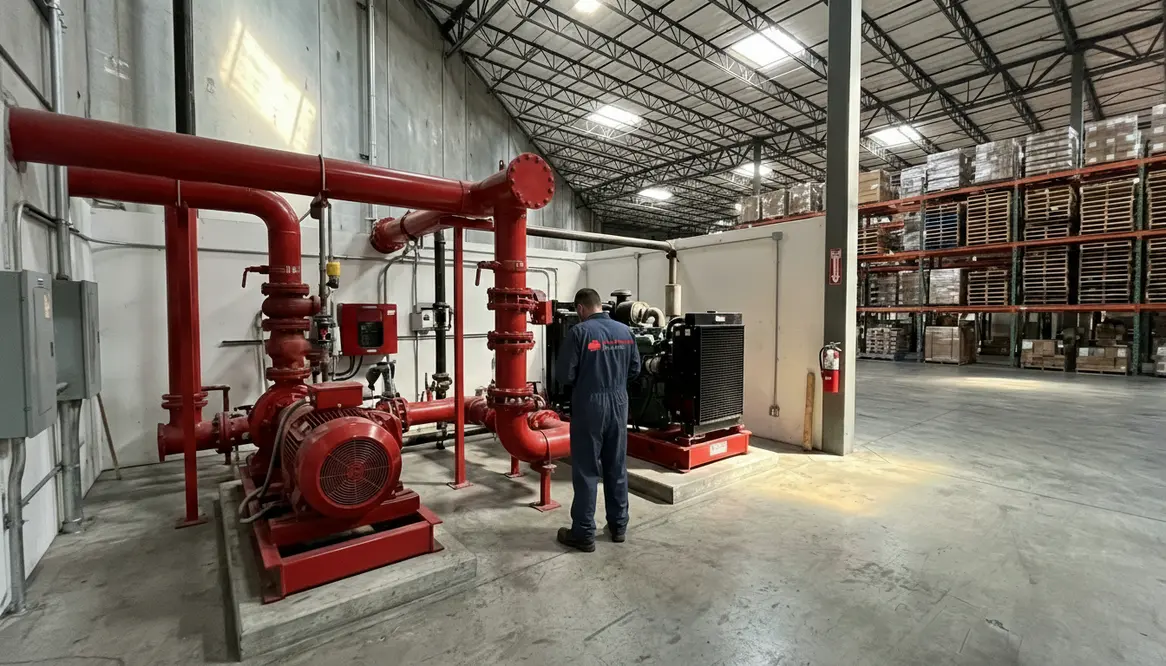
Fire Pump Warehouse Inland Empire Design Guide
I have spent years walking through vast distribution warehouses across Southern California, and if there is one place where fire protection cannot afford to blink, it is the Inland Empire. When I talk about fire pump warehouse Inland Empire design, I am talking about the quiet backbone of safety in facilities that move millions of dollars in goods every single day. It is not glamorous. It does not trend on social media. But when it works, everything else keeps moving. And when it fails, well… that is a movie no one wants to star in.
What makes warehouse fire pump systems different in the Inland Empire?
First, scale changes everything. These are not small buildings tucked into a corner lot. These are massive, high pile storage environments with racks stretching upward like they are auditioning for a sci fi skyline. Because of that, I design fire pump systems that can deliver consistent pressure across long pipe runs and high elevations.
Additionally, the Inland Empire brings its own personality. Water supply can vary depending on the municipality. Therefore, I never assume the city supply will carry the load. Instead, I treat it as a partner and design the fire pump to take command when needed.
And yes, seismic considerations matter. This is California, after all. I anchor equipment, reinforce connections, and plan for movement. Because the last thing anyone wants during an emergency is a system that decides to freestyle.
Core components I prioritize in every design
When I approach a warehouse project, I focus on reliability first, then performance. Flashy features are nice, but consistency saves buildings.
Key elements I always refine:
- Fire pump selection that matches flow and pressure demands without oversizing
- Backup power systems so the pump runs even when the grid taps out
- Controller logic that responds quickly and avoids false starts
- Water storage integration when municipal supply falls short
Moreover, I align every component with NFPA standards while tailoring it to the warehouse layout. Codes give me the rules. Experience tells me how to win the game.
How I size a fire pump for large distribution facilities
This is where things get interesting. And by interesting, I mean math shows up and refuses to leave.
I start with hazard classification. High piled storage with commodities like plastics will demand significantly higher flow rates. Then I calculate sprinkler demand, hose allowances, and duration requirements. After that, I layer in friction loss across the system.
However, I do not stop at calculations. I simulate real world conditions. What happens if multiple zones activate? What if pressure drops unexpectedly? I design with a buffer because real life rarely follows the script.
And yes, I have learned this the hard way. Think of it like building a spaceship. You do not just plan for takeoff. You plan for everything that could go wrong once you are already in orbit.
Fire pump warehouse Inland Empire layout strategies that actually work
Layout is not just about where equipment fits. It is about how quickly and safely crews can access it when seconds matter.
Therefore, I position fire pump rooms with clear access paths, proper ventilation, and enough space for maintenance teams to do their job without feeling like they are solving a puzzle box.
What I always include
- Clear entry points for emergency access
- Drainage systems to handle discharge safely
- Lighting that works during power loss
- Room for future upgrades
What I avoid
- Tight mechanical rooms with no clearance
- Shared spaces with unrelated equipment
- Overcomplicated piping routes
- Designs that ignore maintenance needs
Because at the end of the day, a system that cannot be serviced easily is a system that will eventually fail. And no one wants to discover that during an emergency.
Power supply and redundancy without overcomplicating things
Redundancy sounds great on paper. But too much complexity can create its own problems. So I keep it balanced.
I often specify diesel driven pumps or reliable backup generators. That way, even if the primary power disappears, the system keeps running like it did not get the memo.
Additionally, I design control systems that are straightforward. Operators should not need a PhD to understand what is happening. Clear signals, simple interfaces, and predictable behavior make all the difference.
It is a bit like cooking. You can add every spice in the cabinet, but sometimes a few well chosen ingredients create the best result.
Compliance, inspections, and long term performance
Designing the system is only half the story. Keeping it ready is the other half.
I build systems that align with inspection routines from day one. Weekly churn tests, annual flow testing, and ongoing monitoring all need to happen without disrupting operations.
Furthermore, I think about the people who will maintain the system years down the line. Clear labeling, accessible components, and thoughtful documentation turn a complicated system into a manageable one.
Because if a system only works when the original designer is around, that is not good design. That is job security taken a little too far.
FAQ about fire pump systems in distribution warehouses
Conclusion
Designing a reliable fire pump warehouse Inland Empire system takes more than code compliance. It takes foresight, practical experience, and a clear understanding of how these massive facilities operate under pressure. If you are planning a new distribution center or upgrading an existing one, I can help you build a system that performs when it matters most. Reach out, and let us design something that works quietly, reliably, and without surprises. For more technical resources and industry insight, you can also review material at https://firepumps.org as part of your planning process.